

deposition, in which ions become attached to dust particles and fall to the ground.
“Normal” or unpolluted rain has an acidic pH, but usually no lower than 5.7, because
carbon dioxide and water in the air react together to form carbonic acid, a weak acid
according to the following reaction:
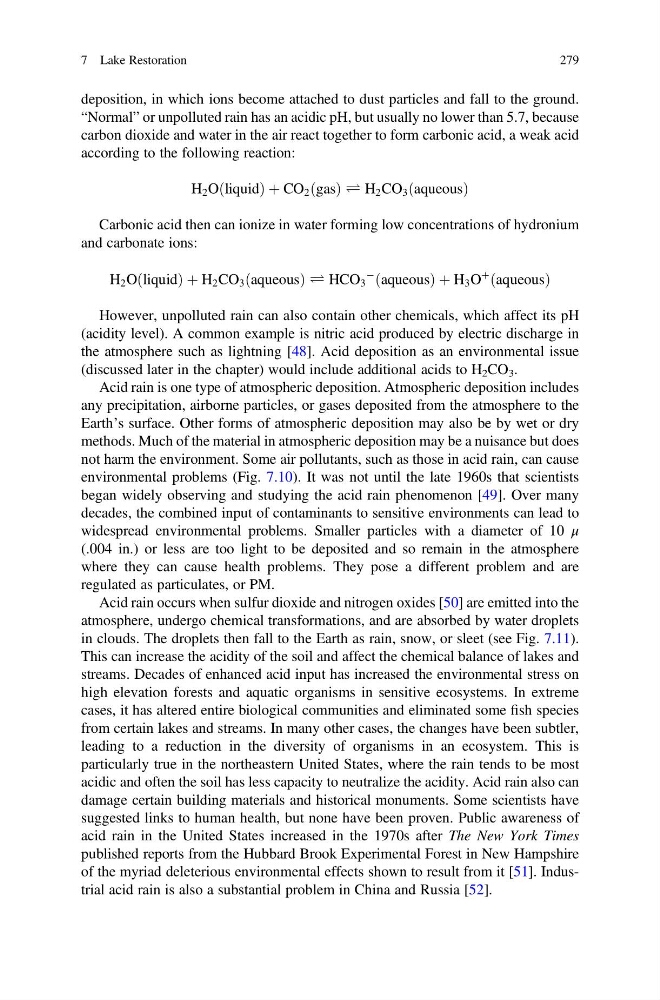
H 2 O liquid
ð
ÞþCO 2 gas
ð Þ Ð H 2 CO 3 aqueous
ð
Þ
Carbonic acid then can ionize in water forming low concentrations of hydronium
and carbonate ions:
H 2 O liquid
ð
ÞþH 2 CO 3 aqueous
ð
ÞÐHCO 3
À aqueous
ð
ÞþH 3 O
þ aqueous
ð
Þ
However, unpolluted rain can also contain other chemicals, which affect its pH
(acidity level). A common example is nitric acid produced by electric discharge in
the atmosphere such as lightning [48]. Acid deposition as an environmental issue
(discussed later in the chapter) would include additional acids to H 2 CO 3 .
Acid rain is one type of atmospheric deposition. Atmospheric deposition includes
any precipitation, airborne particles, or gases deposited from the atmosphere to the
Earth’s surface. Other forms of atmospheric deposition may also be by wet or dry
methods. Much of the material in atmospheric deposition may be a nuisance but does
not harm the environment. Some air pollutants, such as those in acid rain, can cause
environmental problems (Fig. 7.10). It was not until the late 1960s that scientists
began widely observing and studying the acid rain phenomenon [49]. Over many
decades, the combined input of contaminants to sensitive environments can lead to
widespread environmental problems. Smaller particles with a diameter of 10 μ
(.004 in.) or less are too light to be deposited and so remain in the atmosphere
where they can cause health problems. They pose a different problem and are
regulated as particulates, or PM.
Acid rain occurs when sulfur dioxide and nitrogen oxides [50] are emitted into the
atmosphere, undergo chemical transformations, and are absorbed by water droplets
in clouds. The droplets then fall to the Earth as rain, snow, or sleet (see Fig. 7.11).
This can increase the acidity of the soil and affect the chemical balance of lakes and
streams. Decades of enhanced acid input has increased the environmental stress on
high elevation forests and aquatic organisms in sensitive ecosystems. In extreme
cases, it has altered entire biological communities and eliminated some fish species
from certain lakes and streams. In many other cases, the changes have been subtler,
leading to a reduction in the diversity of organisms in an ecosystem. This is
particularly true in the northeastern United States, where the rain tends to be most
acidic and often the soil has less capacity to neutralize the acidity. Acid rain also can
damage certain building materials and historical monuments. Some scientists have
suggested links to human health, but none have been proven. Public awareness of
acid rain in the United States increased in the 1970s after The New York Times
published reports from the Hubbard Brook Experimental Forest in New Hampshire
of the myriad deleterious environmental effects shown to result from it [51]. Industrial acid rain is also a substantial problem in China and Russia [52].
7 Lake Restoration
279
“Normal” or unpolluted rain has an acidic pH, but usually no lower than 5.7, because
carbon dioxide and water in the air react together to form carbonic acid, a weak acid
according to the following reaction:
H 2 O liquid
ð
ÞþCO 2 gas
ð Þ Ð H 2 CO 3 aqueous
ð
Þ
Carbonic acid then can ionize in water forming low concentrations of hydronium
and carbonate ions:
H 2 O liquid
ð
ÞþH 2 CO 3 aqueous
ð
ÞÐHCO 3
À aqueous
ð
ÞþH 3 O
þ aqueous
ð
Þ
However, unpolluted rain can also contain other chemicals, which affect its pH
(acidity level). A common example is nitric acid produced by electric discharge in
the atmosphere such as lightning [48]. Acid deposition as an environmental issue
(discussed later in the chapter) would include additional acids to H 2 CO 3 .
Acid rain is one type of atmospheric deposition. Atmospheric deposition includes
any precipitation, airborne particles, or gases deposited from the atmosphere to the
Earth’s surface. Other forms of atmospheric deposition may also be by wet or dry
methods. Much of the material in atmospheric deposition may be a nuisance but does
not harm the environment. Some air pollutants, such as those in acid rain, can cause
environmental problems (Fig. 7.10). It was not until the late 1960s that scientists
began widely observing and studying the acid rain phenomenon [49]. Over many
decades, the combined input of contaminants to sensitive environments can lead to
widespread environmental problems. Smaller particles with a diameter of 10 μ
(.004 in.) or less are too light to be deposited and so remain in the atmosphere
where they can cause health problems. They pose a different problem and are
regulated as particulates, or PM.
Acid rain occurs when sulfur dioxide and nitrogen oxides [50] are emitted into the
atmosphere, undergo chemical transformations, and are absorbed by water droplets
in clouds. The droplets then fall to the Earth as rain, snow, or sleet (see Fig. 7.11).
This can increase the acidity of the soil and affect the chemical balance of lakes and
streams. Decades of enhanced acid input has increased the environmental stress on
high elevation forests and aquatic organisms in sensitive ecosystems. In extreme
cases, it has altered entire biological communities and eliminated some fish species
from certain lakes and streams. In many other cases, the changes have been subtler,
leading to a reduction in the diversity of organisms in an ecosystem. This is
particularly true in the northeastern United States, where the rain tends to be most
acidic and often the soil has less capacity to neutralize the acidity. Acid rain also can
damage certain building materials and historical monuments. Some scientists have
suggested links to human health, but none have been proven. Public awareness of
acid rain in the United States increased in the 1970s after The New York Times
published reports from the Hubbard Brook Experimental Forest in New Hampshire
of the myriad deleterious environmental effects shown to result from it [51]. Industrial acid rain is also a substantial problem in China and Russia [52].
7 Lake Restoration
279