

5.2 Tri-Star Technologies
Tri-Star Technologies, Inc. is a manufacturer of double-sided and multilayer printed
wiring boards, specializing in products for the electronics industry. With
220 employees at their 120,000 ft
2 facility, they produce 1,000,000 surface ft
2
annually [25].
Broadening of pollution prevention by Tri-Star Technologies, Inc. in Methuen,
Massachusetts, has led to reductions in energy and water use that have resulted in
significant cost savings. During implementation of pollution prevention program,
Tri-Star discovered that demonstrating cost savings is the key to a successful
pollution prevention program.
With several successes to their credit (both from an economic and a waste
reduction standpoint), Tri-Star’s pollution prevention team was able to obtain
funding for projects that are capital intensive. These projects offered increased cost
savings in the long term. For instance, the facility currently installed a cupric
chloride regeneration system to recycle their inner-layer etchant. Such a system
requires a capital investment of about $150,000, but the payback is expected to be
less than 18 months through significant reductions in spent (hazardous) etchant and
virgin chemical purchases and by selling the recovered copper by-product.
Tri-Star engaged cost saving opportunities in energy and water conservation by
looking beyond regulated materials. Such opportunities are a “cheap, and easy way
to reduce a facility’s environmental impact while saving money,” says Ed Gomes,
Environmental Health and Safety Manager for the facility. On a global level
pollution prevention can be successfully achieved by reductions of energy that can
lead to reductions in the by-products of energy use, which can subsequently cause
global warming, acid rain, and smog. Though, Tri-Star projects are directly not
transferable to every facility, however, other manufacturers could use the experienced gained from Tri-Star to examine their own energy and water use.
Tri-Star has implemented several energy conservation projects. The two projects
described in this case study involved collaborative efforts with the electric and/or gas
companies. Together, these two projects have resulted in savings of thousands of
dollars per month or about $51,800 annually.
In order to save energy, Tri-Star was able to balance its airflow rate at the flowrate air make up units. With several pieces of equipment exhausting air, such as wet
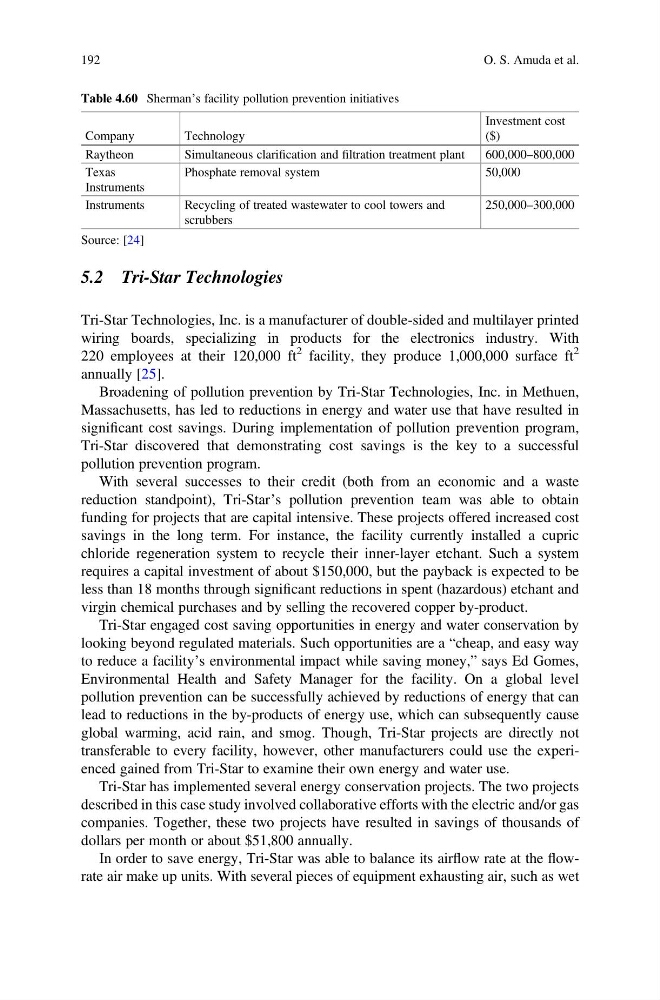
Table 4.60 Sherman’s facility pollution prevention initiatives
Company
Technology
Investment cost
($)
Raytheon
Simultaneous clarification and filtration treatment plant
600,000–800,000
Texas
Instruments
Phosphate removal system
50,000
Instruments
Recycling of treated wastewater to cool towers and
scrubbers
250,000–300,000
Source: [24]
192
O. S. Amuda et al.
Tri-Star Technologies, Inc. is a manufacturer of double-sided and multilayer printed
wiring boards, specializing in products for the electronics industry. With
220 employees at their 120,000 ft
2 facility, they produce 1,000,000 surface ft
2
annually [25].
Broadening of pollution prevention by Tri-Star Technologies, Inc. in Methuen,
Massachusetts, has led to reductions in energy and water use that have resulted in
significant cost savings. During implementation of pollution prevention program,
Tri-Star discovered that demonstrating cost savings is the key to a successful
pollution prevention program.
With several successes to their credit (both from an economic and a waste
reduction standpoint), Tri-Star’s pollution prevention team was able to obtain
funding for projects that are capital intensive. These projects offered increased cost
savings in the long term. For instance, the facility currently installed a cupric
chloride regeneration system to recycle their inner-layer etchant. Such a system
requires a capital investment of about $150,000, but the payback is expected to be
less than 18 months through significant reductions in spent (hazardous) etchant and
virgin chemical purchases and by selling the recovered copper by-product.
Tri-Star engaged cost saving opportunities in energy and water conservation by
looking beyond regulated materials. Such opportunities are a “cheap, and easy way
to reduce a facility’s environmental impact while saving money,” says Ed Gomes,
Environmental Health and Safety Manager for the facility. On a global level
pollution prevention can be successfully achieved by reductions of energy that can
lead to reductions in the by-products of energy use, which can subsequently cause
global warming, acid rain, and smog. Though, Tri-Star projects are directly not
transferable to every facility, however, other manufacturers could use the experienced gained from Tri-Star to examine their own energy and water use.
Tri-Star has implemented several energy conservation projects. The two projects
described in this case study involved collaborative efforts with the electric and/or gas
companies. Together, these two projects have resulted in savings of thousands of
dollars per month or about $51,800 annually.
In order to save energy, Tri-Star was able to balance its airflow rate at the flowrate air make up units. With several pieces of equipment exhausting air, such as wet
Table 4.60 Sherman’s facility pollution prevention initiatives
Company
Technology
Investment cost
($)
Raytheon
Simultaneous clarification and filtration treatment plant
600,000–800,000
Texas
Instruments
Phosphate removal system
50,000
Instruments
Recycling of treated wastewater to cool towers and
scrubbers
250,000–300,000
Source: [24]
192
O. S. Amuda et al.