

neutralization, vacuum filtration, and treatment of the dewatered sludge through
contract hauling. Oil skimming is also employed in the treatment of wastewater from
other parts of the facilities besides those generated from the ball milling. Step
3 treatment processes are applied to compliment the treatment processes in step
2. The processes specifically remove the total suspended solids by using polishing
filter after the neutralization step. Efficiency of step 1 treatment systems observed in
a capacitor manufacturing industry is summarized in Table 4.33.
2.6.6 Treatment Technology and Cost
All the treatment technologies including neutralization which is applicable to both the
capacitor waste stream and ball mill wastes are the best practicable control treatment
(BPT) applicable to the capacitor subcategory. Furthermore, the ball milling waste is
always subjected to sedimentation process after neutralization in order to effectively
treat the effluent to standard specification. The pretreated wastewater from the
treatment process is further subjected to neutralization before discharge. Vacuum
filter is used to dewater the sludge. The best available technologies (BAT) include all
the treatment system recommended in BPT in addition to oil skimming, chemical
precipitation (using lime and coagulants), and sedimentation (ball milling waste
streams). It is further recommended under the BAT that the resulting effluent be
passed through a multimedia filter to free it of total suspended solids. Table 4.34
shows the total annual unit costs for the steps of treatments applicable to the capacitor
subcategory of the electrical and electronic component industry.
2.7 Printed Wiring Boards
2.7.1 Description and Production Process
In the reclassification of the SIC 36 category of the electrical and electronic component industry [2], the printed wiring boards are coded as SIC 3672 and as such an
important subcategory of the industry. They are hard structure on which electronic
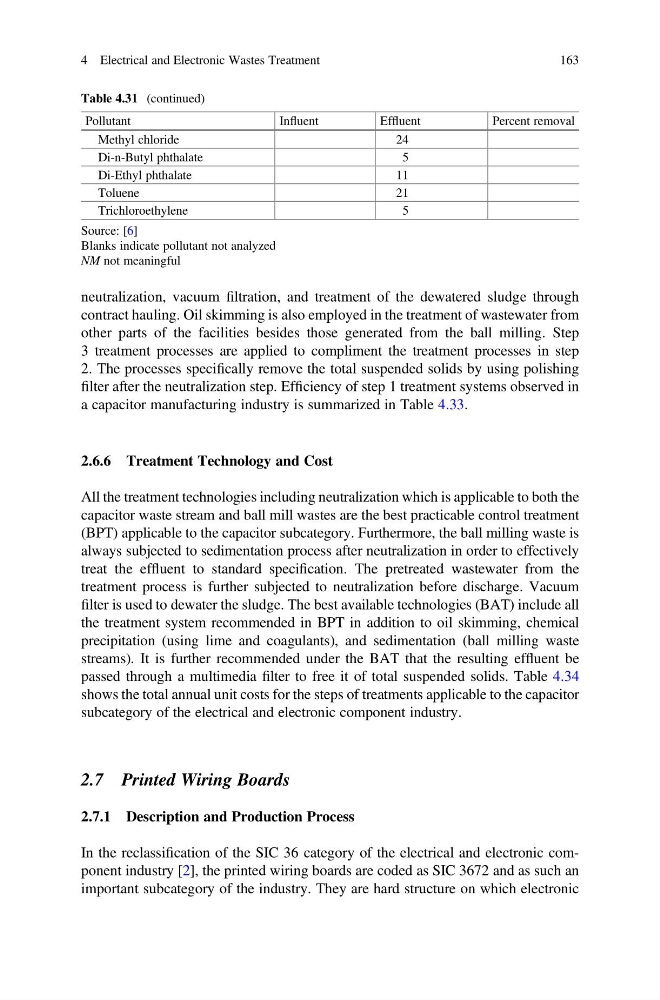
Table 4.31 (continued)
Pollutant
Influent
Effluent
Percent removal
Methyl chloride
24
Di-n-Butyl phthalate
5
Di-Ethyl phthalate
11
Toluene
21
Trichloroethylene
5
Source: [6]
Blanks indicate pollutant not analyzed
NM not meaningful
4 Electrical and Electronic Wastes Treatment
163
contract hauling. Oil skimming is also employed in the treatment of wastewater from
other parts of the facilities besides those generated from the ball milling. Step
3 treatment processes are applied to compliment the treatment processes in step
2. The processes specifically remove the total suspended solids by using polishing
filter after the neutralization step. Efficiency of step 1 treatment systems observed in
a capacitor manufacturing industry is summarized in Table 4.33.
2.6.6 Treatment Technology and Cost
All the treatment technologies including neutralization which is applicable to both the
capacitor waste stream and ball mill wastes are the best practicable control treatment
(BPT) applicable to the capacitor subcategory. Furthermore, the ball milling waste is
always subjected to sedimentation process after neutralization in order to effectively
treat the effluent to standard specification. The pretreated wastewater from the
treatment process is further subjected to neutralization before discharge. Vacuum
filter is used to dewater the sludge. The best available technologies (BAT) include all
the treatment system recommended in BPT in addition to oil skimming, chemical
precipitation (using lime and coagulants), and sedimentation (ball milling waste
streams). It is further recommended under the BAT that the resulting effluent be
passed through a multimedia filter to free it of total suspended solids. Table 4.34
shows the total annual unit costs for the steps of treatments applicable to the capacitor
subcategory of the electrical and electronic component industry.
2.7 Printed Wiring Boards
2.7.1 Description and Production Process
In the reclassification of the SIC 36 category of the electrical and electronic component industry [2], the printed wiring boards are coded as SIC 3672 and as such an
important subcategory of the industry. They are hard structure on which electronic
Table 4.31 (continued)
Pollutant
Influent
Effluent
Percent removal
Methyl chloride
24
Di-n-Butyl phthalate
5
Di-Ethyl phthalate
11
Toluene
21
Trichloroethylene
5
Source: [6]
Blanks indicate pollutant not analyzed
NM not meaningful
4 Electrical and Electronic Wastes Treatment
163