

2.3.3 Water Use
Less volume of water is employed in this subcategory and is used mainly in the
manufacturing process for dissolution of filament mandrel and acid cleaning wastes.
2.3.4 Wastewater Characterization
Wastewater generated in a typical plant, like plant 28077, is settled in tank particularly for pH adjustment before discharge. Results of sample of wastewater verified
before and after pH adjustment in the above plant are given in Table 4.17. Wastewater from the electric lamp subcategory manufacturing plants, where wet process is
mainly employed for filament mandrel dissolution generally, consists of pollutants
as listed in Table 4.18.
2.3.5 Wastewater Treatment Processes
General treatment processes to remove pollutants in the electric lamps subcategory
are achievable through sedimentation, chemical precipitation, and dewatering; pH
adjustment of the wastewater is carried out for recycling and discharge purposes.
Any or all the steps of treatment processes are applicable to any segment of the
subcategory involved with wet processes. Two steps of treatment are commonly
applied to the process water generated in the manufacture of fluorescent, to arrive at
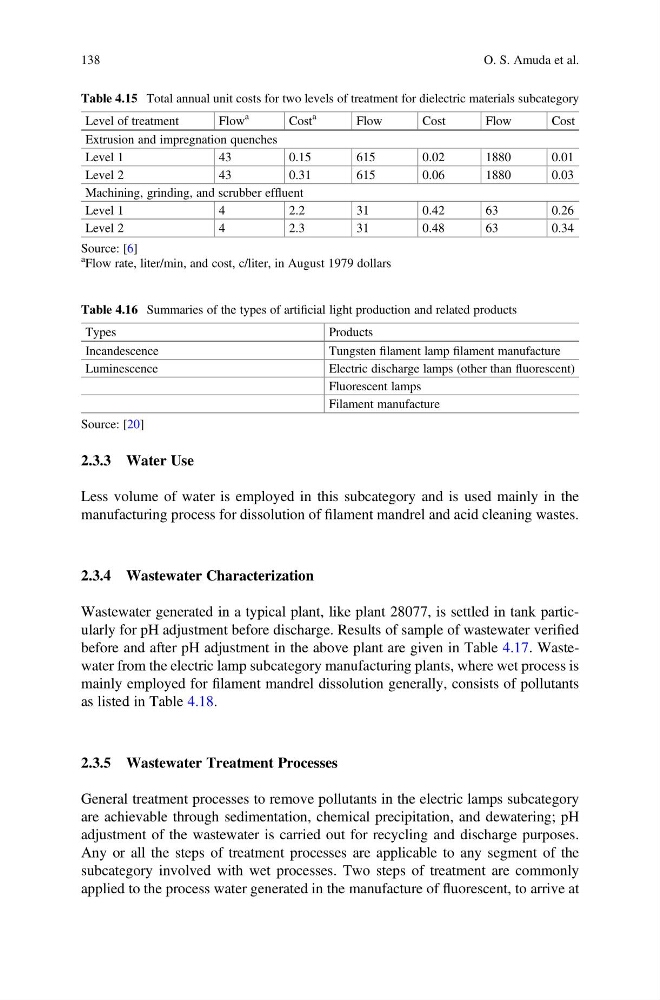
Table 4.15 Total annual unit costs for two levels of treatment for dielectric materials subcategory
Level of treatment
Flow
a
Cost
a
Flow
Cost
Flow
Cost
Extrusion and impregnation quenches
Level 1
43
0.15
615
0.02
1880
0.01
Level 2
43
0.31
615
0.06
1880
0.03
Machining, grinding, and scrubber effluent
Level 1
4
2.2
31
0.42
63
0.26
Level 2
4
2.3
31
0.48
63
0.34
Source: [6]
a Flow rate, liter/min, and cost, c/liter, in August 1979 dollars
Table 4.16 Summaries of the types of artificial light production and related products
Types
Products
Incandescence
Tungsten filament lamp filament manufacture
Luminescence
Electric discharge lamps (other than fluorescent)
Fluorescent lamps
Filament manufacture
Source: [20]
138
O. S. Amuda et al.
Less volume of water is employed in this subcategory and is used mainly in the
manufacturing process for dissolution of filament mandrel and acid cleaning wastes.
2.3.4 Wastewater Characterization
Wastewater generated in a typical plant, like plant 28077, is settled in tank particularly for pH adjustment before discharge. Results of sample of wastewater verified
before and after pH adjustment in the above plant are given in Table 4.17. Wastewater from the electric lamp subcategory manufacturing plants, where wet process is
mainly employed for filament mandrel dissolution generally, consists of pollutants
as listed in Table 4.18.
2.3.5 Wastewater Treatment Processes
General treatment processes to remove pollutants in the electric lamps subcategory
are achievable through sedimentation, chemical precipitation, and dewatering; pH
adjustment of the wastewater is carried out for recycling and discharge purposes.
Any or all the steps of treatment processes are applicable to any segment of the
subcategory involved with wet processes. Two steps of treatment are commonly
applied to the process water generated in the manufacture of fluorescent, to arrive at
Table 4.15 Total annual unit costs for two levels of treatment for dielectric materials subcategory
Level of treatment
Flow
a
Cost
a
Flow
Cost
Flow
Cost
Extrusion and impregnation quenches
Level 1
43
0.15
615
0.02
1880
0.01
Level 2
43
0.31
615
0.06
1880
0.03
Machining, grinding, and scrubber effluent
Level 1
4
2.2
31
0.42
63
0.26
Level 2
4
2.3
31
0.48
63
0.34
Source: [6]
a Flow rate, liter/min, and cost, c/liter, in August 1979 dollars
Table 4.16 Summaries of the types of artificial light production and related products
Types
Products
Incandescence
Tungsten filament lamp filament manufacture
Luminescence
Electric discharge lamps (other than fluorescent)
Fluorescent lamps
Filament manufacture
Source: [20]
138
O. S. Amuda et al.