

4.3 Fecal Coliform Bacterial Die-Off in Urban Watershed
Fecal coliform bacteria are microscopic organisms that live in the intestines of warmblooded animals. They also live in the waste material or feces excreted from the
intestinal tract. When fecal coliform bacteria are present in high numbers in a water
sample, it means that the water may have received fecal matter from one source or
another. Unlike the other conventional water quality parameters, fecal coliform
bacteria are living organisms. They multiply quickly when conditions are favorable
for growth and die in large numbers when they are not. Because bacterial concentrations are dependent upon specific conditions for growth and these conditions
change quickly, fecal coliform bacteria counts are not easy to predict. For example,
although winter rains may wash more fecal matter from urban areas into a lake, cool
water temperatures may cause many of the organisms to die. Direct exposure to
sunlight is also lethal to bacteria, so die-off may be high even in the warmer water of
summer time. Based on bacterial die-off modeled (Fig. 3.15), about 90% of bacteria
will disappear from fresh water within two to five days [39], while the die-off rate is
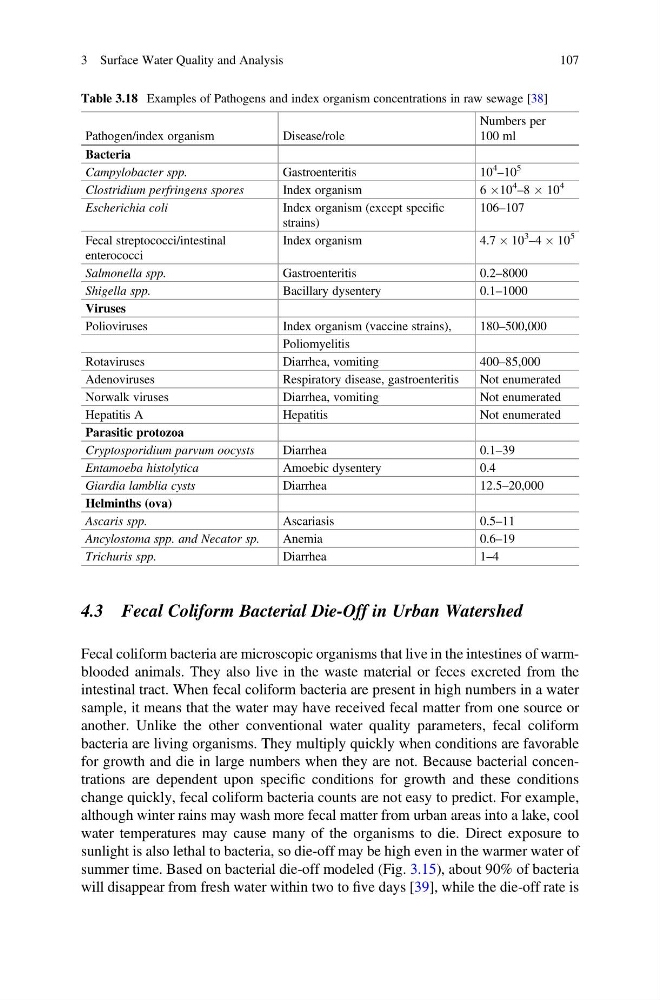
Table 3.18 Examples of Pathogens and index organism concentrations in raw sewage [38]
Pathogen/index organism
Disease/role
Numbers per
100 ml
Bacteria
Campylobacter spp.
Gastroenteritis
10
4
–10
5
Clostridium perfringens spores
Index organism
6 Â10
4
–8 Â 10
4
Escherichia coli
Index organism (except specific
strains)
106–107
Fecal streptococci/intestinal
enterococci
Index organism
4.7 Â 10
3
–4 Â 10
5
Salmonella spp.
Gastroenteritis
0.2–8000
Shigella spp.
Bacillary dysentery
0.1–1000
Viruses
Polioviruses
Index organism (vaccine strains),
180–500,000
Poliomyelitis
Rotaviruses
Diarrhea, vomiting
400–85,000
Adenoviruses
Respiratory disease, gastroenteritis
Not enumerated
Norwalk viruses
Diarrhea, vomiting
Not enumerated
Hepatitis A
Hepatitis
Not enumerated
Parasitic protozoa
Cryptosporidium parvum oocysts
Diarrhea
0.1–39
Entamoeba histolytica
Amoebic dysentery
0.4
Giardia lamblia cysts
Diarrhea
12.5–20,000
Helminths (ova)
Ascaris spp.
Ascariasis
0.5–11
Ancylostoma spp. and Necator sp.
Anemia
0.6–19
Trichuris spp.
Diarrhea
1–4
3 Surface Water Quality and Analysis
107
Fecal coliform bacteria are microscopic organisms that live in the intestines of warmblooded animals. They also live in the waste material or feces excreted from the
intestinal tract. When fecal coliform bacteria are present in high numbers in a water
sample, it means that the water may have received fecal matter from one source or
another. Unlike the other conventional water quality parameters, fecal coliform
bacteria are living organisms. They multiply quickly when conditions are favorable
for growth and die in large numbers when they are not. Because bacterial concentrations are dependent upon specific conditions for growth and these conditions
change quickly, fecal coliform bacteria counts are not easy to predict. For example,
although winter rains may wash more fecal matter from urban areas into a lake, cool
water temperatures may cause many of the organisms to die. Direct exposure to
sunlight is also lethal to bacteria, so die-off may be high even in the warmer water of
summer time. Based on bacterial die-off modeled (Fig. 3.15), about 90% of bacteria
will disappear from fresh water within two to five days [39], while the die-off rate is
Table 3.18 Examples of Pathogens and index organism concentrations in raw sewage [38]
Pathogen/index organism
Disease/role
Numbers per
100 ml
Bacteria
Campylobacter spp.
Gastroenteritis
10
4
–10
5
Clostridium perfringens spores
Index organism
6 Â10
4
–8 Â 10
4
Escherichia coli
Index organism (except specific
strains)
106–107
Fecal streptococci/intestinal
enterococci
Index organism
4.7 Â 10
3
–4 Â 10
5
Salmonella spp.
Gastroenteritis
0.2–8000
Shigella spp.
Bacillary dysentery
0.1–1000
Viruses
Polioviruses
Index organism (vaccine strains),
180–500,000
Poliomyelitis
Rotaviruses
Diarrhea, vomiting
400–85,000
Adenoviruses
Respiratory disease, gastroenteritis
Not enumerated
Norwalk viruses
Diarrhea, vomiting
Not enumerated
Hepatitis A
Hepatitis
Not enumerated
Parasitic protozoa
Cryptosporidium parvum oocysts
Diarrhea
0.1–39
Entamoeba histolytica
Amoebic dysentery
0.4
Giardia lamblia cysts
Diarrhea
12.5–20,000
Helminths (ova)
Ascaris spp.
Ascariasis
0.5–11
Ancylostoma spp. and Necator sp.
Anemia
0.6–19
Trichuris spp.
Diarrhea
1–4
3 Surface Water Quality and Analysis
107