

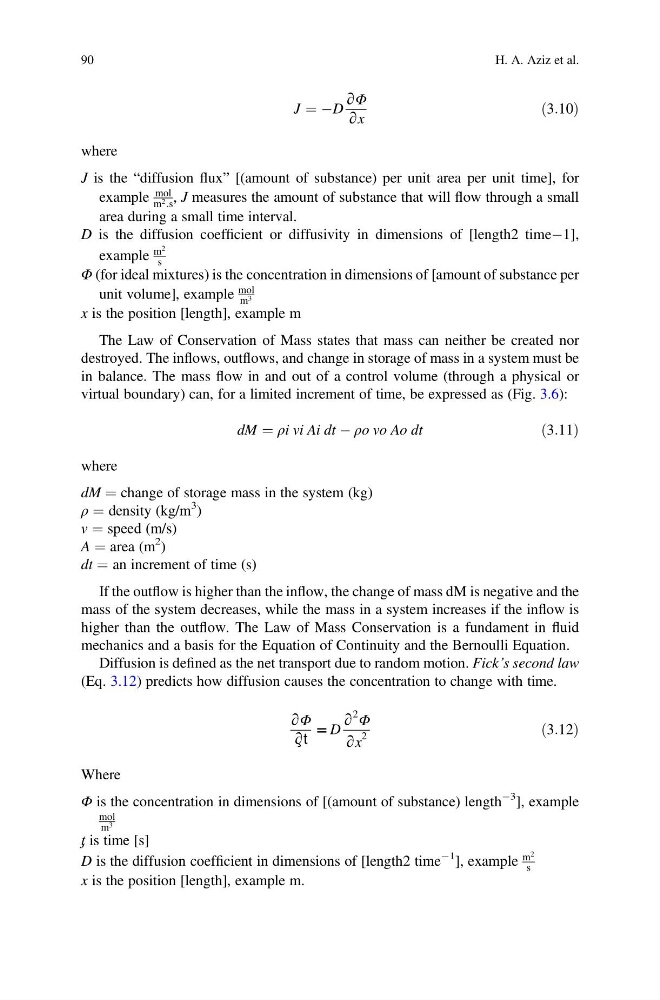
J ¼ ÀD
∂Φ
∂x
ð3:10Þ
where
J is the “diffusion flux” [(amount of substance) per unit area per unit time], for
example
mol
m 2 :s , J measures the amount of substance that will flow through a small
area during a small time interval.
D is the diffusion coefficient or diffusivity in dimensions of [length2 timeÀ1],
example
m
2
s
Φ (for ideal mixtures) is the concentration in dimensions of [amount of substance per
unit volume], example
mol
m 3
x is the position [length], example m
The Law of Conservation of Mass states that mass can neither be created nor
destroyed. The inflows, outflows, and change in storage of mass in a system must be
in balance. The mass flow in and out of a control volume (through a physical or
virtual boundary) can, for a limited increment of time, be expressed as (Fig. 3.6):
dM ¼ ρi vi Ai dt À ρo vo Ao dt
ð3:11Þ
where
dM ¼ change of storage mass in the system (kg)
ρ ¼ density (kg/m
3 )
v ¼ speed (m/s)
A ¼ area (m
2 )
dt ¼ an increment of time (s)
If the outflow is higher than the inflow, the change of mass dM is negative and the
mass of the system decreases, while the mass in a system increases if the inflow is
higher than the outflow. The Law of Mass Conservation is a fundament in fluid
mechanics and a basis for the Equation of Continuity and the Bernoulli Equation.
Diffusion is defined as the net transport due to random motion. Fick’s second law
(Eq. 3.12) predicts how diffusion causes the concentration to change with time.
∂Φ
∂ t
= D
∂
2 Φ
∂x
2
ð3:12Þ
Where
Φ is the concentration in dimensions of [(amount of substance) length
À3 ], example
mol
m 3
ƫ is time [s]
D is the diffusion coefficient in dimensions of [length2 time
À1 ], example
m
2
s
x is the position [length], example m.
90
H. A. Aziz et al.
∂Φ
∂x
ð3:10Þ
where
J is the “diffusion flux” [(amount of substance) per unit area per unit time], for
example
mol
m 2 :s , J measures the amount of substance that will flow through a small
area during a small time interval.
D is the diffusion coefficient or diffusivity in dimensions of [length2 timeÀ1],
example
m
2
s
Φ (for ideal mixtures) is the concentration in dimensions of [amount of substance per
unit volume], example
mol
m 3
x is the position [length], example m
The Law of Conservation of Mass states that mass can neither be created nor
destroyed. The inflows, outflows, and change in storage of mass in a system must be
in balance. The mass flow in and out of a control volume (through a physical or
virtual boundary) can, for a limited increment of time, be expressed as (Fig. 3.6):
dM ¼ ρi vi Ai dt À ρo vo Ao dt
ð3:11Þ
where
dM ¼ change of storage mass in the system (kg)
ρ ¼ density (kg/m
3 )
v ¼ speed (m/s)
A ¼ area (m
2 )
dt ¼ an increment of time (s)
If the outflow is higher than the inflow, the change of mass dM is negative and the
mass of the system decreases, while the mass in a system increases if the inflow is
higher than the outflow. The Law of Mass Conservation is a fundament in fluid
mechanics and a basis for the Equation of Continuity and the Bernoulli Equation.
Diffusion is defined as the net transport due to random motion. Fick’s second law
(Eq. 3.12) predicts how diffusion causes the concentration to change with time.
∂Φ
∂ t
= D
∂
2 Φ
∂x
2
ð3:12Þ
Where
Φ is the concentration in dimensions of [(amount of substance) length
À3 ], example
mol
m 3
ƫ is time [s]
D is the diffusion coefficient in dimensions of [length2 time
À1 ], example
m
2
s
x is the position [length], example m.
90
H. A. Aziz et al.