

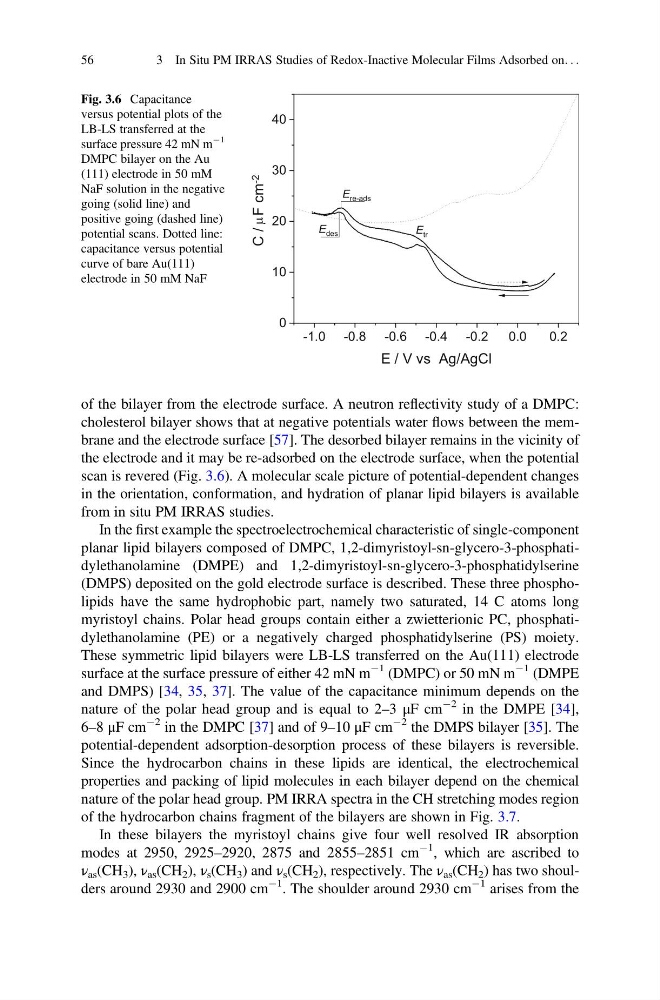
of the bilayer from the electrode surface. A neutron reflectivity study of a DMPC:
cholesterol bilayer shows that at negative potentials water flows between the membrane and the electrode surface [57]. The desorbed bilayer remains in the vicinity of
the electrode and it may be re-adsorbed on the electrode surface, when the potential
scan is revered (Fig. 3.6). A molecular scale picture of potential-dependent changes
in the orientation, conformation, and hydration of planar lipid bilayers is available
from in situ PM IRRAS studies.
In the first example the spectroelectrochemical characteristic of single-component
planar lipid bilayers composed of DMPC, 1,2-dimyristoyl-sn-glycero-3-phosphatidylethanolamine (DMPE) and 1,2-dimyristoyl-sn-glycero-3-phosphatidylserine
(DMPS) deposited on the gold electrode surface is described. These three phospholipids have the same hydrophobic part, namely two saturated, 14 C atoms long
myristoyl chains. Polar head groups contain either a zwietterionic PC, phosphatidylethanolamine (PE) or a negatively charged phosphatidylserine (PS) moiety.
These symmetric lipid bilayers were LB-LS transferred on the Au(111) electrode
surface at the surface pressure of either 42 mN m
À1 (DMPC) or 50 mN m
À1 (DMPE
and DMPS) [34, 35, 37]. The value of the capacitance minimum depends on the
nature of the polar head group and is equal to 2–3 μF cm
À2 in the DMPE [34],
6–8 μF cm
À2 in the DMPC [37] and of 9–10 μF cm
À2 the DMPS bilayer [35]. The
potential-dependent adsorption-desorption process of these bilayers is reversible.
Since the hydrocarbon chains in these lipids are identical, the electrochemical
properties and packing of lipid molecules in each bilayer depend on the chemical
nature of the polar head group. PM IRRA spectra in the CH stretching modes region
of the hydrocarbon chains fragment of the bilayers are shown in Fig. 3.7.
In these bilayers the myristoyl chains give four well resolved IR absorption
modes at 2950, 2925–2920, 2875 and 2855–2851 cm
À1 , which are ascribed to
ν as (CH 3 ), ν as (CH 2 ), ν s (CH 3 ) and ν s (CH 2 ), respectively. The ν as (CH 2 ) has two shoulders around 2930 and 2900 cm
À1 . The shoulder around 2930 cm
À1 arises from the
-1.0 -0.8 -0.6 -0.4 -0.2
0.0
0.2
0
10
20
30
40
C / F cm -2
E / V vs Ag/AgCl
E tr
E des
E re-ads
Fig. 3.6 Capacitance
versus potential plots of the
LB-LS transferred at the
surface pressure 42 mN m
À1
DMPC bilayer on the Au
(111) electrode in 50 mM
NaF solution in the negative
going (solid line) and
positive going (dashed line)
potential scans. Dotted line:
capacitance versus potential
curve of bare Au(111)
electrode in 50 mM NaF
56
3 In Situ PM IRRAS Studies of Redox-Inactive Molecular Films Adsorbed on. . .
cholesterol bilayer shows that at negative potentials water flows between the membrane and the electrode surface [57]. The desorbed bilayer remains in the vicinity of
the electrode and it may be re-adsorbed on the electrode surface, when the potential
scan is revered (Fig. 3.6). A molecular scale picture of potential-dependent changes
in the orientation, conformation, and hydration of planar lipid bilayers is available
from in situ PM IRRAS studies.
In the first example the spectroelectrochemical characteristic of single-component
planar lipid bilayers composed of DMPC, 1,2-dimyristoyl-sn-glycero-3-phosphatidylethanolamine (DMPE) and 1,2-dimyristoyl-sn-glycero-3-phosphatidylserine
(DMPS) deposited on the gold electrode surface is described. These three phospholipids have the same hydrophobic part, namely two saturated, 14 C atoms long
myristoyl chains. Polar head groups contain either a zwietterionic PC, phosphatidylethanolamine (PE) or a negatively charged phosphatidylserine (PS) moiety.
These symmetric lipid bilayers were LB-LS transferred on the Au(111) electrode
surface at the surface pressure of either 42 mN m
À1 (DMPC) or 50 mN m
À1 (DMPE
and DMPS) [34, 35, 37]. The value of the capacitance minimum depends on the
nature of the polar head group and is equal to 2–3 μF cm
À2 in the DMPE [34],
6–8 μF cm
À2 in the DMPC [37] and of 9–10 μF cm
À2 the DMPS bilayer [35]. The
potential-dependent adsorption-desorption process of these bilayers is reversible.
Since the hydrocarbon chains in these lipids are identical, the electrochemical
properties and packing of lipid molecules in each bilayer depend on the chemical
nature of the polar head group. PM IRRA spectra in the CH stretching modes region
of the hydrocarbon chains fragment of the bilayers are shown in Fig. 3.7.
In these bilayers the myristoyl chains give four well resolved IR absorption
modes at 2950, 2925–2920, 2875 and 2855–2851 cm
À1 , which are ascribed to
ν as (CH 3 ), ν as (CH 2 ), ν s (CH 3 ) and ν s (CH 2 ), respectively. The ν as (CH 2 ) has two shoulders around 2930 and 2900 cm
À1 . The shoulder around 2930 cm
À1 arises from the
-1.0 -0.8 -0.6 -0.4 -0.2
0.0
0.2
0
10
20
30
40
C / F cm -2
E / V vs Ag/AgCl
E tr
E des
E re-ads
Fig. 3.6 Capacitance
versus potential plots of the
LB-LS transferred at the
surface pressure 42 mN m
À1
DMPC bilayer on the Au
(111) electrode in 50 mM
NaF solution in the negative
going (solid line) and
positive going (dashed line)
potential scans. Dotted line:
capacitance versus potential
curve of bare Au(111)
electrode in 50 mM NaF
56
3 In Situ PM IRRAS Studies of Redox-Inactive Molecular Films Adsorbed on. . .