

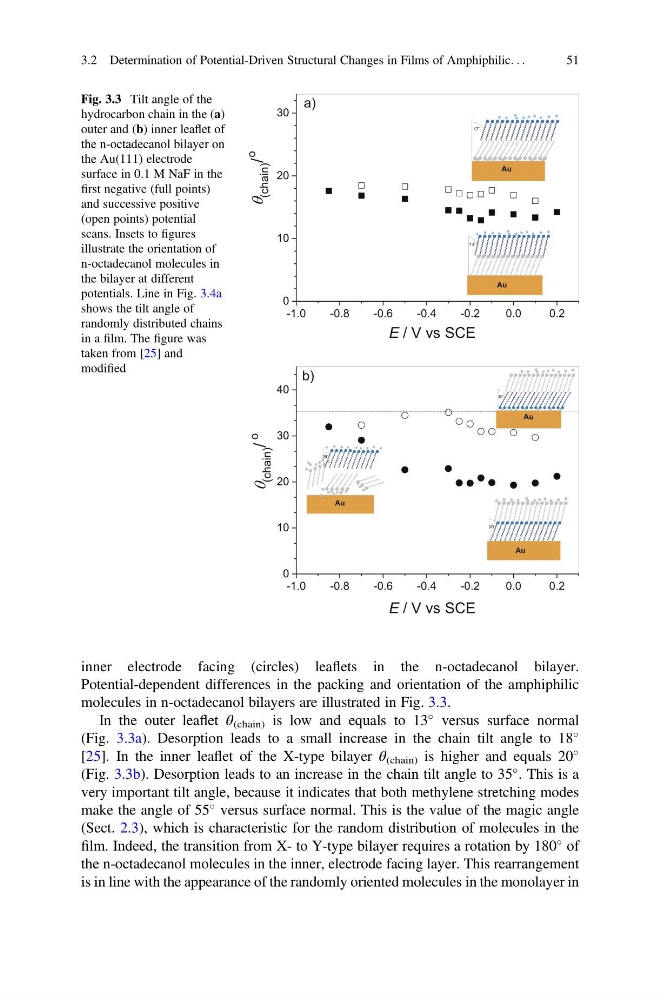
inner electrode facing (circles) leaflets in the n-octadecanol bilayer.
Potential-dependent differences in the packing and orientation of the amphiphilic
molecules in n-octadecanol bilayers are illustrated in Fig. 3.3.
In the outer leaflet θ (chain) is low and equals to 13
versus surface normal
(Fig. 3.3a). Desorption leads to a small increase in the chain tilt angle to 18
[25]. In the inner leaflet of the X-type bilayer θ (chain) is higher and equals 20
(Fig. 3.3b). Desorption leads to an increase in the chain tilt angle to 35
. This is a
very important tilt angle, because it indicates that both methylene stretching modes
make the angle of 55
versus surface normal. This is the value of the magic angle
(Sect. 2.3), which is characteristic for the random distribution of molecules in the
film. Indeed, the transition from X- to Y-type bilayer requires a rotation by 180
of
the n-octadecanol molecules in the inner, electrode facing layer. This rearrangement
is in line with the appearance of the randomly oriented molecules in the monolayer in
-1.0
-0.8
-0.6
-0.4
-0.2
0.0
0.2
0
10
20
30
(chain) /
o
E / V vs SCE
a)
Au
13 o
Au
17 o
-1.0
-0.8
-0.6
-0.4
-0.2
0.0
0.2
0
10
20
30
40
(chain) /
o
E / V vs SCE
b)
Au
20 o
Au
30 o
Au
20 o
Fig. 3.3 Tilt angle of the
hydrocarbon chain in the (a)
outer and (b) inner leaflet of
the n-octadecanol bilayer on
the Au(111) electrode
surface in 0.1 M NaF in the
first negative (full points)
and successive positive
(open points) potential
scans. Insets to figures
illustrate the orientation of
n-octadecanol molecules in
the bilayer at different
potentials. Line in Fig. 3.4a
shows the tilt angle of
randomly distributed chains
in a film. The figure was
taken from [25] and
modified
3.2 Determination of Potential-Driven Structural Changes in Films of Amphiphilic. . .
51
Potential-dependent differences in the packing and orientation of the amphiphilic
molecules in n-octadecanol bilayers are illustrated in Fig. 3.3.
In the outer leaflet θ (chain) is low and equals to 13
versus surface normal
(Fig. 3.3a). Desorption leads to a small increase in the chain tilt angle to 18
[25]. In the inner leaflet of the X-type bilayer θ (chain) is higher and equals 20
(Fig. 3.3b). Desorption leads to an increase in the chain tilt angle to 35
. This is a
very important tilt angle, because it indicates that both methylene stretching modes
make the angle of 55
versus surface normal. This is the value of the magic angle
(Sect. 2.3), which is characteristic for the random distribution of molecules in the
film. Indeed, the transition from X- to Y-type bilayer requires a rotation by 180
of
the n-octadecanol molecules in the inner, electrode facing layer. This rearrangement
is in line with the appearance of the randomly oriented molecules in the monolayer in
-1.0
-0.8
-0.6
-0.4
-0.2
0.0
0.2
0
10
20
30
(chain) /
o
E / V vs SCE
a)
Au
13 o
Au
17 o
-1.0
-0.8
-0.6
-0.4
-0.2
0.0
0.2
0
10
20
30
40
(chain) /
o
E / V vs SCE
b)
Au
20 o
Au
30 o
Au
20 o
Fig. 3.3 Tilt angle of the
hydrocarbon chain in the (a)
outer and (b) inner leaflet of
the n-octadecanol bilayer on
the Au(111) electrode
surface in 0.1 M NaF in the
first negative (full points)
and successive positive
(open points) potential
scans. Insets to figures
illustrate the orientation of
n-octadecanol molecules in
the bilayer at different
potentials. Line in Fig. 3.4a
shows the tilt angle of
randomly distributed chains
in a film. The figure was
taken from [25] and
modified
3.2 Determination of Potential-Driven Structural Changes in Films of Amphiphilic. . .
51