

S νs CH2
ð
Þ ¼
1
2
3 cos
2
θ νs CH2
ð
Þ
À
Á À 1
À
Á
n
o
ð2:54Þ
S νas CH2
ð
Þ ¼
1
2
3 cos
2
θ νas CH2
ð
Þ
À
Á À 1
À
Á
n
o
ð2:55Þ
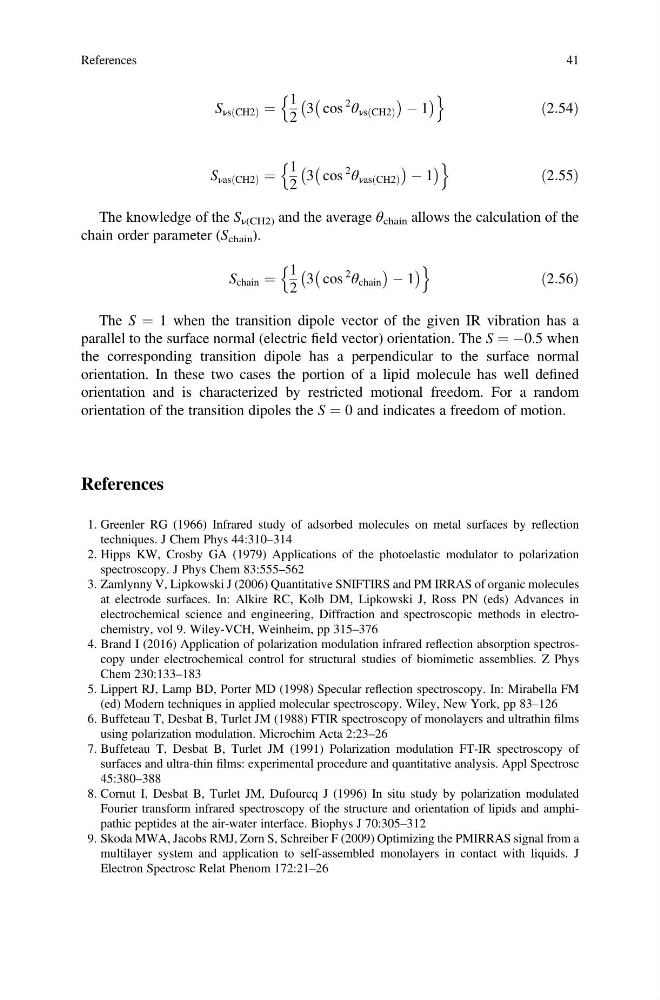
The knowledge of the S ν(CH2) and the average θ chain allows the calculation of the
chain order parameter (S chain ).
S chain ¼
1
2
3 cos
2
θ chain
À
Á À 1
À
Á
n
o
ð2:56Þ
The S ¼ 1 when the transition dipole vector of the given IR vibration has a
parallel to the surface normal (electric field vector) orientation. The S ¼ À0.5 when
the corresponding transition dipole has a perpendicular to the surface normal
orientation. In these two cases the portion of a lipid molecule has well defined
orientation and is characterized by restricted motional freedom. For a random
orientation of the transition dipoles the S ¼ 0 and indicates a freedom of motion.
References
1. Greenler RG (1966) Infrared study of adsorbed molecules on metal surfaces by reflection
techniques. J Chem Phys 44:310–314
2. Hipps KW, Crosby GA (1979) Applications of the photoelastic modulator to polarization
spectroscopy. J Phys Chem 83:555–562
3. Zamlynny V, Lipkowski J (2006) Quantitative SNIFTIRS and PM IRRAS of organic molecules
at electrode surfaces. In: Alkire RC, Kolb DM, Lipkowski J, Ross PN (eds) Advances in
electrochemical science and engineering, Diffraction and spectroscopic methods in electrochemistry, vol 9. Wiley-VCH, Weinheim, pp 315–376
4. Brand I (2016) Application of polarization modulation infrared reflection absorption spectroscopy under electrochemical control for structural studies of biomimetic assemblies. Z Phys
Chem 230:133–183
5. Lippert RJ, Lamp BD, Porter MD (1998) Specular reflection spectroscopy. In: Mirabella FM
(ed) Modern techniques in applied molecular spectroscopy. Wiley, New York, pp 83–126
6. Buffeteau T, Desbat B, Turlet JM (1988) FTIR spectroscopy of monolayers and ultrathin films
using polarization modulation. Microchim Acta 2:23–26
7. Buffeteau T, Desbat B, Turlet JM (1991) Polarization modulation FT-IR spectroscopy of
surfaces and ultra-thin films: experimental procedure and quantitative analysis. Appl Spectrosc
45:380–388
8. Cornut I, Desbat B, Turlet JM, Dufourcq J (1996) In situ study by polarization modulated
Fourier transform infrared spectroscopy of the structure and orientation of lipids and amphipathic peptides at the air-water interface. Biophys J 70:305–312
9. Skoda MWA, Jacobs RMJ, Zorn S, Schreiber F (2009) Optimizing the PMIRRAS signal from a
multilayer system and application to self-assembled monolayers in contact with liquids. J
Electron Spectrosc Relat Phenom 172:21–26
References
41
ð
Þ ¼
1
2
3 cos
2
θ νs CH2
ð
Þ
À
Á À 1
À
Á
n
o
ð2:54Þ
S νas CH2
ð
Þ ¼
1
2
3 cos
2
θ νas CH2
ð
Þ
À
Á À 1
À
Á
n
o
ð2:55Þ
The knowledge of the S ν(CH2) and the average θ chain allows the calculation of the
chain order parameter (S chain ).
S chain ¼
1
2
3 cos
2
θ chain
À
Á À 1
À
Á
n
o
ð2:56Þ
The S ¼ 1 when the transition dipole vector of the given IR vibration has a
parallel to the surface normal (electric field vector) orientation. The S ¼ À0.5 when
the corresponding transition dipole has a perpendicular to the surface normal
orientation. In these two cases the portion of a lipid molecule has well defined
orientation and is characterized by restricted motional freedom. For a random
orientation of the transition dipoles the S ¼ 0 and indicates a freedom of motion.
References
1. Greenler RG (1966) Infrared study of adsorbed molecules on metal surfaces by reflection
techniques. J Chem Phys 44:310–314
2. Hipps KW, Crosby GA (1979) Applications of the photoelastic modulator to polarization
spectroscopy. J Phys Chem 83:555–562
3. Zamlynny V, Lipkowski J (2006) Quantitative SNIFTIRS and PM IRRAS of organic molecules
at electrode surfaces. In: Alkire RC, Kolb DM, Lipkowski J, Ross PN (eds) Advances in
electrochemical science and engineering, Diffraction and spectroscopic methods in electrochemistry, vol 9. Wiley-VCH, Weinheim, pp 315–376
4. Brand I (2016) Application of polarization modulation infrared reflection absorption spectroscopy under electrochemical control for structural studies of biomimetic assemblies. Z Phys
Chem 230:133–183
5. Lippert RJ, Lamp BD, Porter MD (1998) Specular reflection spectroscopy. In: Mirabella FM
(ed) Modern techniques in applied molecular spectroscopy. Wiley, New York, pp 83–126
6. Buffeteau T, Desbat B, Turlet JM (1988) FTIR spectroscopy of monolayers and ultrathin films
using polarization modulation. Microchim Acta 2:23–26
7. Buffeteau T, Desbat B, Turlet JM (1991) Polarization modulation FT-IR spectroscopy of
surfaces and ultra-thin films: experimental procedure and quantitative analysis. Appl Spectrosc
45:380–388
8. Cornut I, Desbat B, Turlet JM, Dufourcq J (1996) In situ study by polarization modulated
Fourier transform infrared spectroscopy of the structure and orientation of lipids and amphipathic peptides at the air-water interface. Biophys J 70:305–312
9. Skoda MWA, Jacobs RMJ, Zorn S, Schreiber F (2009) Optimizing the PMIRRAS signal from a
multilayer system and application to self-assembled monolayers in contact with liquids. J
Electron Spectrosc Relat Phenom 172:21–26
References
41