

δ ¼
λ 0
λ
π cos ω m t
À
Á
ð2:25Þ
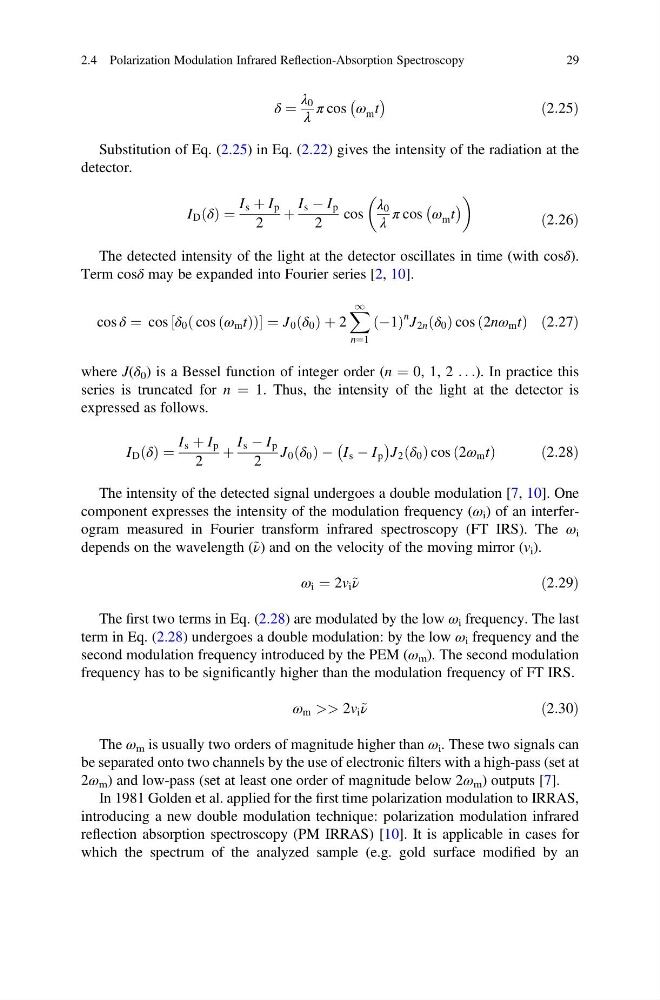
Substitution of Eq. (2.25) in Eq. (2.22) gives the intensity of the radiation at the
detector.
I D δ
ð Þ ¼
I s þ I p
2
þ
I s À I p
2
cos
λ 0
λ
π cos ω m t
À
Á
ð2:26Þ
The detected intensity of the light at the detector oscillates in time (with cosδ).
Term cosδ may be expanded into Fourier series [2, 10].
cos δ ¼ cos δ 0 cos ω m t
ð
Þ
ð
Þ
½
¼J 0 δ 0
ð Þ þ 2
X 1
n¼1
À1
ð Þ
n J 2n δ 0
ð Þcos 2nω m t
ð
Þ ð2:27Þ
where J(δ 0 ) is a Bessel function of integer order (n ¼ 0, 1, 2 . . .). In practice this
series is truncated for n ¼ 1. Thus, the intensity of the light at the detector is
expressed as follows.
I D δ
ð Þ ¼
I s þ I p
2
þ
I s À I p
2
J 0 δ 0
ð Þ À I s À I p
À
Á
J 2 δ 0
ð Þcos 2ω m t
ð
Þ
ð2:28Þ
The intensity of the detected signal undergoes a double modulation [7, 10]. One
component expresses the intensity of the modulation frequency (ω i ) of an interferogram measured in Fourier transform infrared spectroscopy (FT IRS). The ω i
depends on the wavelength (~ ν) and on the velocity of the moving mirror (v i ).
ω i ¼ 2v i ~ ν
ð2:29Þ
The first two terms in Eq. (2.28) are modulated by the low ω i frequency. The last
term in Eq. (2.28) undergoes a double modulation: by the low ω i frequency and the
second modulation frequency introduced by the PEM (ω m ). The second modulation
frequency has to be significantly higher than the modulation frequency of FT IRS.
ω m >> 2v i ~ ν
ð2:30Þ
The ω m is usually two orders of magnitude higher than ω i . These two signals can
be separated onto two channels by the use of electronic filters with a high-pass (set at
2ω m ) and low-pass (set at least one order of magnitude below 2ω m ) outputs [7].
In 1981 Golden et al. applied for the first time polarization modulation to IRRAS,
introducing a new double modulation technique: polarization modulation infrared
reflection absorption spectroscopy (PM IRRAS) [10]. It is applicable in cases for
which the spectrum of the analyzed sample (e.g. gold surface modified by an
2.4 Polarization Modulation Infrared Reflection-Absorption Spectroscopy
29
λ 0
λ
π cos ω m t
À
Á
ð2:25Þ
Substitution of Eq. (2.25) in Eq. (2.22) gives the intensity of the radiation at the
detector.
I D δ
ð Þ ¼
I s þ I p
2
þ
I s À I p
2
cos
λ 0
λ
π cos ω m t
À
Á
ð2:26Þ
The detected intensity of the light at the detector oscillates in time (with cosδ).
Term cosδ may be expanded into Fourier series [2, 10].
cos δ ¼ cos δ 0 cos ω m t
ð
Þ
ð
Þ
½
¼J 0 δ 0
ð Þ þ 2
X 1
n¼1
À1
ð Þ
n J 2n δ 0
ð Þcos 2nω m t
ð
Þ ð2:27Þ
where J(δ 0 ) is a Bessel function of integer order (n ¼ 0, 1, 2 . . .). In practice this
series is truncated for n ¼ 1. Thus, the intensity of the light at the detector is
expressed as follows.
I D δ
ð Þ ¼
I s þ I p
2
þ
I s À I p
2
J 0 δ 0
ð Þ À I s À I p
À
Á
J 2 δ 0
ð Þcos 2ω m t
ð
Þ
ð2:28Þ
The intensity of the detected signal undergoes a double modulation [7, 10]. One
component expresses the intensity of the modulation frequency (ω i ) of an interferogram measured in Fourier transform infrared spectroscopy (FT IRS). The ω i
depends on the wavelength (~ ν) and on the velocity of the moving mirror (v i ).
ω i ¼ 2v i ~ ν
ð2:29Þ
The first two terms in Eq. (2.28) are modulated by the low ω i frequency. The last
term in Eq. (2.28) undergoes a double modulation: by the low ω i frequency and the
second modulation frequency introduced by the PEM (ω m ). The second modulation
frequency has to be significantly higher than the modulation frequency of FT IRS.
ω m >> 2v i ~ ν
ð2:30Þ
The ω m is usually two orders of magnitude higher than ω i . These two signals can
be separated onto two channels by the use of electronic filters with a high-pass (set at
2ω m ) and low-pass (set at least one order of magnitude below 2ω m ) outputs [7].
In 1981 Golden et al. applied for the first time polarization modulation to IRRAS,
introducing a new double modulation technique: polarization modulation infrared
reflection absorption spectroscopy (PM IRRAS) [10]. It is applicable in cases for
which the spectrum of the analyzed sample (e.g. gold surface modified by an
2.4 Polarization Modulation Infrared Reflection-Absorption Spectroscopy
29