

As described above, each medium in which the IR radiation propagates, has a
distinct refractive index, thickness and is assumed to be non-magnetic, homogenous,
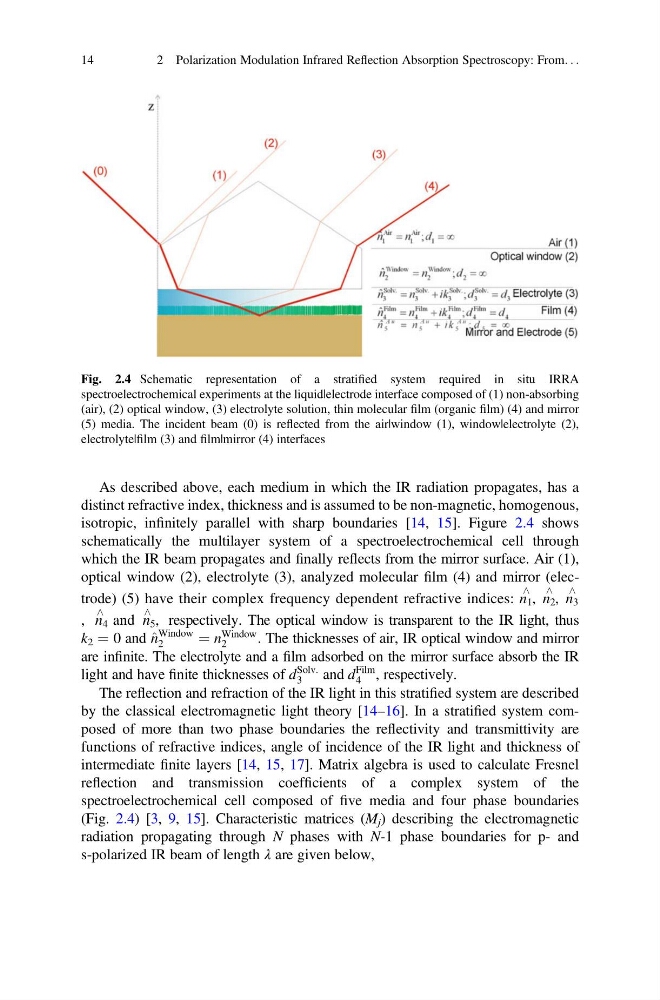
isotropic, infinitely parallel with sharp boundaries [14, 15]. Figure 2.4 shows
schematically the multilayer system of a spectroelectrochemical cell through
which the IR beam propagates and finally reflects from the mirror surface. Air (1),
optical window (2), electrolyte (3), analyzed molecular film (4) and mirror (electrode) (5) have their complex frequency dependent refractive indices: n 1
^ , n 2
^ , n 3
^
, n 4
^ and n 5
^ , respectively. The optical window is transparent to the IR light, thus
k 2 ¼ 0 and ^ n
Window
2
¼ n
Window
2
. The thicknesses of air, IR optical window and mirror
are infinite. The electrolyte and a film adsorbed on the mirror surface absorb the IR
light and have finite thicknesses of d
Solv:
3
and d
Film
4 , respectively.
The reflection and refraction of the IR light in this stratified system are described
by the classical electromagnetic light theory [14–16]. In a stratified system composed of more than two phase boundaries the reflectivity and transmittivity are
functions of refractive indices, angle of incidence of the IR light and thickness of
intermediate finite layers [14, 15, 17]. Matrix algebra is used to calculate Fresnel
reflection and transmission coefficients of a complex system of the
spectroelectrochemical cell composed of five media and four phase boundaries
(Fig. 2.4) [3, 9, 15]. Characteristic matrices (M j ) describing the electromagnetic
radiation propagating through N phases with N-1 phase boundaries for p- and
s-polarized IR beam of length λ are given below,
Fig. 2.4 Schematic representation of a stratified system required in situ IRRA
spectroelectrochemical experiments at the liquid|electrode interface composed of (1) non-absorbing
(air), (2) optical window, (3) electrolyte solution, thin molecular film (organic film) (4) and mirror
(5) media. The incident beam (0) is reflected from the air|window (1), window|electrolyte (2),
electrolyte|film (3) and film|mirror (4) interfaces
14
2 Polarization Modulation Infrared Reflection Absorption Spectroscopy: From. . .
distinct refractive index, thickness and is assumed to be non-magnetic, homogenous,
isotropic, infinitely parallel with sharp boundaries [14, 15]. Figure 2.4 shows
schematically the multilayer system of a spectroelectrochemical cell through
which the IR beam propagates and finally reflects from the mirror surface. Air (1),
optical window (2), electrolyte (3), analyzed molecular film (4) and mirror (electrode) (5) have their complex frequency dependent refractive indices: n 1
^ , n 2
^ , n 3
^
, n 4
^ and n 5
^ , respectively. The optical window is transparent to the IR light, thus
k 2 ¼ 0 and ^ n
Window
2
¼ n
Window
2
. The thicknesses of air, IR optical window and mirror
are infinite. The electrolyte and a film adsorbed on the mirror surface absorb the IR
light and have finite thicknesses of d
Solv:
3
and d
Film
4 , respectively.
The reflection and refraction of the IR light in this stratified system are described
by the classical electromagnetic light theory [14–16]. In a stratified system composed of more than two phase boundaries the reflectivity and transmittivity are
functions of refractive indices, angle of incidence of the IR light and thickness of
intermediate finite layers [14, 15, 17]. Matrix algebra is used to calculate Fresnel
reflection and transmission coefficients of a complex system of the
spectroelectrochemical cell composed of five media and four phase boundaries
(Fig. 2.4) [3, 9, 15]. Characteristic matrices (M j ) describing the electromagnetic
radiation propagating through N phases with N-1 phase boundaries for p- and
s-polarized IR beam of length λ are given below,
Fig. 2.4 Schematic representation of a stratified system required in situ IRRA
spectroelectrochemical experiments at the liquid|electrode interface composed of (1) non-absorbing
(air), (2) optical window, (3) electrolyte solution, thin molecular film (organic film) (4) and mirror
(5) media. The incident beam (0) is reflected from the air|window (1), window|electrolyte (2),
electrolyte|film (3) and film|mirror (4) interfaces
14
2 Polarization Modulation Infrared Reflection Absorption Spectroscopy: From. . .