

2.1 Polyphenols and Their Relationship to Med Diet Health Benefits
21
Given their protective properties, polyphenols can be useful as food additives and
preservatives (e.g. in conjunction with controlled atmospheres in food packaging or
in freezing treatments) (Laganà et al. 2017a, b, c, d, 2019a, b, c, d; Steinka et al.
2017a, b, c, d).
In the case of Mediterranean dietary pattern, as referred above, plant foods predominate and olive oil (OO) is the main source of lipids accounting for a relevant part
of the daily energy intake (Almeida et al. 2017); the wide variety of seasonal vegetables, fruits and aromatic herbs (including gathered from the wild) supply vitamins,
fibres and phytonutrients. Beans, peas and cheese should be important sources of
protein. Many simple cooking recipes allow reducing the consumption of meat and
fish to very small amounts. Wheat, potatoes and rice (mostly minimally processed)
should be the source of energy and fibres.
As observed by Keys and coworkers (Keys et al. 1986; Keys 1995), in the 1950s
and in the 1960s, a classical meal always included a large amount of cooked and/or
raw vegetables, thus resulting in an expected intake of a large variety and quantity
of polyphenols. Typical examples are salads that include a large variety of leaves
and herbs, seasoned with olive oil. Red wine was most often present in adult’s
meals, except in Muslim countries; similar amounts of tannins and catechins may be
supplied by green tea. At both shores of the Mediterranean basin, cakes and other
sweet desserts were typically reserved for special occasions (as family and religious
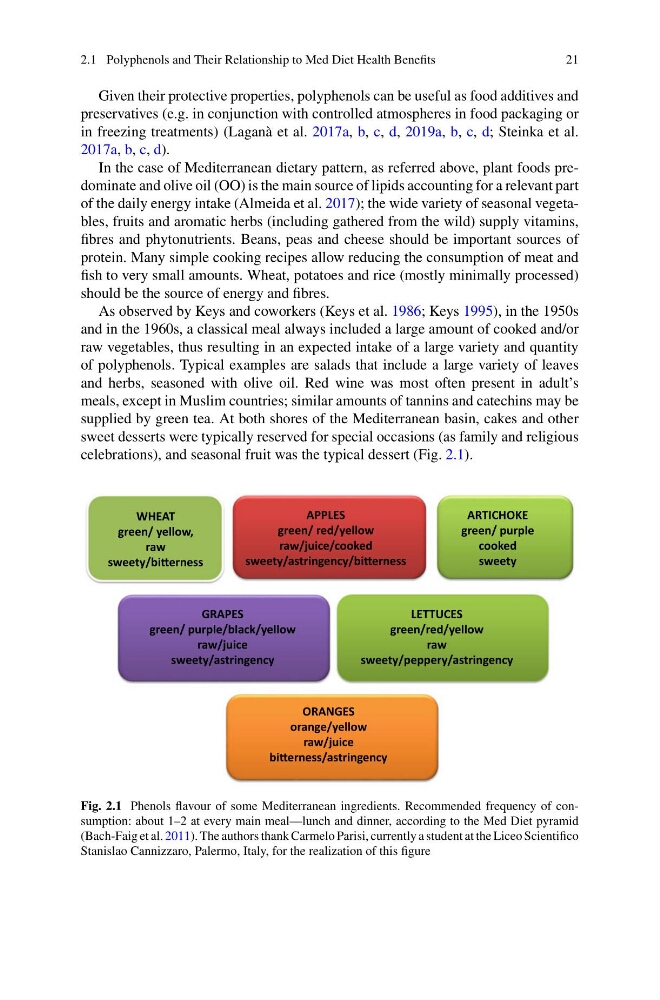
celebrations), and seasonal fruit was the typical dessert (Fig. 2.1).
WHEAT
green/ yellow,
raw
sweety/biƩerness
ARTICHOKE
green/ purple
cooked
sweety
APPLES
green/ red/yellow
raw/juice/cooked
sweety/astringency/biƩerness
GRAPES
green/ purple/black/yellow
raw/juice
sweety/astringency
ORANGES
orange/yellow
raw/juice
biƩerness/astringency
LETTUCES
green/red/yellow
raw
sweety/peppery/astringency
Fig. 2.1 Phenols flavour of some Mediterranean ingredients. Recommended frequency of consumption: about 1–2 at every main meal—lunch and dinner, according to the Med Diet pyramid
(Bach-Faig et al. 2011). The authors thank Carmelo Parisi, currently a student at the Liceo Scientifico
Stanislao Cannizzaro, Palermo, Italy, for the realization of this figure
21
Given their protective properties, polyphenols can be useful as food additives and
preservatives (e.g. in conjunction with controlled atmospheres in food packaging or
in freezing treatments) (Laganà et al. 2017a, b, c, d, 2019a, b, c, d; Steinka et al.
2017a, b, c, d).
In the case of Mediterranean dietary pattern, as referred above, plant foods predominate and olive oil (OO) is the main source of lipids accounting for a relevant part
of the daily energy intake (Almeida et al. 2017); the wide variety of seasonal vegetables, fruits and aromatic herbs (including gathered from the wild) supply vitamins,
fibres and phytonutrients. Beans, peas and cheese should be important sources of
protein. Many simple cooking recipes allow reducing the consumption of meat and
fish to very small amounts. Wheat, potatoes and rice (mostly minimally processed)
should be the source of energy and fibres.
As observed by Keys and coworkers (Keys et al. 1986; Keys 1995), in the 1950s
and in the 1960s, a classical meal always included a large amount of cooked and/or
raw vegetables, thus resulting in an expected intake of a large variety and quantity
of polyphenols. Typical examples are salads that include a large variety of leaves
and herbs, seasoned with olive oil. Red wine was most often present in adult’s
meals, except in Muslim countries; similar amounts of tannins and catechins may be
supplied by green tea. At both shores of the Mediterranean basin, cakes and other
sweet desserts were typically reserved for special occasions (as family and religious
celebrations), and seasonal fruit was the typical dessert (Fig. 2.1).
WHEAT
green/ yellow,
raw
sweety/biƩerness
ARTICHOKE
green/ purple
cooked
sweety
APPLES
green/ red/yellow
raw/juice/cooked
sweety/astringency/biƩerness
GRAPES
green/ purple/black/yellow
raw/juice
sweety/astringency
ORANGES
orange/yellow
raw/juice
biƩerness/astringency
LETTUCES
green/red/yellow
raw
sweety/peppery/astringency
Fig. 2.1 Phenols flavour of some Mediterranean ingredients. Recommended frequency of consumption: about 1–2 at every main meal—lunch and dinner, according to the Med Diet pyramid
(Bach-Faig et al. 2011). The authors thank Carmelo Parisi, currently a student at the Liceo Scientifico
Stanislao Cannizzaro, Palermo, Italy, for the realization of this figure