

6
1 Polyphenols and the Mediterranean Diet …
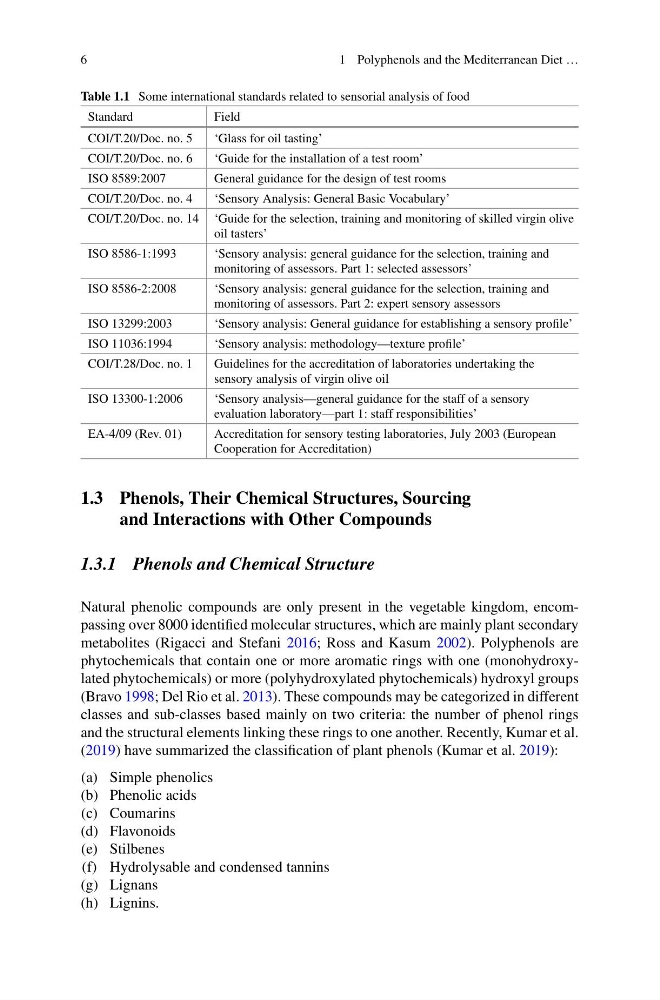
Table 1.1 Some international standards related to sensorial analysis of food
Standard
Field
COI/T.20/Doc. no. 5
‘Glass for oil tasting’
COI/T.20/Doc. no. 6
‘Guide for the installation of a test room’
ISO 8589:2007
General guidance for the design of test rooms
COI/T.20/Doc. no. 4
‘Sensory Analysis: General Basic Vocabulary’
COI/T.20/Doc. no. 14 ‘Guide for the selection, training and monitoring of skilled virgin olive
oil tasters’
ISO 8586-1:1993
‘Sensory analysis: general guidance for the selection, training and
monitoring of assessors. Part 1: selected assessors’
ISO 8586-2:2008
‘Sensory analysis: general guidance for the selection, training and
monitoring of assessors. Part 2: expert sensory assessors
ISO 13299:2003
‘Sensory analysis: General guidance for establishing a sensory profile’
ISO 11036:1994
‘Sensory analysis: methodology—texture profile’
COI/T.28/Doc. no. 1
Guidelines for the accreditation of laboratories undertaking the
sensory analysis of virgin olive oil
ISO 13300-1:2006
‘Sensory analysis—general guidance for the staff of a sensory
evaluation laboratory—part 1: staff responsibilities’
EA-4/09 (Rev. 01)
Accreditation for sensory testing laboratories, July 2003 (European
Cooperation for Accreditation)
1.3 Phenols, Their Chemical Structures, Sourcing
and Interactions with Other Compounds
1.3.1 Phenols and Chemical Structure
Natural phenolic compounds are only present in the vegetable kingdom, encompassing over 8000 identified molecular structures, which are mainly plant secondary
metabolites (Rigacci and Stefani 2016; Ross and Kasum 2002). Polyphenols are
phytochemicals that contain one or more aromatic rings with one (monohydroxylated phytochemicals) or more (polyhydroxylated phytochemicals) hydroxyl groups
(Bravo 1998; Del Rio et al. 2013). These compounds may be categorized in different
classes and sub-classes based mainly on two criteria: the number of phenol rings
and the structural elements linking these rings to one another. Recently, Kumar et al.
(2019) have summarized the classification of plant phenols (Kumar et al. 2019):
(a) Simple phenolics
(b) Phenolic acids
(c) Coumarins
(d) Flavonoids
(e) Stilbenes
(f) Hydrolysable and condensed tannins
(g) Lignans
(h) Lignins.
1 Polyphenols and the Mediterranean Diet …
Table 1.1 Some international standards related to sensorial analysis of food
Standard
Field
COI/T.20/Doc. no. 5
‘Glass for oil tasting’
COI/T.20/Doc. no. 6
‘Guide for the installation of a test room’
ISO 8589:2007
General guidance for the design of test rooms
COI/T.20/Doc. no. 4
‘Sensory Analysis: General Basic Vocabulary’
COI/T.20/Doc. no. 14 ‘Guide for the selection, training and monitoring of skilled virgin olive
oil tasters’
ISO 8586-1:1993
‘Sensory analysis: general guidance for the selection, training and
monitoring of assessors. Part 1: selected assessors’
ISO 8586-2:2008
‘Sensory analysis: general guidance for the selection, training and
monitoring of assessors. Part 2: expert sensory assessors
ISO 13299:2003
‘Sensory analysis: General guidance for establishing a sensory profile’
ISO 11036:1994
‘Sensory analysis: methodology—texture profile’
COI/T.28/Doc. no. 1
Guidelines for the accreditation of laboratories undertaking the
sensory analysis of virgin olive oil
ISO 13300-1:2006
‘Sensory analysis—general guidance for the staff of a sensory
evaluation laboratory—part 1: staff responsibilities’
EA-4/09 (Rev. 01)
Accreditation for sensory testing laboratories, July 2003 (European
Cooperation for Accreditation)
1.3 Phenols, Their Chemical Structures, Sourcing
and Interactions with Other Compounds
1.3.1 Phenols and Chemical Structure
Natural phenolic compounds are only present in the vegetable kingdom, encompassing over 8000 identified molecular structures, which are mainly plant secondary
metabolites (Rigacci and Stefani 2016; Ross and Kasum 2002). Polyphenols are
phytochemicals that contain one or more aromatic rings with one (monohydroxylated phytochemicals) or more (polyhydroxylated phytochemicals) hydroxyl groups
(Bravo 1998; Del Rio et al. 2013). These compounds may be categorized in different
classes and sub-classes based mainly on two criteria: the number of phenol rings
and the structural elements linking these rings to one another. Recently, Kumar et al.
(2019) have summarized the classification of plant phenols (Kumar et al. 2019):
(a) Simple phenolics
(b) Phenolic acids
(c) Coumarins
(d) Flavonoids
(e) Stilbenes
(f) Hydrolysable and condensed tannins
(g) Lignans
(h) Lignins.