

2 Reassessment of Urban Sustainability …
51
they recognise food products as an intrinsic part of urban economy, land use and
lifestyle. To empower the interested urban residents imparting ecological, horticultural skills through agroecological training and extension programmes can be helpful
in capacity-building.
This pandemic has brought a host of new challenges, out of which the urban food
security is one. Emphasis should be given to develop a robust plan for overcoming that
and there are several practical ways of handling the issue involving high population
density, lockdown vulnerabilities and shortage of supply as discussed in the paper.
However, in the long run only policy formulation by the government, involvement
of the city dwellers not only out of the fear of food shortage due to the pandemic
shall be paying. The ‘uber-urbans’ need to note urban agriculture as ‘chic’, ‘cool’,
‘happening’ and ‘awesome’ then only they would be genuinely involved directly or
indirectly in pursuing it in the open spaces of their condominiums, backyard of their
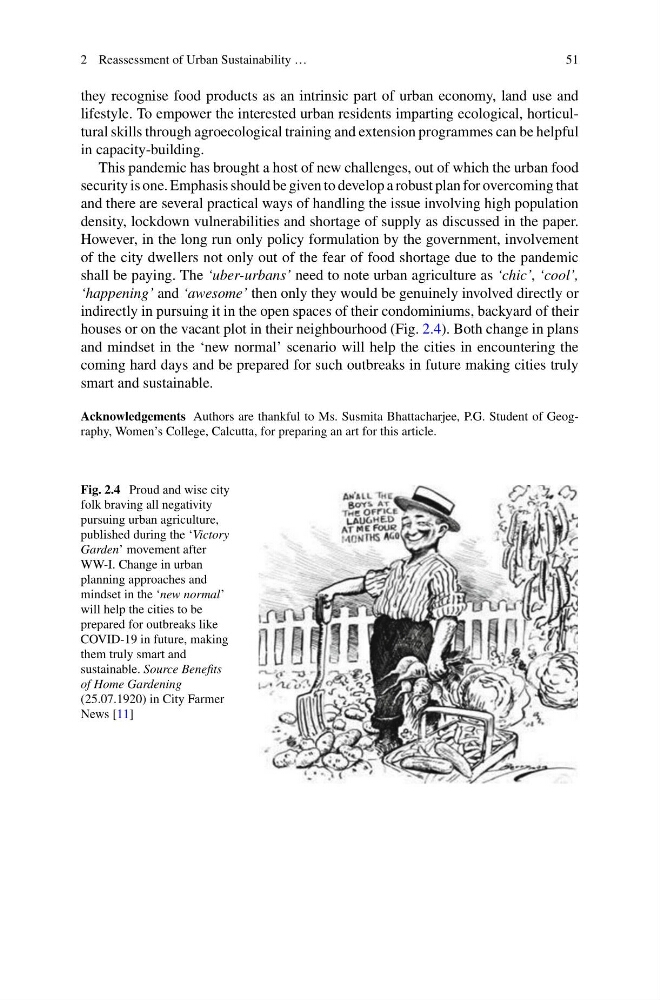
houses or on the vacant plot in their neighbourhood (Fig. 2.4). Both change in plans
and mindset in the ‘new normal’ scenario will help the cities in encountering the
coming hard days and be prepared for such outbreaks in future making cities truly
smart and sustainable.
Acknowledgements Authors are thankful to Ms. Susmita Bhattacharjee, P.G. Student of Geography, Women’s College, Calcutta, for preparing an art for this article.
Fig. 2.4 Proud and wise city
folk braving all negativity
pursuing urban agriculture,
published during the ‘Victory
Garden’ movement after
WW-I. Change in urban
planning approaches and
mindset in the ‘new normal’
will help the cities to be
prepared for outbreaks like
COVID-19 in future, making
them truly smart and
sustainable. Source Benefits
of Home Gardening
(25.07.1920) in City Farmer
News [11]
51
they recognise food products as an intrinsic part of urban economy, land use and
lifestyle. To empower the interested urban residents imparting ecological, horticultural skills through agroecological training and extension programmes can be helpful
in capacity-building.
This pandemic has brought a host of new challenges, out of which the urban food
security is one. Emphasis should be given to develop a robust plan for overcoming that
and there are several practical ways of handling the issue involving high population
density, lockdown vulnerabilities and shortage of supply as discussed in the paper.
However, in the long run only policy formulation by the government, involvement
of the city dwellers not only out of the fear of food shortage due to the pandemic
shall be paying. The ‘uber-urbans’ need to note urban agriculture as ‘chic’, ‘cool’,
‘happening’ and ‘awesome’ then only they would be genuinely involved directly or
indirectly in pursuing it in the open spaces of their condominiums, backyard of their
houses or on the vacant plot in their neighbourhood (Fig. 2.4). Both change in plans
and mindset in the ‘new normal’ scenario will help the cities in encountering the
coming hard days and be prepared for such outbreaks in future making cities truly
smart and sustainable.
Acknowledgements Authors are thankful to Ms. Susmita Bhattacharjee, P.G. Student of Geography, Women’s College, Calcutta, for preparing an art for this article.
Fig. 2.4 Proud and wise city
folk braving all negativity
pursuing urban agriculture,
published during the ‘Victory
Garden’ movement after
WW-I. Change in urban
planning approaches and
mindset in the ‘new normal’
will help the cities to be
prepared for outbreaks like
COVID-19 in future, making
them truly smart and
sustainable. Source Benefits
of Home Gardening
(25.07.1920) in City Farmer
News [11]