

2 Reassessment of Urban Sustainability …
47
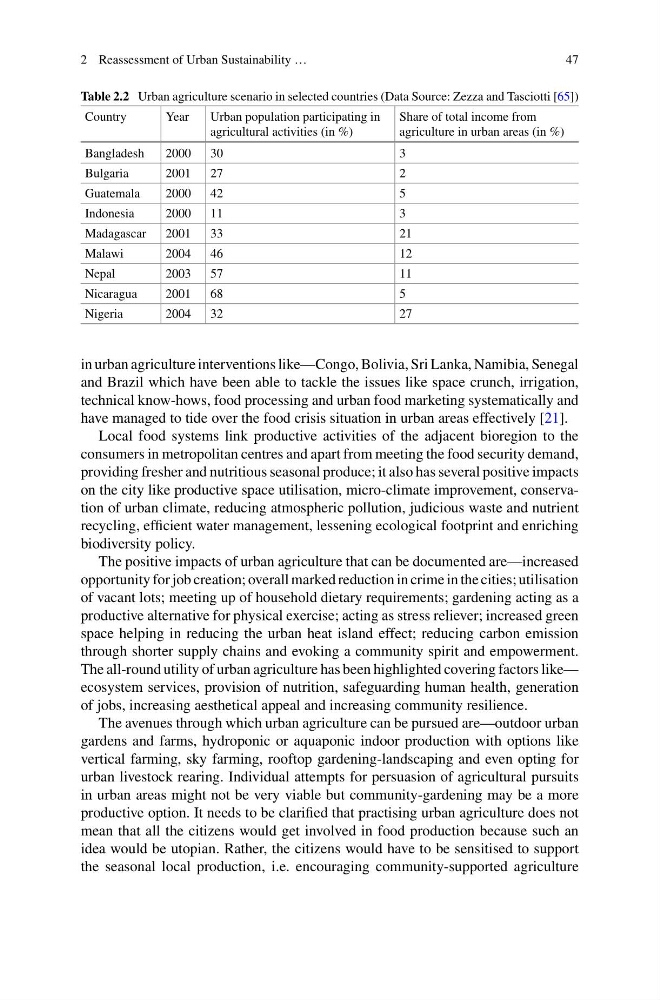
Table 2.2 Urban agriculture scenario in selected countries (Data Source: Zezza and Tasciotti [65])
Country
Year
Urban population participating in
agricultural activities (in %)
Share of total income from
agriculture in urban areas (in %)
Bangladesh
2000
30
3
Bulgaria
2001
27
2
Guatemala
2000
42
5
Indonesia
2000
11
3
Madagascar
2001
33
21
Malawi
2004
46
12
Nepal
2003
57
11
Nicaragua
2001
68
5
Nigeria
2004
32
27
in urban agriculture interventions like—Congo, Bolivia, Sri Lanka, Namibia, Senegal
and Brazil which have been able to tackle the issues like space crunch, irrigation,
technical know-hows, food processing and urban food marketing systematically and
have managed to tide over the food crisis situation in urban areas effectively [21].
Local food systems link productive activities of the adjacent bioregion to the
consumers in metropolitan centres and apart from meeting the food security demand,
providing fresher and nutritious seasonal produce; it also has several positive impacts
on the city like productive space utilisation, micro-climate improvement, conservation of urban climate, reducing atmospheric pollution, judicious waste and nutrient
recycling, efficient water management, lessening ecological footprint and enriching
biodiversity policy.
The positive impacts of urban agriculture that can be documented are—increased
opportunity for job creation; overall marked reduction in crime in the cities; utilisation
of vacant lots; meeting up of household dietary requirements; gardening acting as a
productive alternative for physical exercise; acting as stress reliever; increased green
space helping in reducing the urban heat island effect; reducing carbon emission
through shorter supply chains and evoking a community spirit and empowerment.
The all-round utility of urban agriculture has been highlighted covering factors like—
ecosystem services, provision of nutrition, safeguarding human health, generation
of jobs, increasing aesthetical appeal and increasing community resilience.
The avenues through which urban agriculture can be pursued are—outdoor urban
gardens and farms, hydroponic or aquaponic indoor production with options like
vertical farming, sky farming, rooftop gardening-landscaping and even opting for
urban livestock rearing. Individual attempts for persuasion of agricultural pursuits
in urban areas might not be very viable but community-gardening may be a more
productive option. It needs to be clarified that practising urban agriculture does not
mean that all the citizens would get involved in food production because such an
idea would be utopian. Rather, the citizens would have to be sensitised to support
the seasonal local production, i.e. encouraging community-supported agriculture
47
Table 2.2 Urban agriculture scenario in selected countries (Data Source: Zezza and Tasciotti [65])
Country
Year
Urban population participating in
agricultural activities (in %)
Share of total income from
agriculture in urban areas (in %)
Bangladesh
2000
30
3
Bulgaria
2001
27
2
Guatemala
2000
42
5
Indonesia
2000
11
3
Madagascar
2001
33
21
Malawi
2004
46
12
Nepal
2003
57
11
Nicaragua
2001
68
5
Nigeria
2004
32
27
in urban agriculture interventions like—Congo, Bolivia, Sri Lanka, Namibia, Senegal
and Brazil which have been able to tackle the issues like space crunch, irrigation,
technical know-hows, food processing and urban food marketing systematically and
have managed to tide over the food crisis situation in urban areas effectively [21].
Local food systems link productive activities of the adjacent bioregion to the
consumers in metropolitan centres and apart from meeting the food security demand,
providing fresher and nutritious seasonal produce; it also has several positive impacts
on the city like productive space utilisation, micro-climate improvement, conservation of urban climate, reducing atmospheric pollution, judicious waste and nutrient
recycling, efficient water management, lessening ecological footprint and enriching
biodiversity policy.
The positive impacts of urban agriculture that can be documented are—increased
opportunity for job creation; overall marked reduction in crime in the cities; utilisation
of vacant lots; meeting up of household dietary requirements; gardening acting as a
productive alternative for physical exercise; acting as stress reliever; increased green
space helping in reducing the urban heat island effect; reducing carbon emission
through shorter supply chains and evoking a community spirit and empowerment.
The all-round utility of urban agriculture has been highlighted covering factors like—
ecosystem services, provision of nutrition, safeguarding human health, generation
of jobs, increasing aesthetical appeal and increasing community resilience.
The avenues through which urban agriculture can be pursued are—outdoor urban
gardens and farms, hydroponic or aquaponic indoor production with options like
vertical farming, sky farming, rooftop gardening-landscaping and even opting for
urban livestock rearing. Individual attempts for persuasion of agricultural pursuits
in urban areas might not be very viable but community-gardening may be a more
productive option. It needs to be clarified that practising urban agriculture does not
mean that all the citizens would get involved in food production because such an
idea would be utopian. Rather, the citizens would have to be sensitised to support
the seasonal local production, i.e. encouraging community-supported agriculture