

42
B. Anindya and K. N. Sekhar
2.5.1 Food Security
Food security is defined as the all-time access to certain amount of food required to
lead a healthy life, for all [7]. Since, the twentieth century, food security for millions
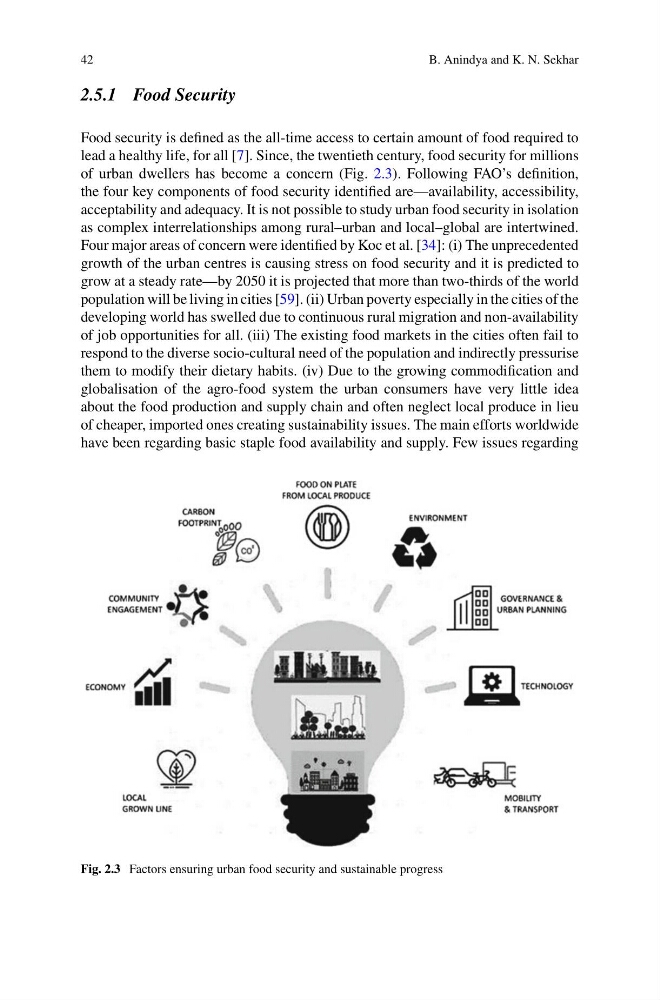
of urban dwellers has become a concern (Fig. 2.3). Following FAO’s definition,
the four key components of food security identified are—availability, accessibility,
acceptability and adequacy. It is not possible to study urban food security in isolation
as complex interrelationships among rural–urban and local–global are intertwined.
Four major areas of concern were identified by Koc et al. [34]: (i) The unprecedented
growth of the urban centres is causing stress on food security and it is predicted to
grow at a steady rate—by 2050 it is projected that more than two-thirds of the world
population will be living in cities [59]. (ii) Urban poverty especially in the cities of the
developing world has swelled due to continuous rural migration and non-availability
of job opportunities for all. (iii) The existing food markets in the cities often fail to
respond to the diverse socio-cultural need of the population and indirectly pressurise
them to modify their dietary habits. (iv) Due to the growing commodification and
globalisation of the agro-food system the urban consumers have very little idea
about the food production and supply chain and often neglect local produce in lieu
of cheaper, imported ones creating sustainability issues. The main efforts worldwide
have been regarding basic staple food availability and supply. Few issues regarding
Fig. 2.3 Factors ensuring urban food security and sustainable progress
B. Anindya and K. N. Sekhar
2.5.1 Food Security
Food security is defined as the all-time access to certain amount of food required to
lead a healthy life, for all [7]. Since, the twentieth century, food security for millions
of urban dwellers has become a concern (Fig. 2.3). Following FAO’s definition,
the four key components of food security identified are—availability, accessibility,
acceptability and adequacy. It is not possible to study urban food security in isolation
as complex interrelationships among rural–urban and local–global are intertwined.
Four major areas of concern were identified by Koc et al. [34]: (i) The unprecedented
growth of the urban centres is causing stress on food security and it is predicted to
grow at a steady rate—by 2050 it is projected that more than two-thirds of the world
population will be living in cities [59]. (ii) Urban poverty especially in the cities of the
developing world has swelled due to continuous rural migration and non-availability
of job opportunities for all. (iii) The existing food markets in the cities often fail to
respond to the diverse socio-cultural need of the population and indirectly pressurise
them to modify their dietary habits. (iv) Due to the growing commodification and
globalisation of the agro-food system the urban consumers have very little idea
about the food production and supply chain and often neglect local produce in lieu
of cheaper, imported ones creating sustainability issues. The main efforts worldwide
have been regarding basic staple food availability and supply. Few issues regarding
Fig. 2.3 Factors ensuring urban food security and sustainable progress