

2 Reassessment of Urban Sustainability …
39
food in spite of available vacant areas and determined the respective levels of potential
self-reliance. A study on Sarajevo was conducted by Sommers and Smit [50] which
highlighted the fact that a two-year-long blockade forced the country to pursue selfreliance in urban food production leading to a 30% increase in vegetable and minor
livestock production. Similar situation was narrated by Brown and Jameton [8] for
the United States during the ‘victory garden’ movement of World War II when the
households were able to meet 40% of the country’s total vegetable demand. Few
cities that have already achieved a degree of self-sufficiency in urban agriculture as
documented by Lee-Smith [37] are—Dar es Salaam, Tanzania, Sanghai and Beijing,
China which internally produced more than 80% of their vegetable demand. While
explaining the importance of urban agriculture, Masi [38] coined the term ‘food
desert’ where fast-food restaurants are much closer than grocery stores selling fresh
produce in a neighbourhood.
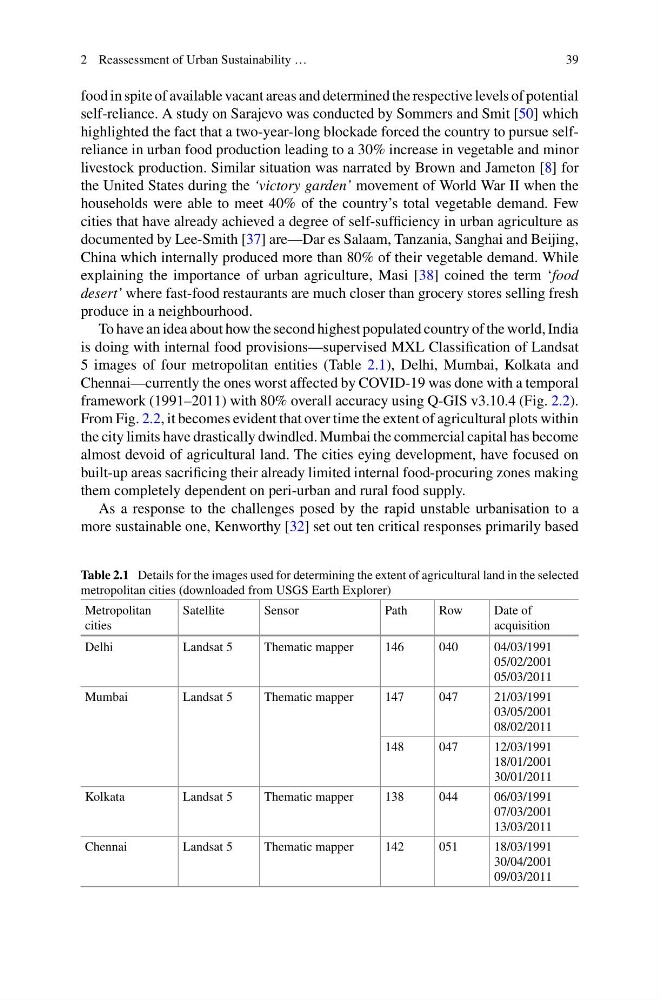
To have an idea about how the second highest populated country of the world, India
is doing with internal food provisions—supervised MXL Classification of Landsat
5 images of four metropolitan entities (Table 2.1), Delhi, Mumbai, Kolkata and
Chennai—currently the ones worst affected by COVID-19 was done with a temporal
framework (1991–2011) with 80% overall accuracy using Q-GIS v3.10.4 (Fig. 2.2).
From Fig. 2.2, it becomes evident that over time the extent of agricultural plots within
the city limits have drastically dwindled. Mumbai the commercial capital has become
almost devoid of agricultural land. The cities eying development, have focused on
built-up areas sacrificing their already limited internal food-procuring zones making
them completely dependent on peri-urban and rural food supply.
As a response to the challenges posed by the rapid unstable urbanisation to a
more sustainable one, Kenworthy [32] set out ten critical responses primarily based
Table 2.1 Details for the images used for determining the extent of agricultural land in the selected
metropolitan cities (downloaded from USGS Earth Explorer)
Metropolitan
cities
Satellite
Sensor
Path
Row
Date of
acquisition
Delhi
Landsat 5
Thematic mapper
146
040
04/03/1991
05/02/2001
05/03/2011
Mumbai
Landsat 5
Thematic mapper
147
047
21/03/1991
03/05/2001
08/02/2011
148
047
12/03/1991
18/01/2001
30/01/2011
Kolkata
Landsat 5
Thematic mapper
138
044
06/03/1991
07/03/2001
13/03/2011
Chennai
Landsat 5
Thematic mapper
142
051
18/03/1991
30/04/2001
09/03/2011
39
food in spite of available vacant areas and determined the respective levels of potential
self-reliance. A study on Sarajevo was conducted by Sommers and Smit [50] which
highlighted the fact that a two-year-long blockade forced the country to pursue selfreliance in urban food production leading to a 30% increase in vegetable and minor
livestock production. Similar situation was narrated by Brown and Jameton [8] for
the United States during the ‘victory garden’ movement of World War II when the
households were able to meet 40% of the country’s total vegetable demand. Few
cities that have already achieved a degree of self-sufficiency in urban agriculture as
documented by Lee-Smith [37] are—Dar es Salaam, Tanzania, Sanghai and Beijing,
China which internally produced more than 80% of their vegetable demand. While
explaining the importance of urban agriculture, Masi [38] coined the term ‘food
desert’ where fast-food restaurants are much closer than grocery stores selling fresh
produce in a neighbourhood.
To have an idea about how the second highest populated country of the world, India
is doing with internal food provisions—supervised MXL Classification of Landsat
5 images of four metropolitan entities (Table 2.1), Delhi, Mumbai, Kolkata and
Chennai—currently the ones worst affected by COVID-19 was done with a temporal
framework (1991–2011) with 80% overall accuracy using Q-GIS v3.10.4 (Fig. 2.2).
From Fig. 2.2, it becomes evident that over time the extent of agricultural plots within
the city limits have drastically dwindled. Mumbai the commercial capital has become
almost devoid of agricultural land. The cities eying development, have focused on
built-up areas sacrificing their already limited internal food-procuring zones making
them completely dependent on peri-urban and rural food supply.
As a response to the challenges posed by the rapid unstable urbanisation to a
more sustainable one, Kenworthy [32] set out ten critical responses primarily based
Table 2.1 Details for the images used for determining the extent of agricultural land in the selected
metropolitan cities (downloaded from USGS Earth Explorer)
Metropolitan
cities
Satellite
Sensor
Path
Row
Date of
acquisition
Delhi
Landsat 5
Thematic mapper
146
040
04/03/1991
05/02/2001
05/03/2011
Mumbai
Landsat 5
Thematic mapper
147
047
21/03/1991
03/05/2001
08/02/2011
148
047
12/03/1991
18/01/2001
30/01/2011
Kolkata
Landsat 5
Thematic mapper
138
044
06/03/1991
07/03/2001
13/03/2011
Chennai
Landsat 5
Thematic mapper
142
051
18/03/1991
30/04/2001
09/03/2011