

32
B. Anindya and K. N. Sekhar
To make existing cities and upcoming urban centres more ecologically viable
there is an urgent priority in the global push for sustainability. A city that strives to
be more ecologically sound has to be concerned about access to green space and
food security. Most of the modern cities exclusively rely on the import of all sorts
of resources to meet their daily basic needs. Food and other essential materials and
goods are transported from long distances, within the country or even from other
nations and in some cases often across continents. As the future population growth is
expected to crowd the cities more and more, there is a need to look into the potential
for local self-reliance in food within the cities.
Achievement of high levels of local self-reliance requires the active role of city
government, planners, citizens involving a high degree of physical labour and financial investment but the returns like benefits to human health and well-being, local
economy and environment must outweigh the costs involved. The main hindrance
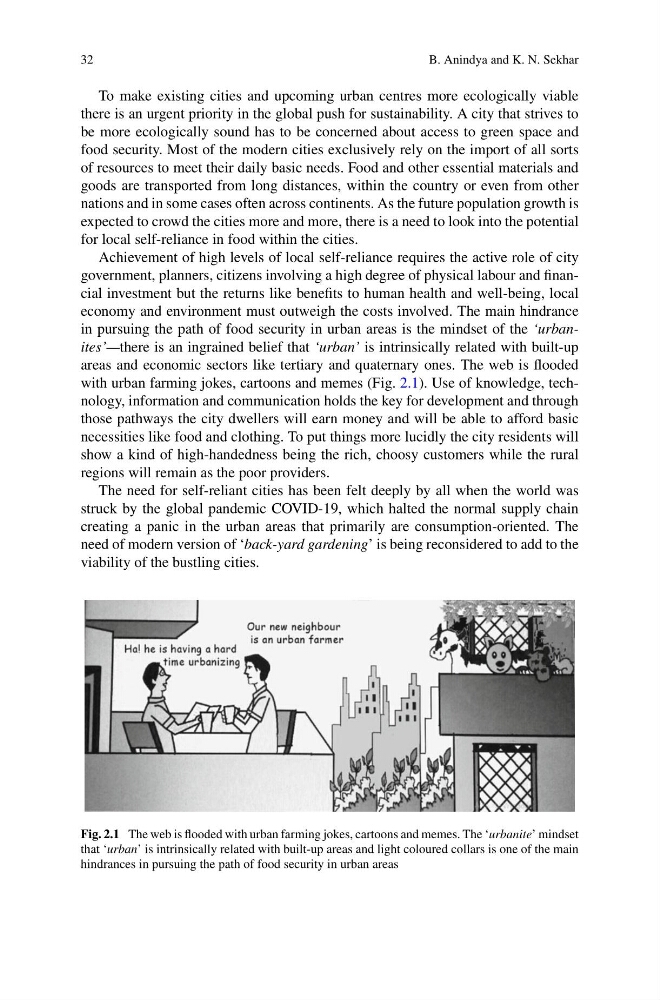
in pursuing the path of food security in urban areas is the mindset of the ‘urbanites’—there is an ingrained belief that ‘urban’ is intrinsically related with built-up
areas and economic sectors like tertiary and quaternary ones. The web is flooded
with urban farming jokes, cartoons and memes (Fig. 2.1). Use of knowledge, technology, information and communication holds the key for development and through
those pathways the city dwellers will earn money and will be able to afford basic
necessities like food and clothing. To put things more lucidly the city residents will
show a kind of high-handedness being the rich, choosy customers while the rural
regions will remain as the poor providers.
The need for self-reliant cities has been felt deeply by all when the world was
struck by the global pandemic COVID-19, which halted the normal supply chain
creating a panic in the urban areas that primarily are consumption-oriented. The
need of modern version of ‘back-yard gardening’ is being reconsidered to add to the
viability of the bustling cities.
Fig. 2.1 The web is flooded with urban farming jokes, cartoons and memes. The ‘urbanite’ mindset
that ‘urban’ is intrinsically related with built-up areas and light coloured collars is one of the main
hindrances in pursuing the path of food security in urban areas
B. Anindya and K. N. Sekhar
To make existing cities and upcoming urban centres more ecologically viable
there is an urgent priority in the global push for sustainability. A city that strives to
be more ecologically sound has to be concerned about access to green space and
food security. Most of the modern cities exclusively rely on the import of all sorts
of resources to meet their daily basic needs. Food and other essential materials and
goods are transported from long distances, within the country or even from other
nations and in some cases often across continents. As the future population growth is
expected to crowd the cities more and more, there is a need to look into the potential
for local self-reliance in food within the cities.
Achievement of high levels of local self-reliance requires the active role of city
government, planners, citizens involving a high degree of physical labour and financial investment but the returns like benefits to human health and well-being, local
economy and environment must outweigh the costs involved. The main hindrance
in pursuing the path of food security in urban areas is the mindset of the ‘urbanites’—there is an ingrained belief that ‘urban’ is intrinsically related with built-up
areas and economic sectors like tertiary and quaternary ones. The web is flooded
with urban farming jokes, cartoons and memes (Fig. 2.1). Use of knowledge, technology, information and communication holds the key for development and through
those pathways the city dwellers will earn money and will be able to afford basic
necessities like food and clothing. To put things more lucidly the city residents will
show a kind of high-handedness being the rich, choosy customers while the rural
regions will remain as the poor providers.
The need for self-reliant cities has been felt deeply by all when the world was
struck by the global pandemic COVID-19, which halted the normal supply chain
creating a panic in the urban areas that primarily are consumption-oriented. The
need of modern version of ‘back-yard gardening’ is being reconsidered to add to the
viability of the bustling cities.
Fig. 2.1 The web is flooded with urban farming jokes, cartoons and memes. The ‘urbanite’ mindset
that ‘urban’ is intrinsically related with built-up areas and light coloured collars is one of the main
hindrances in pursuing the path of food security in urban areas