

360
S. Kalita and H. Talukdar
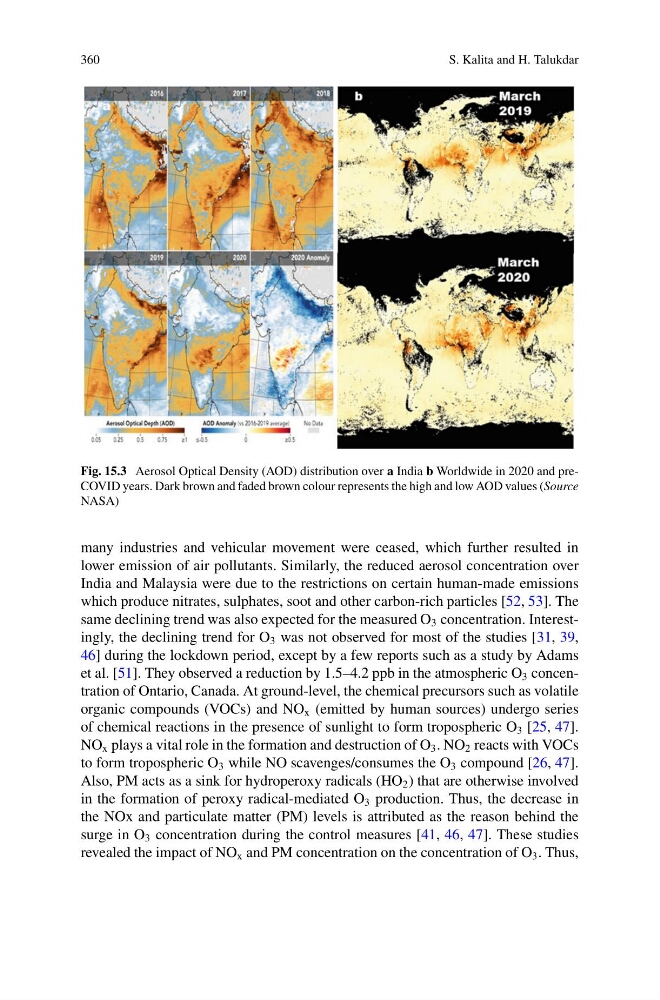
Fig. 15.3 Aerosol Optical Density (AOD) distribution over a India b Worldwide in 2020 and preCOVID years. Dark brown and faded brown colour represents the high and low AOD values (Source
NASA)
many industries and vehicular movement were ceased, which further resulted in
lower emission of air pollutants. Similarly, the reduced aerosol concentration over
India and Malaysia were due to the restrictions on certain human-made emissions
which produce nitrates, sulphates, soot and other carbon-rich particles [52, 53]. The
same declining trend was also expected for the measured O 3 concentration. Interestingly, the declining trend for O 3 was not observed for most of the studies [31, 39,
46] during the lockdown period, except by a few reports such as a study by Adams
et al. [51]. They observed a reduction by 1.5–4.2 ppb in the atmospheric O 3 concentration of Ontario, Canada. At ground-level, the chemical precursors such as volatile
organic compounds (VOCs) and NO x (emitted by human sources) undergo series
of chemical reactions in the presence of sunlight to form tropospheric O 3 [25, 47].
NO x plays a vital role in the formation and destruction of O 3 . NO 2 reacts with VOCs
to form tropospheric O 3 while NO scavenges/consumes the O 3 compound [26, 47].
Also, PM acts as a sink for hydroperoxy radicals (HO 2 ) that are otherwise involved
in the formation of peroxy radical-mediated O 3 production. Thus, the decrease in
the NOx and particulate matter (PM) levels is attributed as the reason behind the
surge in O 3 concentration during the control measures [41, 46, 47]. These studies
revealed the impact of NO x and PM concentration on the concentration of O 3 . Thus,
S. Kalita and H. Talukdar
Fig. 15.3 Aerosol Optical Density (AOD) distribution over a India b Worldwide in 2020 and preCOVID years. Dark brown and faded brown colour represents the high and low AOD values (Source
NASA)
many industries and vehicular movement were ceased, which further resulted in
lower emission of air pollutants. Similarly, the reduced aerosol concentration over
India and Malaysia were due to the restrictions on certain human-made emissions
which produce nitrates, sulphates, soot and other carbon-rich particles [52, 53]. The
same declining trend was also expected for the measured O 3 concentration. Interestingly, the declining trend for O 3 was not observed for most of the studies [31, 39,
46] during the lockdown period, except by a few reports such as a study by Adams
et al. [51]. They observed a reduction by 1.5–4.2 ppb in the atmospheric O 3 concentration of Ontario, Canada. At ground-level, the chemical precursors such as volatile
organic compounds (VOCs) and NO x (emitted by human sources) undergo series
of chemical reactions in the presence of sunlight to form tropospheric O 3 [25, 47].
NO x plays a vital role in the formation and destruction of O 3 . NO 2 reacts with VOCs
to form tropospheric O 3 while NO scavenges/consumes the O 3 compound [26, 47].
Also, PM acts as a sink for hydroperoxy radicals (HO 2 ) that are otherwise involved
in the formation of peroxy radical-mediated O 3 production. Thus, the decrease in
the NOx and particulate matter (PM) levels is attributed as the reason behind the
surge in O 3 concentration during the control measures [41, 46, 47]. These studies
revealed the impact of NO x and PM concentration on the concentration of O 3 . Thus,