

15 COVID-19 Pandemic: An Unprecedented Blessing for Nature
351
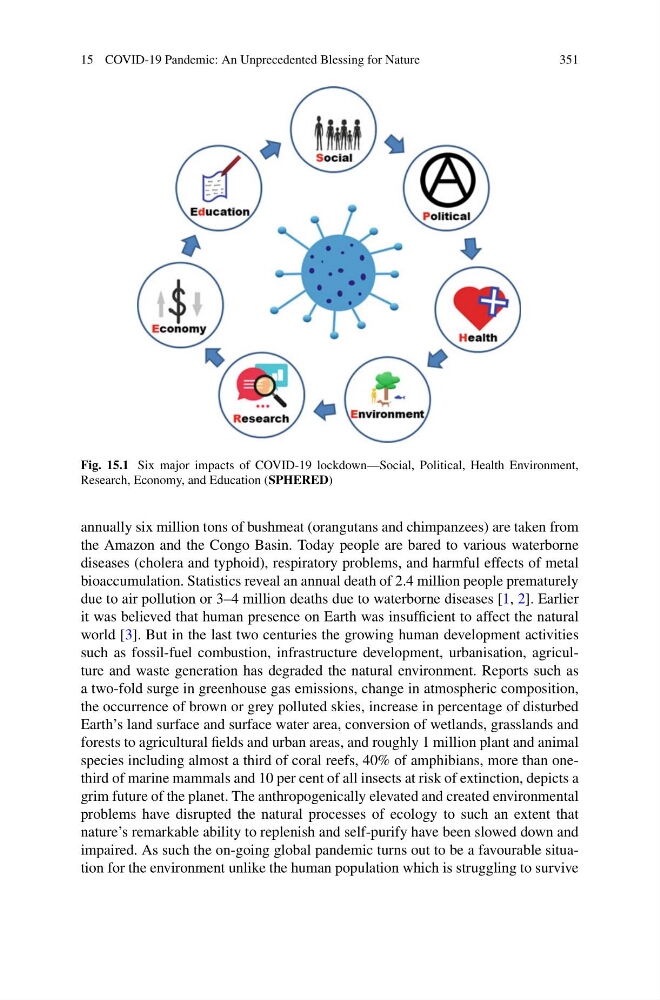
Fig. 15.1 Six major impacts of COVID-19 lockdown—Social, Political, Health Environment,
Research, Economy, and Education (SPHERED)
annually six million tons of bushmeat (orangutans and chimpanzees) are taken from
the Amazon and the Congo Basin. Today people are bared to various waterborne
diseases (cholera and typhoid), respiratory problems, and harmful effects of metal
bioaccumulation. Statistics reveal an annual death of 2.4 million people prematurely
due to air pollution or 3–4 million deaths due to waterborne diseases [1, 2]. Earlier
it was believed that human presence on Earth was insufficient to affect the natural
world [3]. But in the last two centuries the growing human development activities
such as fossil-fuel combustion, infrastructure development, urbanisation, agriculture and waste generation has degraded the natural environment. Reports such as
a two-fold surge in greenhouse gas emissions, change in atmospheric composition,
the occurrence of brown or grey polluted skies, increase in percentage of disturbed
Earth’s land surface and surface water area, conversion of wetlands, grasslands and
forests to agricultural fields and urban areas, and roughly 1 million plant and animal
species including almost a third of coral reefs, 40% of amphibians, more than onethird of marine mammals and 10 per cent of all insects at risk of extinction, depicts a
grim future of the planet. The anthropogenically elevated and created environmental
problems have disrupted the natural processes of ecology to such an extent that
nature’s remarkable ability to replenish and self-purify have been slowed down and
impaired. As such the on-going global pandemic turns out to be a favourable situation for the environment unlike the human population which is struggling to survive
351
Fig. 15.1 Six major impacts of COVID-19 lockdown—Social, Political, Health Environment,
Research, Economy, and Education (SPHERED)
annually six million tons of bushmeat (orangutans and chimpanzees) are taken from
the Amazon and the Congo Basin. Today people are bared to various waterborne
diseases (cholera and typhoid), respiratory problems, and harmful effects of metal
bioaccumulation. Statistics reveal an annual death of 2.4 million people prematurely
due to air pollution or 3–4 million deaths due to waterborne diseases [1, 2]. Earlier
it was believed that human presence on Earth was insufficient to affect the natural
world [3]. But in the last two centuries the growing human development activities
such as fossil-fuel combustion, infrastructure development, urbanisation, agriculture and waste generation has degraded the natural environment. Reports such as
a two-fold surge in greenhouse gas emissions, change in atmospheric composition,
the occurrence of brown or grey polluted skies, increase in percentage of disturbed
Earth’s land surface and surface water area, conversion of wetlands, grasslands and
forests to agricultural fields and urban areas, and roughly 1 million plant and animal
species including almost a third of coral reefs, 40% of amphibians, more than onethird of marine mammals and 10 per cent of all insects at risk of extinction, depicts a
grim future of the planet. The anthropogenically elevated and created environmental
problems have disrupted the natural processes of ecology to such an extent that
nature’s remarkable ability to replenish and self-purify have been slowed down and
impaired. As such the on-going global pandemic turns out to be a favourable situation for the environment unlike the human population which is struggling to survive