

13 IoT Based Wearable Healthcare System: Post COVID-19
309
13.2.2 Flexible Wearable Chemical Sensors
In the diagnostic centre, doctors used to take blood and by analysing the blood’s many
diseases, molecular levels have been identified. This is a completely invasive method
which requires many more individuals to conduct the test and analyse the results. This
results in lack of the dynamic and continuous real time health monitoring. Human
sweat is another fluid that also contains the molecular level information of chemicals,
which can be used as an alternative strategy to diagnose the diseases and physiological
state of the body [19–21]. There are different chemical compositions found in the
healthy and unhealthy human beings. If a person has not good health, he/she will have
different sweat concentrations which have different analytes [22–24]. By analysing
these analytes within sweat we can diagnose the disease of a human body. Mostly
flexible electrochemical sensors are used for this type of activity to measure the pH,
Na
+ , K
+ , Ca
2+ ions, dehydration, glucose and lactate [22]. The increase of Na +
ions in the sweat suggests the dehydration in the body [22]. Changes in Cl
− ions in
sweat can be used to identify the cystic fibrosis [25, 26]. Takei groups in Japan have
used the iontophoresis principle in sweat to measure the glucose level in the body.
Recently a wearable sweatband was introduced in continuous mode for detecting
methylxanthine drug levels in a body by sensing caffeine [27].
Some of the research groups are trying to fabricate multifunctional wearable
sensors by including both physical and chemical sensors. While incorporating these
sensors, they have to keep in mind that wearable sensors should not be thick and it
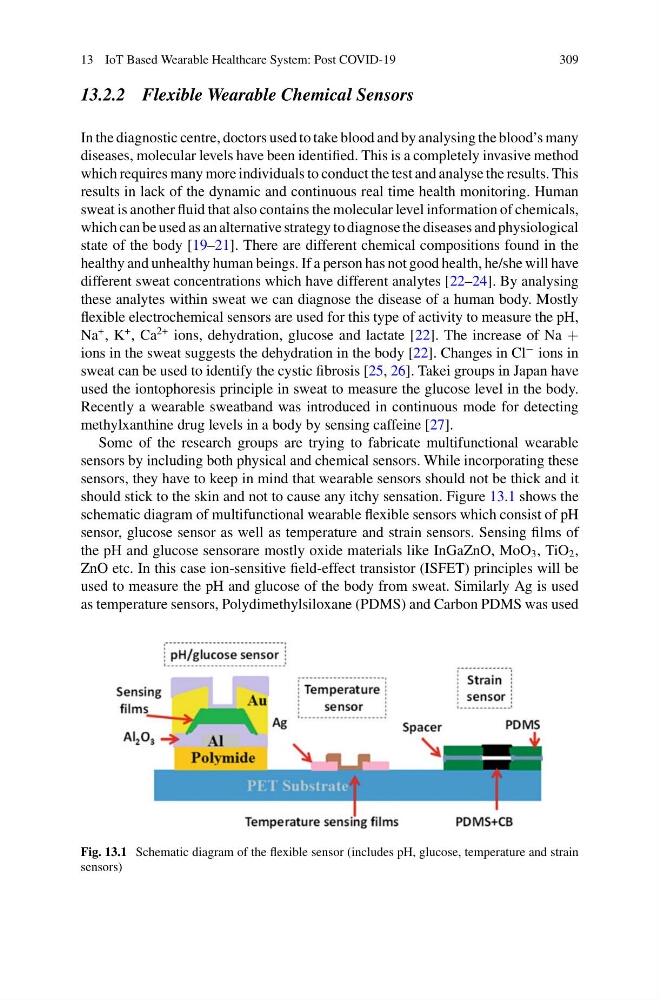
should stick to the skin and not to cause any itchy sensation. Figure 13.1 shows the
schematic diagram of multifunctional wearable flexible sensors which consist of pH
sensor, glucose sensor as well as temperature and strain sensors. Sensing films of
the pH and glucose sensorare mostly oxide materials like InGaZnO, MoO 3 , TiO 2 ,
ZnO etc. In this case ion-sensitive field-effect transistor (ISFET) principles will be
used to measure the pH and glucose of the body from sweat. Similarly Ag is used
as temperature sensors, Polydimethylsiloxane (PDMS) and Carbon PDMS was used
Fig. 13.1 Schematic diagram of the flexible sensor (includes pH, glucose, temperature and strain
sensors)
309
13.2.2 Flexible Wearable Chemical Sensors
In the diagnostic centre, doctors used to take blood and by analysing the blood’s many
diseases, molecular levels have been identified. This is a completely invasive method
which requires many more individuals to conduct the test and analyse the results. This
results in lack of the dynamic and continuous real time health monitoring. Human
sweat is another fluid that also contains the molecular level information of chemicals,
which can be used as an alternative strategy to diagnose the diseases and physiological
state of the body [19–21]. There are different chemical compositions found in the
healthy and unhealthy human beings. If a person has not good health, he/she will have
different sweat concentrations which have different analytes [22–24]. By analysing
these analytes within sweat we can diagnose the disease of a human body. Mostly
flexible electrochemical sensors are used for this type of activity to measure the pH,
Na
+ , K
+ , Ca
2+ ions, dehydration, glucose and lactate [22]. The increase of Na +
ions in the sweat suggests the dehydration in the body [22]. Changes in Cl
− ions in
sweat can be used to identify the cystic fibrosis [25, 26]. Takei groups in Japan have
used the iontophoresis principle in sweat to measure the glucose level in the body.
Recently a wearable sweatband was introduced in continuous mode for detecting
methylxanthine drug levels in a body by sensing caffeine [27].
Some of the research groups are trying to fabricate multifunctional wearable
sensors by including both physical and chemical sensors. While incorporating these
sensors, they have to keep in mind that wearable sensors should not be thick and it
should stick to the skin and not to cause any itchy sensation. Figure 13.1 shows the
schematic diagram of multifunctional wearable flexible sensors which consist of pH
sensor, glucose sensor as well as temperature and strain sensors. Sensing films of
the pH and glucose sensorare mostly oxide materials like InGaZnO, MoO 3 , TiO 2 ,
ZnO etc. In this case ion-sensitive field-effect transistor (ISFET) principles will be
used to measure the pH and glucose of the body from sweat. Similarly Ag is used
as temperature sensors, Polydimethylsiloxane (PDMS) and Carbon PDMS was used
Fig. 13.1 Schematic diagram of the flexible sensor (includes pH, glucose, temperature and strain
sensors)