

272
R. Majumdar
niche adaptions of the pathogen within the receptor’s intestinal tract and the expression of the organism within the receptor’s intestinal tract (e.g. tissue distribution,
multiplication, etc., depending on the nature of the pathogen).
In addition to the amplification mechanisms that have been discussed above in
the context of an enteric pathogen, some other amplification attributes exhibited by
SARS-CoV-2 include infection in the upper respiratory tract, followed by inflammation in the alveoli and filling of alveoli with fluid and pus, eventually leading
to pneumonia [58]; intra-host genomic variability (several low to higher-frequency
single nucleotide variations (SNVs) across the viral genome has been reported, with
7 out of 10 protein-coding viral genes being affected and the density of genome modification has been found to be variable) [59]; and immune evasion during cytokine
storm caused by systemic immune over-activation in the hosts with severe infection
[60].
Most of the current evidences indicate that the human-to-human transmission
of COVID-19 virus primarily occurs via the respiratory droplets and contact routes.
More specifically, COVID-19 respiratory infections are transmitted through (a) larger
respiratory droplets of diameter >5–10 μm (they travel over short distances, L ~<
1 m), as well as, (b) virus-laden aerosolized droplets or droplet nuclei (droplets with
diameter smaller than 5 μm) (they travel over distances >1 m). Droplet transmission
from the infected individual to the uninfected people may occur due to coughing
and sneezing while being in close contact. In such cases, upon getting exposed to
the infective respiratory droplets, the mucosae of mouth and nose, as well as, the
conjunctiva of the eyes may facilitate the entry of virus particulates into the body
of an uninfected individual [51]. The COVID 19 virus has also been reported to
be active and alive for substantial period on the surfaces of the fomites, thereby
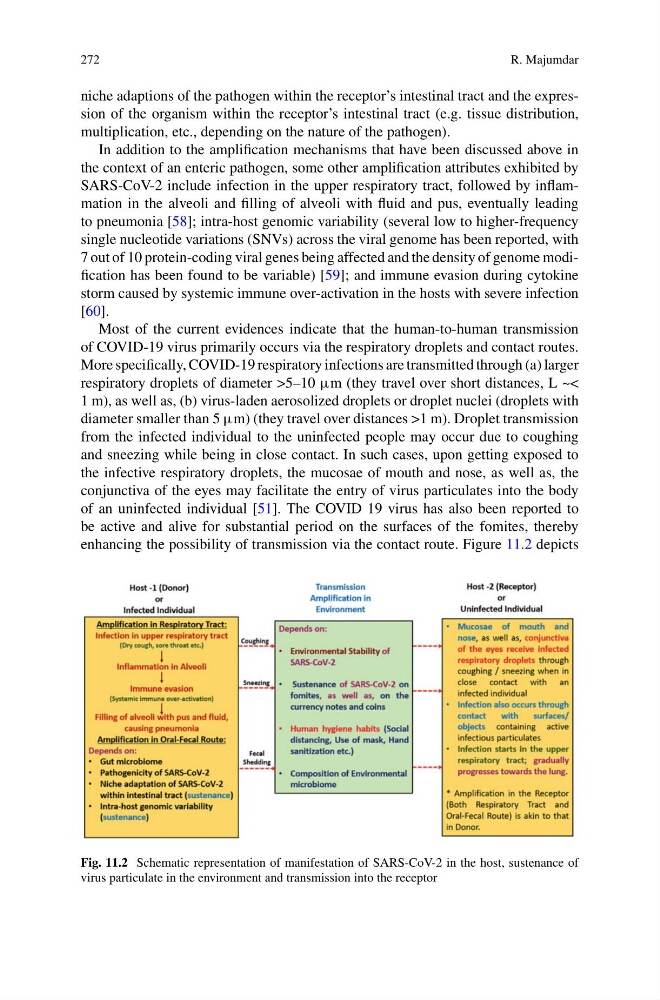
enhancing the possibility of transmission via the contact route. Figure 11.2 depicts
Fig. 11.2 Schematic representation of manifestation of SARS-CoV-2 in the host, sustenance of
virus particulate in the environment and transmission into the receptor
R. Majumdar
niche adaptions of the pathogen within the receptor’s intestinal tract and the expression of the organism within the receptor’s intestinal tract (e.g. tissue distribution,
multiplication, etc., depending on the nature of the pathogen).
In addition to the amplification mechanisms that have been discussed above in
the context of an enteric pathogen, some other amplification attributes exhibited by
SARS-CoV-2 include infection in the upper respiratory tract, followed by inflammation in the alveoli and filling of alveoli with fluid and pus, eventually leading
to pneumonia [58]; intra-host genomic variability (several low to higher-frequency
single nucleotide variations (SNVs) across the viral genome has been reported, with
7 out of 10 protein-coding viral genes being affected and the density of genome modification has been found to be variable) [59]; and immune evasion during cytokine
storm caused by systemic immune over-activation in the hosts with severe infection
[60].
Most of the current evidences indicate that the human-to-human transmission
of COVID-19 virus primarily occurs via the respiratory droplets and contact routes.
More specifically, COVID-19 respiratory infections are transmitted through (a) larger
respiratory droplets of diameter >5–10 μm (they travel over short distances, L ~<
1 m), as well as, (b) virus-laden aerosolized droplets or droplet nuclei (droplets with
diameter smaller than 5 μm) (they travel over distances >1 m). Droplet transmission
from the infected individual to the uninfected people may occur due to coughing
and sneezing while being in close contact. In such cases, upon getting exposed to
the infective respiratory droplets, the mucosae of mouth and nose, as well as, the
conjunctiva of the eyes may facilitate the entry of virus particulates into the body
of an uninfected individual [51]. The COVID 19 virus has also been reported to
be active and alive for substantial period on the surfaces of the fomites, thereby
enhancing the possibility of transmission via the contact route. Figure 11.2 depicts
Fig. 11.2 Schematic representation of manifestation of SARS-CoV-2 in the host, sustenance of
virus particulate in the environment and transmission into the receptor