

11 Sludge Hygienisation—A Novel Technology for Urban Areas …
269
them even more hazardous in the context of both human and environmental health
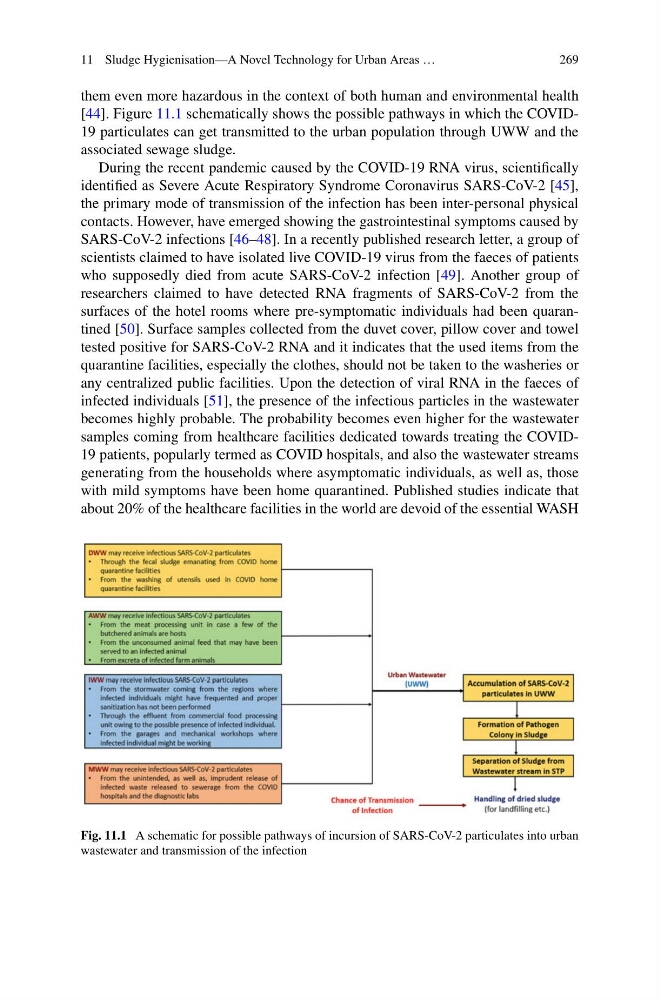
[44]. Figure 11.1 schematically shows the possible pathways in which the COVID19 particulates can get transmitted to the urban population through UWW and the
associated sewage sludge.
During the recent pandemic caused by the COVID-19 RNA virus, scientifically
identified as Severe Acute Respiratory Syndrome Coronavirus SARS-CoV-2 [45],
the primary mode of transmission of the infection has been inter-personal physical
contacts. However, have emerged showing the gastrointestinal symptoms caused by
SARS-CoV-2 infections [46–48]. In a recently published research letter, a group of
scientists claimed to have isolated live COVID-19 virus from the faeces of patients
who supposedly died from acute SARS-CoV-2 infection [49]. Another group of
researchers claimed to have detected RNA fragments of SARS-CoV-2 from the
surfaces of the hotel rooms where pre-symptomatic individuals had been quarantined [50]. Surface samples collected from the duvet cover, pillow cover and towel
tested positive for SARS-CoV-2 RNA and it indicates that the used items from the
quarantine facilities, especially the clothes, should not be taken to the washeries or
any centralized public facilities. Upon the detection of viral RNA in the faeces of
infected individuals [51], the presence of the infectious particles in the wastewater
becomes highly probable. The probability becomes even higher for the wastewater
samples coming from healthcare facilities dedicated towards treating the COVID19 patients, popularly termed as COVID hospitals, and also the wastewater streams
generating from the households where asymptomatic individuals, as well as, those
with mild symptoms have been home quarantined. Published studies indicate that
about 20% of the healthcare facilities in the world are devoid of the essential WASH
Fig. 11.1 A schematic for possible pathways of incursion of SARS-CoV-2 particulates into urban
wastewater and transmission of the infection
269
them even more hazardous in the context of both human and environmental health
[44]. Figure 11.1 schematically shows the possible pathways in which the COVID19 particulates can get transmitted to the urban population through UWW and the
associated sewage sludge.
During the recent pandemic caused by the COVID-19 RNA virus, scientifically
identified as Severe Acute Respiratory Syndrome Coronavirus SARS-CoV-2 [45],
the primary mode of transmission of the infection has been inter-personal physical
contacts. However, have emerged showing the gastrointestinal symptoms caused by
SARS-CoV-2 infections [46–48]. In a recently published research letter, a group of
scientists claimed to have isolated live COVID-19 virus from the faeces of patients
who supposedly died from acute SARS-CoV-2 infection [49]. Another group of
researchers claimed to have detected RNA fragments of SARS-CoV-2 from the
surfaces of the hotel rooms where pre-symptomatic individuals had been quarantined [50]. Surface samples collected from the duvet cover, pillow cover and towel
tested positive for SARS-CoV-2 RNA and it indicates that the used items from the
quarantine facilities, especially the clothes, should not be taken to the washeries or
any centralized public facilities. Upon the detection of viral RNA in the faeces of
infected individuals [51], the presence of the infectious particles in the wastewater
becomes highly probable. The probability becomes even higher for the wastewater
samples coming from healthcare facilities dedicated towards treating the COVID19 patients, popularly termed as COVID hospitals, and also the wastewater streams
generating from the households where asymptomatic individuals, as well as, those
with mild symptoms have been home quarantined. Published studies indicate that
about 20% of the healthcare facilities in the world are devoid of the essential WASH
Fig. 11.1 A schematic for possible pathways of incursion of SARS-CoV-2 particulates into urban
wastewater and transmission of the infection