

10 Impact of Biomedical Waste Management System …
257
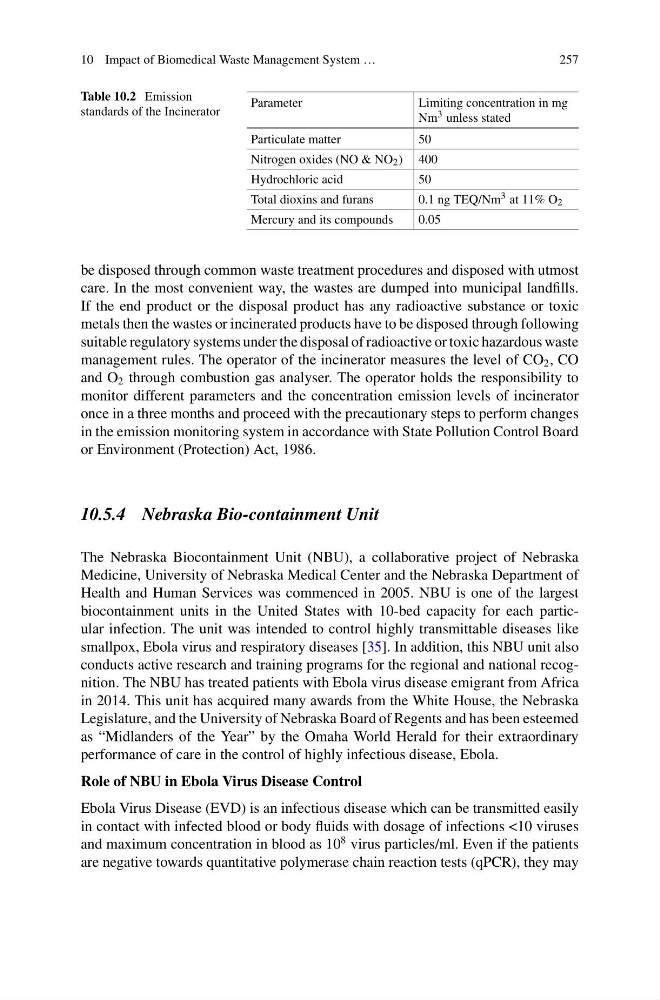
Table 10.2 Emission
standards of the Incinerator
Parameter
Limiting concentration in mg
Nm 3 unless stated
Particulate matter
50
Nitrogen oxides (NO & NO 2 ) 400
Hydrochloric acid
50
Total dioxins and furans
0.1 ng TEQ/Nm 3 at 11% O 2
Mercury and its compounds
0.05
be disposed through common waste treatment procedures and disposed with utmost
care. In the most convenient way, the wastes are dumped into municipal landfills.
If the end product or the disposal product has any radioactive substance or toxic
metals then the wastes or incinerated products have to be disposed through following
suitable regulatory systems under the disposal of radioactive or toxic hazardous waste
management rules. The operator of the incinerator measures the level of CO 2 , CO
and O 2 through combustion gas analyser. The operator holds the responsibility to
monitor different parameters and the concentration emission levels of incinerator
once in a three months and proceed with the precautionary steps to perform changes
in the emission monitoring system in accordance with State Pollution Control Board
or Environment (Protection) Act, 1986.
10.5.4 Nebraska Bio-containment Unit
The Nebraska Biocontainment Unit (NBU), a collaborative project of Nebraska
Medicine, University of Nebraska Medical Center and the Nebraska Department of
Health and Human Services was commenced in 2005. NBU is one of the largest
biocontainment units in the United States with 10-bed capacity for each particular infection. The unit was intended to control highly transmittable diseases like
smallpox, Ebola virus and respiratory diseases [35]. In addition, this NBU unit also
conducts active research and training programs for the regional and national recognition. The NBU has treated patients with Ebola virus disease emigrant from Africa
in 2014. This unit has acquired many awards from the White House, the Nebraska
Legislature, and the University of Nebraska Board of Regents and has been esteemed
as “Midlanders of the Year” by the Omaha World Herald for their extraordinary
performance of care in the control of highly infectious disease, Ebola.
Role of NBU in Ebola Virus Disease Control
Ebola Virus Disease (EVD) is an infectious disease which can be transmitted easily
in contact with infected blood or body fluids with dosage of infections <10 viruses
and maximum concentration in blood as 10
8 virus particles/ml. Even if the patients
are negative towards quantitative polymerase chain reaction tests (qPCR), they may
257
Table 10.2 Emission
standards of the Incinerator
Parameter
Limiting concentration in mg
Nm 3 unless stated
Particulate matter
50
Nitrogen oxides (NO & NO 2 ) 400
Hydrochloric acid
50
Total dioxins and furans
0.1 ng TEQ/Nm 3 at 11% O 2
Mercury and its compounds
0.05
be disposed through common waste treatment procedures and disposed with utmost
care. In the most convenient way, the wastes are dumped into municipal landfills.
If the end product or the disposal product has any radioactive substance or toxic
metals then the wastes or incinerated products have to be disposed through following
suitable regulatory systems under the disposal of radioactive or toxic hazardous waste
management rules. The operator of the incinerator measures the level of CO 2 , CO
and O 2 through combustion gas analyser. The operator holds the responsibility to
monitor different parameters and the concentration emission levels of incinerator
once in a three months and proceed with the precautionary steps to perform changes
in the emission monitoring system in accordance with State Pollution Control Board
or Environment (Protection) Act, 1986.
10.5.4 Nebraska Bio-containment Unit
The Nebraska Biocontainment Unit (NBU), a collaborative project of Nebraska
Medicine, University of Nebraska Medical Center and the Nebraska Department of
Health and Human Services was commenced in 2005. NBU is one of the largest
biocontainment units in the United States with 10-bed capacity for each particular infection. The unit was intended to control highly transmittable diseases like
smallpox, Ebola virus and respiratory diseases [35]. In addition, this NBU unit also
conducts active research and training programs for the regional and national recognition. The NBU has treated patients with Ebola virus disease emigrant from Africa
in 2014. This unit has acquired many awards from the White House, the Nebraska
Legislature, and the University of Nebraska Board of Regents and has been esteemed
as “Midlanders of the Year” by the Omaha World Herald for their extraordinary
performance of care in the control of highly infectious disease, Ebola.
Role of NBU in Ebola Virus Disease Control
Ebola Virus Disease (EVD) is an infectious disease which can be transmitted easily
in contact with infected blood or body fluids with dosage of infections <10 viruses
and maximum concentration in blood as 10
8 virus particles/ml. Even if the patients
are negative towards quantitative polymerase chain reaction tests (qPCR), they may