

10 Impact of Biomedical Waste Management System …
253
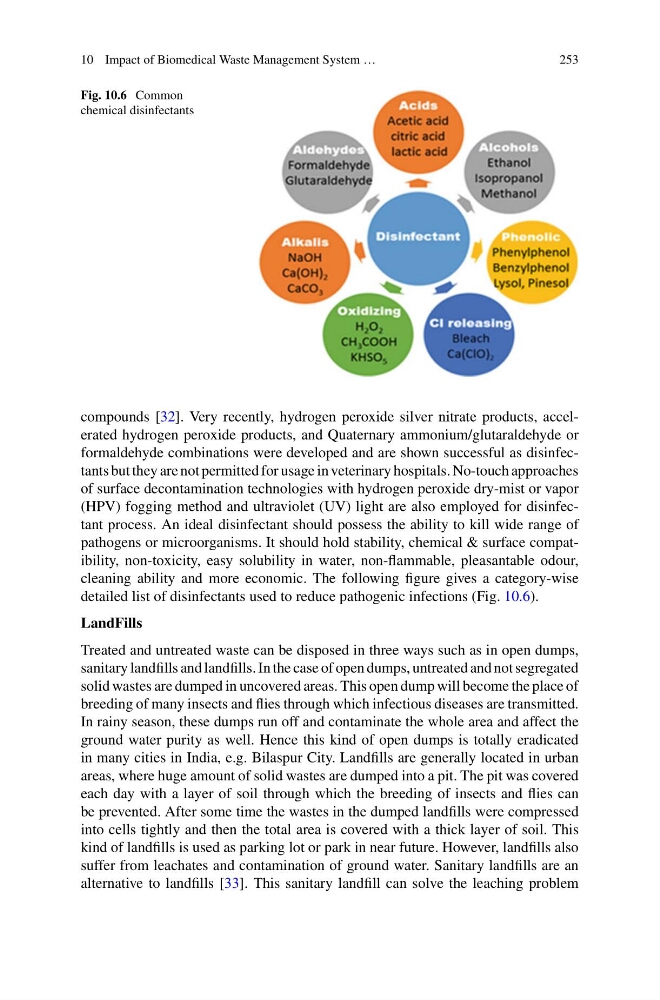
Fig. 10.6 Common
chemical disinfectants
compounds [32]. Very recently, hydrogen peroxide silver nitrate products, accelerated hydrogen peroxide products, and Quaternary ammonium/glutaraldehyde or
formaldehyde combinations were developed and are shown successful as disinfectants but they are not permitted for usage in veterinary hospitals. No-touch approaches
of surface decontamination technologies with hydrogen peroxide dry-mist or vapor
(HPV) fogging method and ultraviolet (UV) light are also employed for disinfectant process. An ideal disinfectant should possess the ability to kill wide range of
pathogens or microorganisms. It should hold stability, chemical & surface compatibility, non-toxicity, easy solubility in water, non-flammable, pleasantable odour,
cleaning ability and more economic. The following figure gives a category-wise
detailed list of disinfectants used to reduce pathogenic infections (Fig. 10.6).
LandFills
Treated and untreated waste can be disposed in three ways such as in open dumps,
sanitary landfills and landfills. In the case of open dumps, untreated and not segregated
solid wastes are dumped in uncovered areas. This open dump will become the place of
breeding of many insects and flies through which infectious diseases are transmitted.
In rainy season, these dumps run off and contaminate the whole area and affect the
ground water purity as well. Hence this kind of open dumps is totally eradicated
in many cities in India, e.g. Bilaspur City. Landfills are generally located in urban
areas, where huge amount of solid wastes are dumped into a pit. The pit was covered
each day with a layer of soil through which the breeding of insects and flies can
be prevented. After some time the wastes in the dumped landfills were compressed
into cells tightly and then the total area is covered with a thick layer of soil. This
kind of landfills is used as parking lot or park in near future. However, landfills also
suffer from leachates and contamination of ground water. Sanitary landfills are an
alternative to landfills [33]. This sanitary landfill can solve the leaching problem
253
Fig. 10.6 Common
chemical disinfectants
compounds [32]. Very recently, hydrogen peroxide silver nitrate products, accelerated hydrogen peroxide products, and Quaternary ammonium/glutaraldehyde or
formaldehyde combinations were developed and are shown successful as disinfectants but they are not permitted for usage in veterinary hospitals. No-touch approaches
of surface decontamination technologies with hydrogen peroxide dry-mist or vapor
(HPV) fogging method and ultraviolet (UV) light are also employed for disinfectant process. An ideal disinfectant should possess the ability to kill wide range of
pathogens or microorganisms. It should hold stability, chemical & surface compatibility, non-toxicity, easy solubility in water, non-flammable, pleasantable odour,
cleaning ability and more economic. The following figure gives a category-wise
detailed list of disinfectants used to reduce pathogenic infections (Fig. 10.6).
LandFills
Treated and untreated waste can be disposed in three ways such as in open dumps,
sanitary landfills and landfills. In the case of open dumps, untreated and not segregated
solid wastes are dumped in uncovered areas. This open dump will become the place of
breeding of many insects and flies through which infectious diseases are transmitted.
In rainy season, these dumps run off and contaminate the whole area and affect the
ground water purity as well. Hence this kind of open dumps is totally eradicated
in many cities in India, e.g. Bilaspur City. Landfills are generally located in urban
areas, where huge amount of solid wastes are dumped into a pit. The pit was covered
each day with a layer of soil through which the breeding of insects and flies can
be prevented. After some time the wastes in the dumped landfills were compressed
into cells tightly and then the total area is covered with a thick layer of soil. This
kind of landfills is used as parking lot or park in near future. However, landfills also
suffer from leachates and contamination of ground water. Sanitary landfills are an
alternative to landfills [33]. This sanitary landfill can solve the leaching problem