

1 COVID-19: An Opportunity for Smart and Sustainable …
11
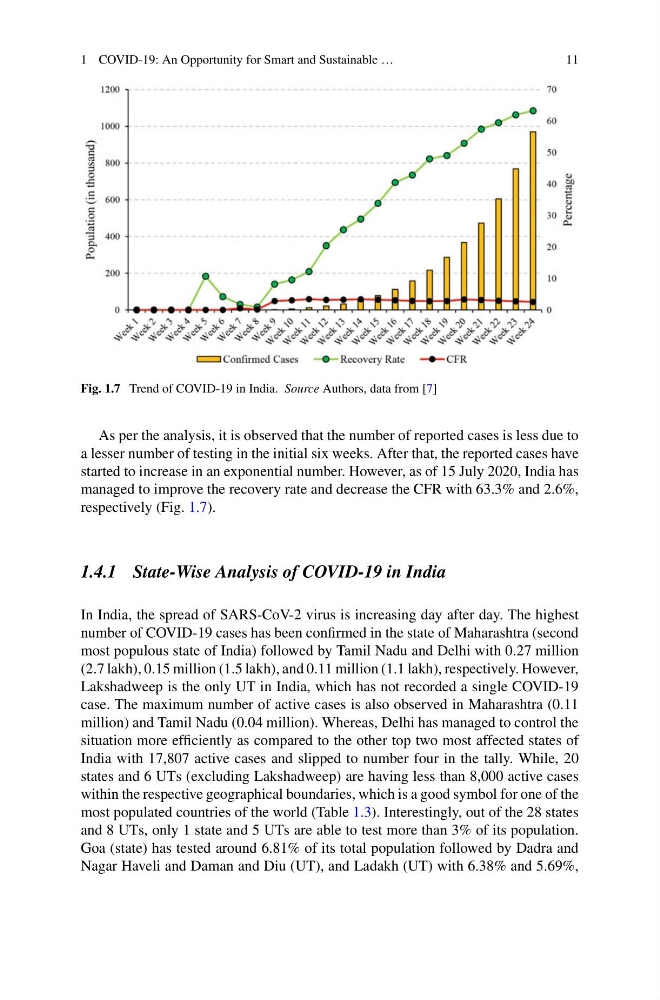
Fig. 1.7 Trend of COVID-19 in India. Source Authors, data from [7]
As per the analysis, it is observed that the number of reported cases is less due to
a lesser number of testing in the initial six weeks. After that, the reported cases have
started to increase in an exponential number. However, as of 15 July 2020, India has
managed to improve the recovery rate and decrease the CFR with 63.3% and 2.6%,
respectively (Fig. 1.7).
1.4.1 State-Wise Analysis of COVID-19 in India
In India, the spread of SARS-CoV-2 virus is increasing day after day. The highest
number of COVID-19 cases has been confirmed in the state of Maharashtra (second
most populous state of India) followed by Tamil Nadu and Delhi with 0.27 million
(2.7 lakh), 0.15 million (1.5 lakh), and 0.11 million (1.1 lakh), respectively. However,
Lakshadweep is the only UT in India, which has not recorded a single COVID-19
case. The maximum number of active cases is also observed in Maharashtra (0.11
million) and Tamil Nadu (0.04 million). Whereas, Delhi has managed to control the
situation more efficiently as compared to the other top two most affected states of
India with 17,807 active cases and slipped to number four in the tally. While, 20
states and 6 UTs (excluding Lakshadweep) are having less than 8,000 active cases
within the respective geographical boundaries, which is a good symbol for one of the
most populated countries of the world (Table 1.3). Interestingly, out of the 28 states
and 8 UTs, only 1 state and 5 UTs are able to test more than 3% of its population.
Goa (state) has tested around 6.81% of its total population followed by Dadra and
Nagar Haveli and Daman and Diu (UT), and Ladakh (UT) with 6.38% and 5.69%,
11
Fig. 1.7 Trend of COVID-19 in India. Source Authors, data from [7]
As per the analysis, it is observed that the number of reported cases is less due to
a lesser number of testing in the initial six weeks. After that, the reported cases have
started to increase in an exponential number. However, as of 15 July 2020, India has
managed to improve the recovery rate and decrease the CFR with 63.3% and 2.6%,
respectively (Fig. 1.7).
1.4.1 State-Wise Analysis of COVID-19 in India
In India, the spread of SARS-CoV-2 virus is increasing day after day. The highest
number of COVID-19 cases has been confirmed in the state of Maharashtra (second
most populous state of India) followed by Tamil Nadu and Delhi with 0.27 million
(2.7 lakh), 0.15 million (1.5 lakh), and 0.11 million (1.1 lakh), respectively. However,
Lakshadweep is the only UT in India, which has not recorded a single COVID-19
case. The maximum number of active cases is also observed in Maharashtra (0.11
million) and Tamil Nadu (0.04 million). Whereas, Delhi has managed to control the
situation more efficiently as compared to the other top two most affected states of
India with 17,807 active cases and slipped to number four in the tally. While, 20
states and 6 UTs (excluding Lakshadweep) are having less than 8,000 active cases
within the respective geographical boundaries, which is a good symbol for one of the
most populated countries of the world (Table 1.3). Interestingly, out of the 28 states
and 8 UTs, only 1 state and 5 UTs are able to test more than 3% of its population.
Goa (state) has tested around 6.81% of its total population followed by Dadra and
Nagar Haveli and Daman and Diu (UT), and Ladakh (UT) with 6.38% and 5.69%,