

7 COVID-19: Disaster or an Opportunity …
179
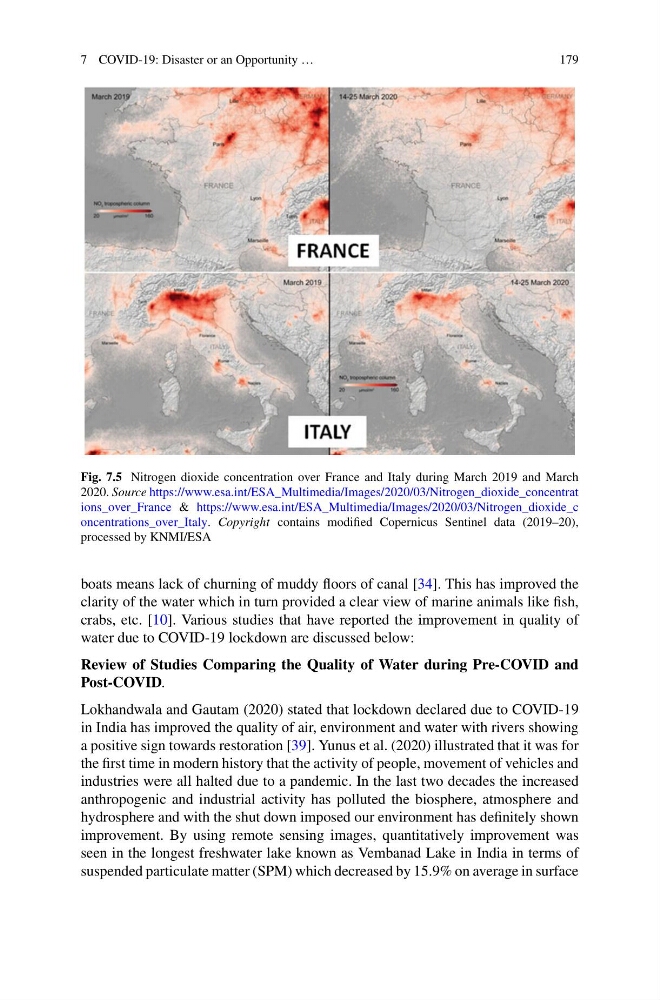
Fig. 7.5 Nitrogen dioxide concentration over France and Italy during March 2019 and March
2020. Source https://www.esa.int/ESA_Multimedia/Images/2020/03/Nitrogen_dioxide_concentrat
ions_over_France & https://www.esa.int/ESA_Multimedia/Images/2020/03/Nitrogen_dioxide_c
oncentrations_over_Italy. Copyright contains modified Copernicus Sentinel data (2019–20),
processed by KNMI/ESA
boats means lack of churning of muddy floors of canal [34]. This has improved the
clarity of the water which in turn provided a clear view of marine animals like fish,
crabs, etc. [10]. Various studies that have reported the improvement in quality of
water due to COVID-19 lockdown are discussed below:
Review of Studies Comparing the Quality of Water during Pre-COVID and
Post-COVID.
Lokhandwala and Gautam (2020) stated that lockdown declared due to COVID-19
in India has improved the quality of air, environment and water with rivers showing
a positive sign towards restoration [39]. Yunus et al. (2020) illustrated that it was for
the first time in modern history that the activity of people, movement of vehicles and
industries were all halted due to a pandemic. In the last two decades the increased
anthropogenic and industrial activity has polluted the biosphere, atmosphere and
hydrosphere and with the shut down imposed our environment has definitely shown
improvement. By using remote sensing images, quantitatively improvement was
seen in the longest freshwater lake known as Vembanad Lake in India in terms of
suspended particulate matter (SPM) which decreased by 15.9% on average in surface
179
Fig. 7.5 Nitrogen dioxide concentration over France and Italy during March 2019 and March
2020. Source https://www.esa.int/ESA_Multimedia/Images/2020/03/Nitrogen_dioxide_concentrat
ions_over_France & https://www.esa.int/ESA_Multimedia/Images/2020/03/Nitrogen_dioxide_c
oncentrations_over_Italy. Copyright contains modified Copernicus Sentinel data (2019–20),
processed by KNMI/ESA
boats means lack of churning of muddy floors of canal [34]. This has improved the
clarity of the water which in turn provided a clear view of marine animals like fish,
crabs, etc. [10]. Various studies that have reported the improvement in quality of
water due to COVID-19 lockdown are discussed below:
Review of Studies Comparing the Quality of Water during Pre-COVID and
Post-COVID.
Lokhandwala and Gautam (2020) stated that lockdown declared due to COVID-19
in India has improved the quality of air, environment and water with rivers showing
a positive sign towards restoration [39]. Yunus et al. (2020) illustrated that it was for
the first time in modern history that the activity of people, movement of vehicles and
industries were all halted due to a pandemic. In the last two decades the increased
anthropogenic and industrial activity has polluted the biosphere, atmosphere and
hydrosphere and with the shut down imposed our environment has definitely shown
improvement. By using remote sensing images, quantitatively improvement was
seen in the longest freshwater lake known as Vembanad Lake in India in terms of
suspended particulate matter (SPM) which decreased by 15.9% on average in surface