

174
A. Chauhan
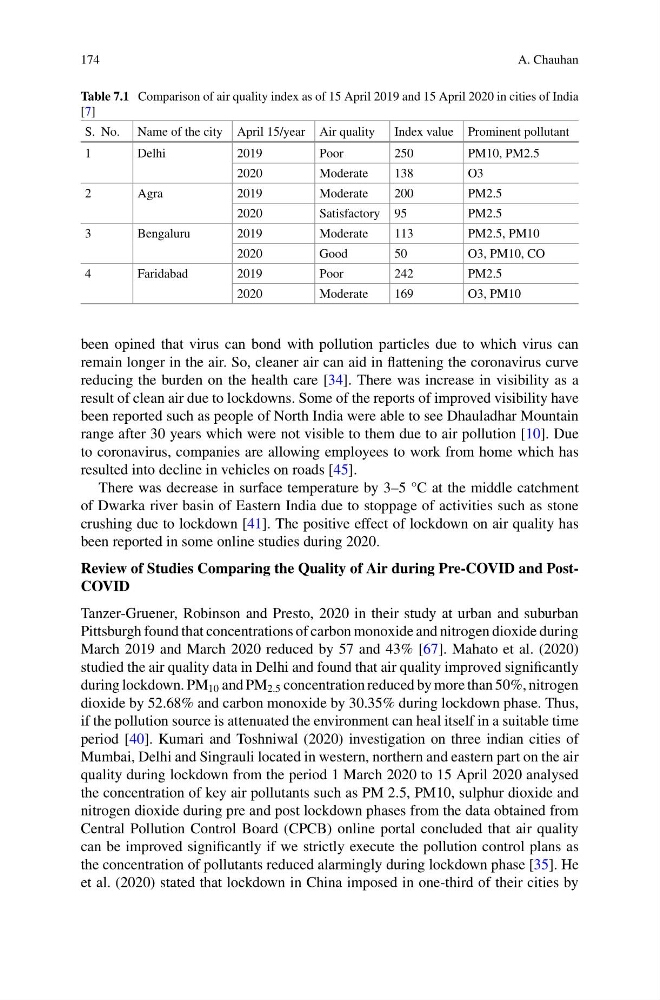
Table 7.1 Comparison of air quality index as of 15 April 2019 and 15 April 2020 in cities of India
[7]
S. No. Name of the city April 15/year Air quality
Index value Prominent pollutant
1
Delhi
2019
Poor
250
PM10, PM2.5
2020
Moderate
138
O3
2
Agra
2019
Moderate
200
PM2.5
2020
Satisfactory 95
PM2.5
3
Bengaluru
2019
Moderate
113
PM2.5, PM10
2020
Good
50
O3, PM10, CO
4
Faridabad
2019
Poor
242
PM2.5
2020
Moderate
169
O3, PM10
been opined that virus can bond with pollution particles due to which virus can
remain longer in the air. So, cleaner air can aid in flattening the coronavirus curve
reducing the burden on the health care [34]. There was increase in visibility as a
result of clean air due to lockdowns. Some of the reports of improved visibility have
been reported such as people of North India were able to see Dhauladhar Mountain
range after 30 years which were not visible to them due to air pollution [10]. Due
to coronavirus, companies are allowing employees to work from home which has
resulted into decline in vehicles on roads [45].
There was decrease in surface temperature by 3–5 °C at the middle catchment
of Dwarka river basin of Eastern India due to stoppage of activities such as stone
crushing due to lockdown [41]. The positive effect of lockdown on air quality has
been reported in some online studies during 2020.
Review of Studies Comparing the Quality of Air during Pre-COVID and PostCOVID
Tanzer-Gruener, Robinson and Presto, 2020 in their study at urban and suburban
Pittsburgh found that concentrations of carbon monoxide and nitrogen dioxide during
March 2019 and March 2020 reduced by 57 and 43% [67]. Mahato et al. (2020)
studied the air quality data in Delhi and found that air quality improved significantly
during lockdown. PM 10 and PM 2.5 concentration reduced by more than 50%, nitrogen
dioxide by 52.68% and carbon monoxide by 30.35% during lockdown phase. Thus,
if the pollution source is attenuated the environment can heal itself in a suitable time
period [40]. Kumari and Toshniwal (2020) investigation on three indian cities of
Mumbai, Delhi and Singrauli located in western, northern and eastern part on the air
quality during lockdown from the period 1 March 2020 to 15 April 2020 analysed
the concentration of key air pollutants such as PM 2.5, PM10, sulphur dioxide and
nitrogen dioxide during pre and post lockdown phases from the data obtained from
Central Pollution Control Board (CPCB) online portal concluded that air quality
can be improved significantly if we strictly execute the pollution control plans as
the concentration of pollutants reduced alarmingly during lockdown phase [35]. He
et al. (2020) stated that lockdown in China imposed in one-third of their cities by
A. Chauhan
Table 7.1 Comparison of air quality index as of 15 April 2019 and 15 April 2020 in cities of India
[7]
S. No. Name of the city April 15/year Air quality
Index value Prominent pollutant
1
Delhi
2019
Poor
250
PM10, PM2.5
2020
Moderate
138
O3
2
Agra
2019
Moderate
200
PM2.5
2020
Satisfactory 95
PM2.5
3
Bengaluru
2019
Moderate
113
PM2.5, PM10
2020
Good
50
O3, PM10, CO
4
Faridabad
2019
Poor
242
PM2.5
2020
Moderate
169
O3, PM10
been opined that virus can bond with pollution particles due to which virus can
remain longer in the air. So, cleaner air can aid in flattening the coronavirus curve
reducing the burden on the health care [34]. There was increase in visibility as a
result of clean air due to lockdowns. Some of the reports of improved visibility have
been reported such as people of North India were able to see Dhauladhar Mountain
range after 30 years which were not visible to them due to air pollution [10]. Due
to coronavirus, companies are allowing employees to work from home which has
resulted into decline in vehicles on roads [45].
There was decrease in surface temperature by 3–5 °C at the middle catchment
of Dwarka river basin of Eastern India due to stoppage of activities such as stone
crushing due to lockdown [41]. The positive effect of lockdown on air quality has
been reported in some online studies during 2020.
Review of Studies Comparing the Quality of Air during Pre-COVID and PostCOVID
Tanzer-Gruener, Robinson and Presto, 2020 in their study at urban and suburban
Pittsburgh found that concentrations of carbon monoxide and nitrogen dioxide during
March 2019 and March 2020 reduced by 57 and 43% [67]. Mahato et al. (2020)
studied the air quality data in Delhi and found that air quality improved significantly
during lockdown. PM 10 and PM 2.5 concentration reduced by more than 50%, nitrogen
dioxide by 52.68% and carbon monoxide by 30.35% during lockdown phase. Thus,
if the pollution source is attenuated the environment can heal itself in a suitable time
period [40]. Kumari and Toshniwal (2020) investigation on three indian cities of
Mumbai, Delhi and Singrauli located in western, northern and eastern part on the air
quality during lockdown from the period 1 March 2020 to 15 April 2020 analysed
the concentration of key air pollutants such as PM 2.5, PM10, sulphur dioxide and
nitrogen dioxide during pre and post lockdown phases from the data obtained from
Central Pollution Control Board (CPCB) online portal concluded that air quality
can be improved significantly if we strictly execute the pollution control plans as
the concentration of pollutants reduced alarmingly during lockdown phase [35]. He
et al. (2020) stated that lockdown in China imposed in one-third of their cities by