

158
R. S. Sharma et al.
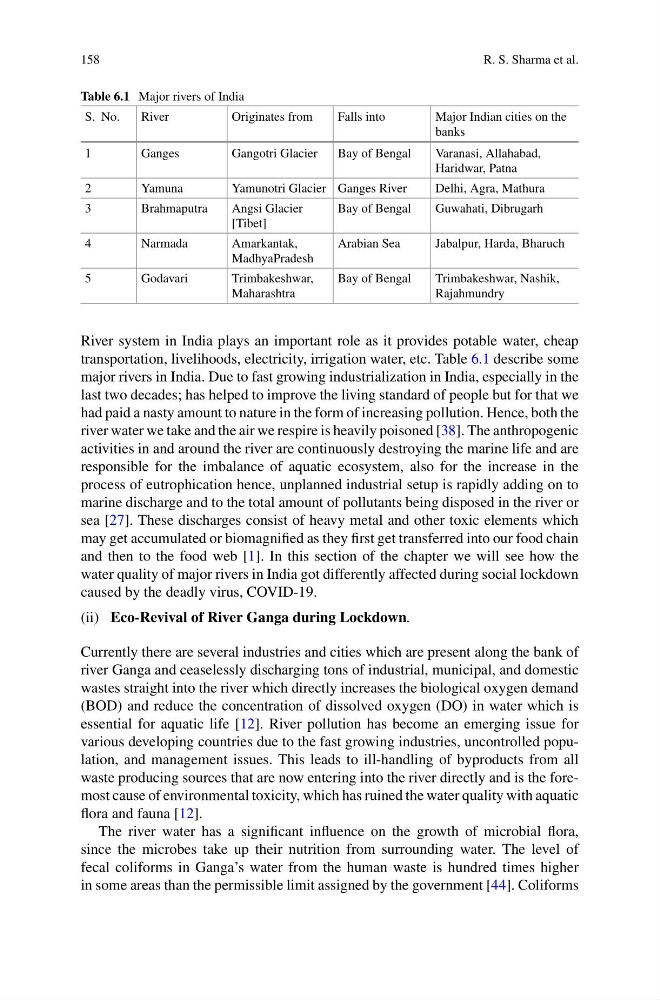
Table 6.1 Major rivers of India
S. No.
River
Originates from
Falls into
Major Indian cities on the
banks
1
Ganges
Gangotri Glacier
Bay of Bengal
Varanasi, Allahabad,
Haridwar, Patna
2
Yamuna
Yamunotri Glacier Ganges River
Delhi, Agra, Mathura
3
Brahmaputra
Angsi Glacier
[Tibet]
Bay of Bengal
Guwahati, Dibrugarh
4
Narmada
Amarkantak,
MadhyaPradesh
Arabian Sea
Jabalpur, Harda, Bharuch
5
Godavari
Trimbakeshwar,
Maharashtra
Bay of Bengal
Trimbakeshwar, Nashik,
Rajahmundry
River system in India plays an important role as it provides potable water, cheap
transportation, livelihoods, electricity, irrigation water, etc. Table 6.1 describe some
major rivers in India. Due to fast growing industrialization in India, especially in the
last two decades; has helped to improve the living standard of people but for that we
had paid a nasty amount to nature in the form of increasing pollution. Hence, both the
river water we take and the air we respire is heavily poisoned [38]. The anthropogenic
activities in and around the river are continuously destroying the marine life and are
responsible for the imbalance of aquatic ecosystem, also for the increase in the
process of eutrophication hence, unplanned industrial setup is rapidly adding on to
marine discharge and to the total amount of pollutants being disposed in the river or
sea [27]. These discharges consist of heavy metal and other toxic elements which
may get accumulated or biomagnified as they first get transferred into our food chain
and then to the food web [1]. In this section of the chapter we will see how the
water quality of major rivers in India got differently affected during social lockdown
caused by the deadly virus, COVID-19.
(ii) Eco-Revival of River Ganga during Lockdown.
Currently there are several industries and cities which are present along the bank of
river Ganga and ceaselessly discharging tons of industrial, municipal, and domestic
wastes straight into the river which directly increases the biological oxygen demand
(BOD) and reduce the concentration of dissolved oxygen (DO) in water which is
essential for aquatic life [12]. River pollution has become an emerging issue for
various developing countries due to the fast growing industries, uncontrolled population, and management issues. This leads to ill-handling of byproducts from all
waste producing sources that are now entering into the river directly and is the foremost cause of environmental toxicity, which has ruined the water quality with aquatic
flora and fauna [12].
The river water has a significant influence on the growth of microbial flora,
since the microbes take up their nutrition from surrounding water. The level of
fecal coliforms in Ganga’s water from the human waste is hundred times higher
in some areas than the permissible limit assigned by the government [44]. Coliforms
R. S. Sharma et al.
Table 6.1 Major rivers of India
S. No.
River
Originates from
Falls into
Major Indian cities on the
banks
1
Ganges
Gangotri Glacier
Bay of Bengal
Varanasi, Allahabad,
Haridwar, Patna
2
Yamuna
Yamunotri Glacier Ganges River
Delhi, Agra, Mathura
3
Brahmaputra
Angsi Glacier
[Tibet]
Bay of Bengal
Guwahati, Dibrugarh
4
Narmada
Amarkantak,
MadhyaPradesh
Arabian Sea
Jabalpur, Harda, Bharuch
5
Godavari
Trimbakeshwar,
Maharashtra
Bay of Bengal
Trimbakeshwar, Nashik,
Rajahmundry
River system in India plays an important role as it provides potable water, cheap
transportation, livelihoods, electricity, irrigation water, etc. Table 6.1 describe some
major rivers in India. Due to fast growing industrialization in India, especially in the
last two decades; has helped to improve the living standard of people but for that we
had paid a nasty amount to nature in the form of increasing pollution. Hence, both the
river water we take and the air we respire is heavily poisoned [38]. The anthropogenic
activities in and around the river are continuously destroying the marine life and are
responsible for the imbalance of aquatic ecosystem, also for the increase in the
process of eutrophication hence, unplanned industrial setup is rapidly adding on to
marine discharge and to the total amount of pollutants being disposed in the river or
sea [27]. These discharges consist of heavy metal and other toxic elements which
may get accumulated or biomagnified as they first get transferred into our food chain
and then to the food web [1]. In this section of the chapter we will see how the
water quality of major rivers in India got differently affected during social lockdown
caused by the deadly virus, COVID-19.
(ii) Eco-Revival of River Ganga during Lockdown.
Currently there are several industries and cities which are present along the bank of
river Ganga and ceaselessly discharging tons of industrial, municipal, and domestic
wastes straight into the river which directly increases the biological oxygen demand
(BOD) and reduce the concentration of dissolved oxygen (DO) in water which is
essential for aquatic life [12]. River pollution has become an emerging issue for
various developing countries due to the fast growing industries, uncontrolled population, and management issues. This leads to ill-handling of byproducts from all
waste producing sources that are now entering into the river directly and is the foremost cause of environmental toxicity, which has ruined the water quality with aquatic
flora and fauna [12].
The river water has a significant influence on the growth of microbial flora,
since the microbes take up their nutrition from surrounding water. The level of
fecal coliforms in Ganga’s water from the human waste is hundred times higher
in some areas than the permissible limit assigned by the government [44]. Coliforms