

5 The Dual Impact of Lockdown on Curbing COVID-19 Spread …
129
It is the process which expresses this polynomial factorisation property with p =
p
− d, and is given by:
(1 −
p
i=1
ϕ i L
i
) · (1 − L)
d
· X t = (1 +
q
i=1
θ i L
i
)ε t
So at a particular case in the ARMA ( p + d, q) model, having an autoregressive
equation of polynomial consisting d unit-roots the equation becomes:
(1 −
p
i=1
ϕ i L
i
) · (1 − L)
d
· X t = δ + (1 +
q
i=1
θ i L
i
)ε t
Here, AR means autoregression means the relationship between dependent variables and lags observation is taken into account. Integrating means to understand the
difference and implementing it to make series stationery. It is represented as ARIMA
(p, d, q) where p is lag order, d is the degree of difference and q is the order of MA.
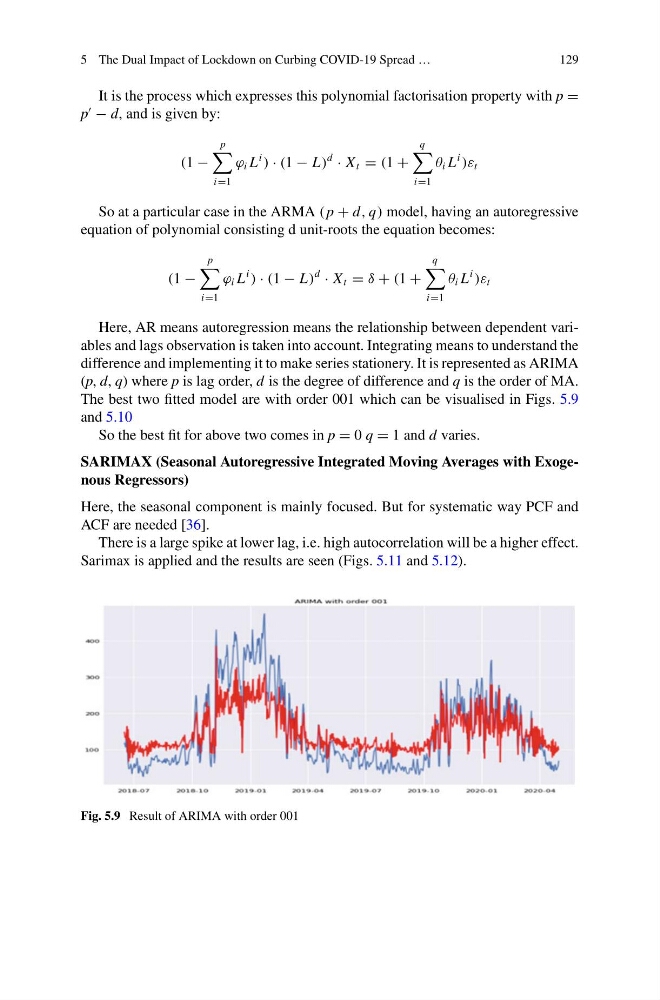
The best two fitted model are with order 001 which can be visualised in Figs. 5.9
and 5.10
So the best fit for above two comes in p = 0 q = 1 and d varies.
SARIMAX (Seasonal Autoregressive Integrated Moving Averages with Exogenous Regressors)
Here, the seasonal component is mainly focused. But for systematic way PCF and
ACF are needed [36].
There is a large spike at lower lag, i.e. high autocorrelation will be a higher effect.
Sarimax is applied and the results are seen (Figs. 5.11 and 5.12).
Fig. 5.9 Result of ARIMA with order 001
129
It is the process which expresses this polynomial factorisation property with p =
p
− d, and is given by:
(1 −
p
i=1
ϕ i L
i
) · (1 − L)
d
· X t = (1 +
q
i=1
θ i L
i
)ε t
So at a particular case in the ARMA ( p + d, q) model, having an autoregressive
equation of polynomial consisting d unit-roots the equation becomes:
(1 −
p
i=1
ϕ i L
i
) · (1 − L)
d
· X t = δ + (1 +
q
i=1
θ i L
i
)ε t
Here, AR means autoregression means the relationship between dependent variables and lags observation is taken into account. Integrating means to understand the
difference and implementing it to make series stationery. It is represented as ARIMA
(p, d, q) where p is lag order, d is the degree of difference and q is the order of MA.
The best two fitted model are with order 001 which can be visualised in Figs. 5.9
and 5.10
So the best fit for above two comes in p = 0 q = 1 and d varies.
SARIMAX (Seasonal Autoregressive Integrated Moving Averages with Exogenous Regressors)
Here, the seasonal component is mainly focused. But for systematic way PCF and
ACF are needed [36].
There is a large spike at lower lag, i.e. high autocorrelation will be a higher effect.
Sarimax is applied and the results are seen (Figs. 5.11 and 5.12).
Fig. 5.9 Result of ARIMA with order 001