

is clear, purified water (Milli-Q or similar) can be used for
dilutions and blank measurements. If the growth medium
contains salt, remember to add same amount of salt to the
purified water.
6. The measured NR fluorescence is always relative and systemspecific. Thus, for absolute quantification of lipids with the NR
method, a calibration step (i.e., connecting fluorescence values
with actual lipid concentration) is needed.
7. Always check with microscopy or imaging flow cytometry,
whether cells stay intact during staining. If cells break, decrease
the dye and/or solvent concentration.
8. A commonly used wavelength combination is ~530/580 nm.
9. Mix the sample every ~2 min, to keep the cells in suspension.
10. Due to spectral overlapping, NR also fluoresces in water at the
optimal wavelengths. To get the final proxy for neutral lipids,
extract the NR background fluorescence from the NR fluorescence value measured from the culture samples, and take into
account the possible dilution factor.
11. If the measured NR fluorescence stays stable for some time at
the maximum value, it is not so crucial to apply the exact same
staining time for every sample. Instead, hitting a certain time
window is sufficient to get comparable results.
12. Also, heating the cells, e.g., with microwave treatment, has
been suggested for enhancing NR penetration [13].
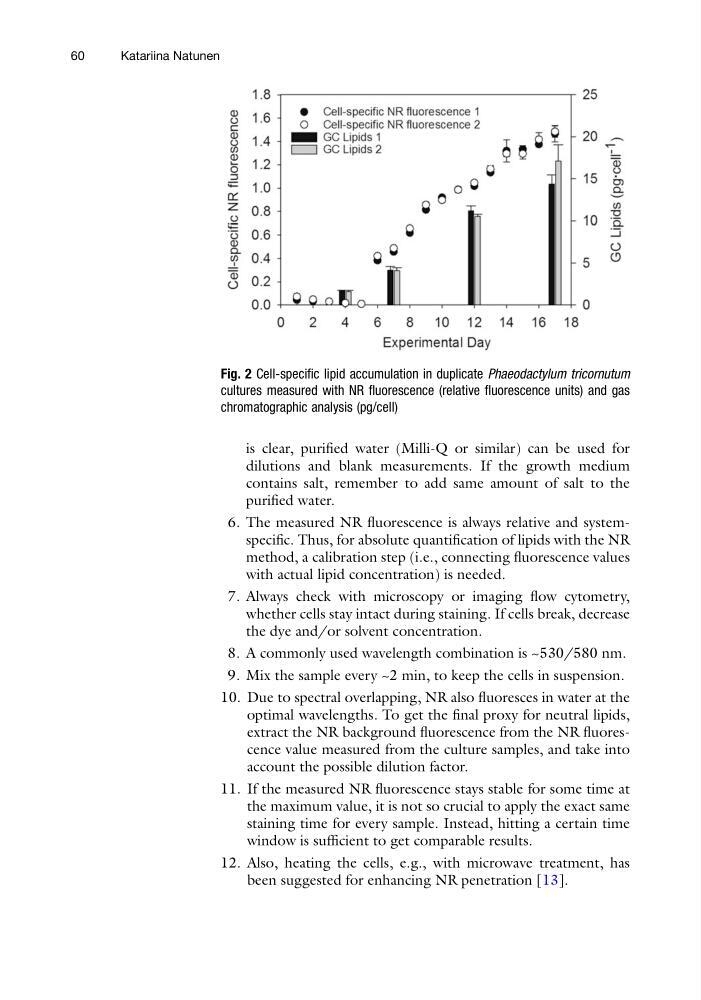
Fig. 2 Cell-specific lipid accumulation in duplicate Phaeodactylum tricornutum
cultures measured with NR fluorescence (relative fluorescence units) and gas
chromatographic analysis (pg/cell)
60
Katariina Natunen
dilutions and blank measurements. If the growth medium
contains salt, remember to add same amount of salt to the
purified water.
6. The measured NR fluorescence is always relative and systemspecific. Thus, for absolute quantification of lipids with the NR
method, a calibration step (i.e., connecting fluorescence values
with actual lipid concentration) is needed.
7. Always check with microscopy or imaging flow cytometry,
whether cells stay intact during staining. If cells break, decrease
the dye and/or solvent concentration.
8. A commonly used wavelength combination is ~530/580 nm.
9. Mix the sample every ~2 min, to keep the cells in suspension.
10. Due to spectral overlapping, NR also fluoresces in water at the
optimal wavelengths. To get the final proxy for neutral lipids,
extract the NR background fluorescence from the NR fluorescence value measured from the culture samples, and take into
account the possible dilution factor.
11. If the measured NR fluorescence stays stable for some time at
the maximum value, it is not so crucial to apply the exact same
staining time for every sample. Instead, hitting a certain time
window is sufficient to get comparable results.
12. Also, heating the cells, e.g., with microwave treatment, has
been suggested for enhancing NR penetration [13].
Fig. 2 Cell-specific lipid accumulation in duplicate Phaeodactylum tricornutum
cultures measured with NR fluorescence (relative fluorescence units) and gas
chromatographic analysis (pg/cell)
60
Katariina Natunen