

5. DCMU (3-(3,4-dichlorophenyl)-1,1-dimethylurea).
6. Ethanol (96%).
7. An alternative to using a standard fluorescence spectrophotometer and DCMU is to use a variable fluorometer (PAM or FRRF).
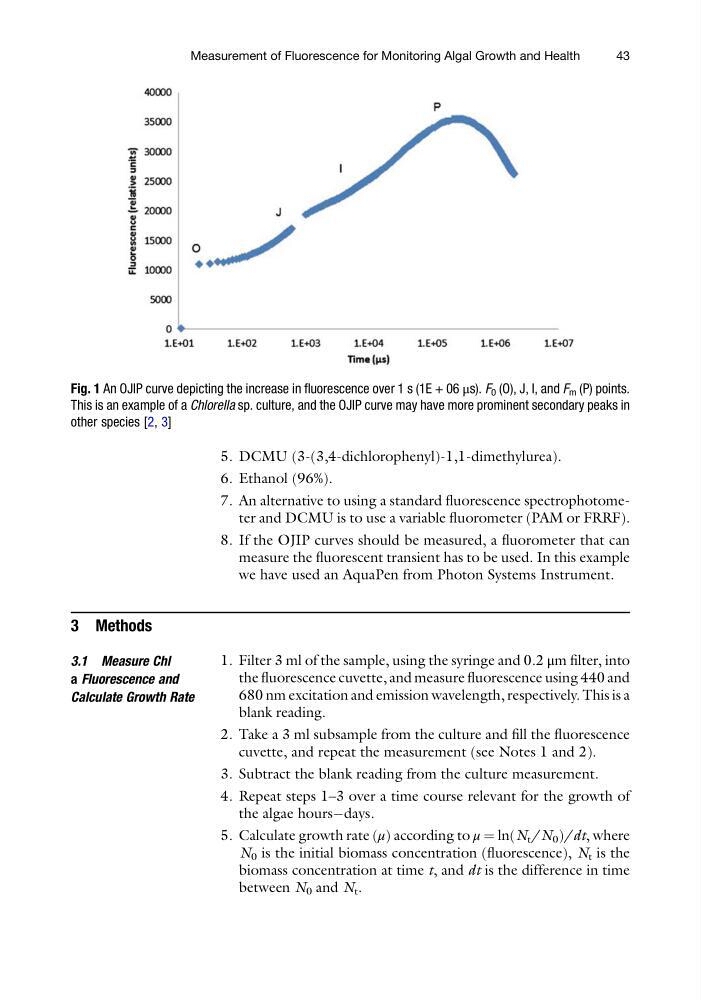
8. If the OJIP curves should be measured, a fluorometer that can
measure the fluorescent transient has to be used. In this example
we have used an AquaPen from Photon Systems Instrument.
3 Methods
3.1 Measure Chl
a Fluorescence and
Calculate Growth Rate
1. Filter 3 ml of the sample, using the syringe and 0.2 μm filter, into
the fluorescence cuvette, and measure fluorescence using 440 and
680 nm excitation and emission wavelength, respectively. This is a
blank reading.
2. Take a 3 ml subsample from the culture and fill the fluorescence
cuvette, and repeat the measurement (see Notes 1 and 2).
3. Subtract the blank reading from the culture measurement.
4. Repeat steps 1–3 over a time course relevant for the growth of
the algae hoursÀdays.
5. Calculate growth rate (μ) according to μ ¼ ln(N t /N 0 )/dt, where
N 0 is the initial biomass concentration (fluorescence), N t is the
biomass concentration at time t, and dt is the difference in time
between N 0 and N t .
Fig. 1 An OJIP curve depicting the increase in fluorescence over 1 s (1E + 06 μs). F 0 (O), J, I, and F m (P) points.
This is an example of a Chlorella sp. culture, and the OJIP curve may have more prominent secondary peaks in
other species [2, 3]
Measurement of Fluorescence for Monitoring Algal Growth and Health
43
6. Ethanol (96%).
7. An alternative to using a standard fluorescence spectrophotometer and DCMU is to use a variable fluorometer (PAM or FRRF).
8. If the OJIP curves should be measured, a fluorometer that can
measure the fluorescent transient has to be used. In this example
we have used an AquaPen from Photon Systems Instrument.
3 Methods
3.1 Measure Chl
a Fluorescence and
Calculate Growth Rate
1. Filter 3 ml of the sample, using the syringe and 0.2 μm filter, into
the fluorescence cuvette, and measure fluorescence using 440 and
680 nm excitation and emission wavelength, respectively. This is a
blank reading.
2. Take a 3 ml subsample from the culture and fill the fluorescence
cuvette, and repeat the measurement (see Notes 1 and 2).
3. Subtract the blank reading from the culture measurement.
4. Repeat steps 1–3 over a time course relevant for the growth of
the algae hoursÀdays.
5. Calculate growth rate (μ) according to μ ¼ ln(N t /N 0 )/dt, where
N 0 is the initial biomass concentration (fluorescence), N t is the
biomass concentration at time t, and dt is the difference in time
between N 0 and N t .
Fig. 1 An OJIP curve depicting the increase in fluorescence over 1 s (1E + 06 μs). F 0 (O), J, I, and F m (P) points.
This is an example of a Chlorella sp. culture, and the OJIP curve may have more prominent secondary peaks in
other species [2, 3]
Measurement of Fluorescence for Monitoring Algal Growth and Health
43