

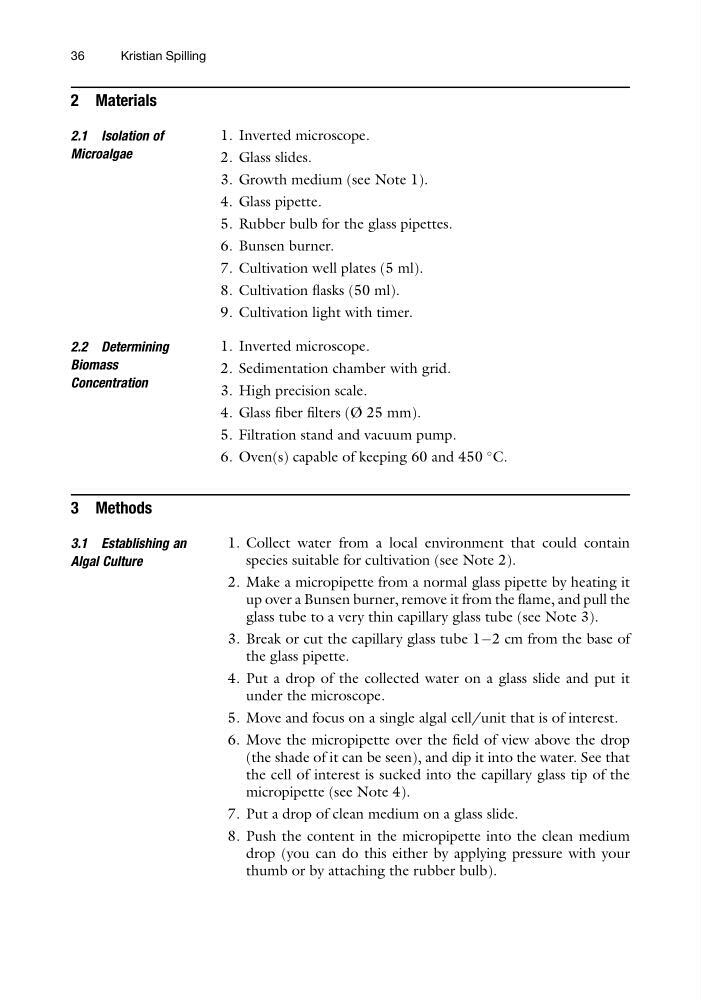
2 Materials
2.1 Isolation of
Microalgae
1. Inverted microscope.
2. Glass slides.
3. Growth medium (see Note 1).
4. Glass pipette.
5. Rubber bulb for the glass pipettes.
6. Bunsen burner.
7. Cultivation well plates (5 ml).
8. Cultivation flasks (50 ml).
9. Cultivation light with timer.
2.2 Determining
Biomass
Concentration
1. Inverted microscope.
2. Sedimentation chamber with grid.
3. High precision scale.
4. Glass fiber filters (Ø 25 mm).
5. Filtration stand and vacuum pump.
6. Oven(s) capable of keeping 60 and 450
C.
3 Methods
3.1 Establishing an
Algal Culture
1. Collect water from a local environment that could contain
species suitable for cultivation (see Note 2).
2. Make a micropipette from a normal glass pipette by heating it
up over a Bunsen burner, remove it from the flame, and pull the
glass tube to a very thin capillary glass tube (see Note 3).
3. Break or cut the capillary glass tube 1À2 cm from the base of
the glass pipette.
4. Put a drop of the collected water on a glass slide and put it
under the microscope.
5. Move and focus on a single algal cell/unit that is of interest.
6. Move the micropipette over the field of view above the drop
(the shade of it can be seen), and dip it into the water. See that
the cell of interest is sucked into the capillary glass tip of the
micropipette (see Note 4).
7. Put a drop of clean medium on a glass slide.
8. Push the content in the micropipette into the clean medium
drop (you can do this either by applying pressure with your
thumb or by attaching the rubber bulb).
36
Kristian Spilling
2.1 Isolation of
Microalgae
1. Inverted microscope.
2. Glass slides.
3. Growth medium (see Note 1).
4. Glass pipette.
5. Rubber bulb for the glass pipettes.
6. Bunsen burner.
7. Cultivation well plates (5 ml).
8. Cultivation flasks (50 ml).
9. Cultivation light with timer.
2.2 Determining
Biomass
Concentration
1. Inverted microscope.
2. Sedimentation chamber with grid.
3. High precision scale.
4. Glass fiber filters (Ø 25 mm).
5. Filtration stand and vacuum pump.
6. Oven(s) capable of keeping 60 and 450
C.
3 Methods
3.1 Establishing an
Algal Culture
1. Collect water from a local environment that could contain
species suitable for cultivation (see Note 2).
2. Make a micropipette from a normal glass pipette by heating it
up over a Bunsen burner, remove it from the flame, and pull the
glass tube to a very thin capillary glass tube (see Note 3).
3. Break or cut the capillary glass tube 1À2 cm from the base of
the glass pipette.
4. Put a drop of the collected water on a glass slide and put it
under the microscope.
5. Move and focus on a single algal cell/unit that is of interest.
6. Move the micropipette over the field of view above the drop
(the shade of it can be seen), and dip it into the water. See that
the cell of interest is sucked into the capillary glass tip of the
micropipette (see Note 4).
7. Put a drop of clean medium on a glass slide.
8. Push the content in the micropipette into the clean medium
drop (you can do this either by applying pressure with your
thumb or by attaching the rubber bulb).
36
Kristian Spilling