

L ¼ v t dark þ t light
À
Á
=l
ð29Þ
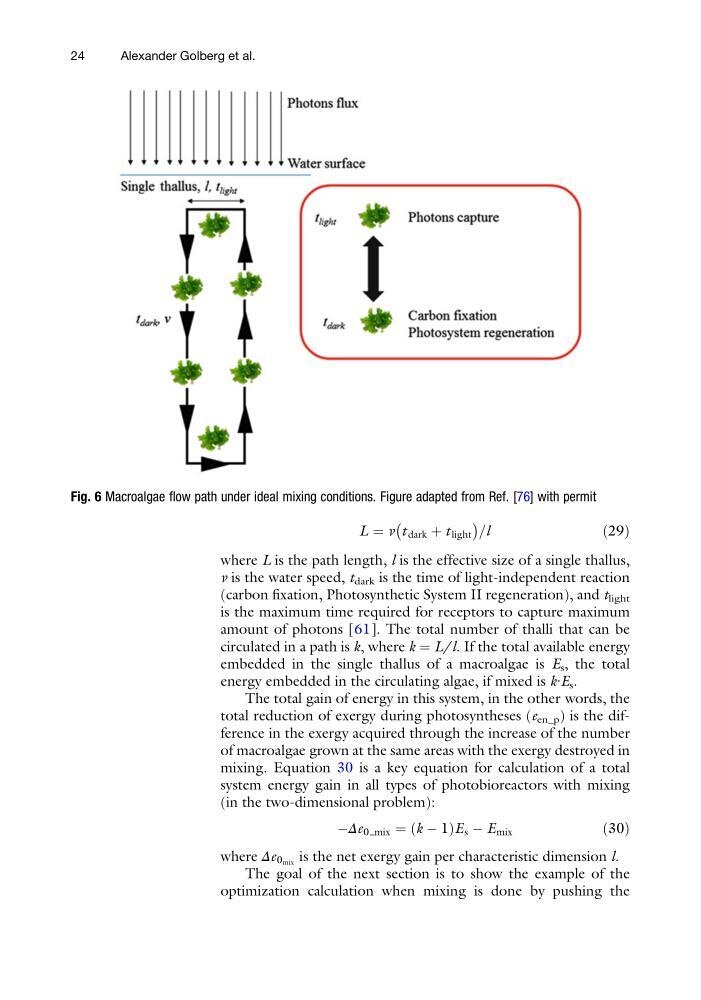
where L is the path length, l is the effective size of a single thallus,
v is the water speed, t dark is the time of light-independent reaction
(carbon fixation, Photosynthetic System II regeneration), and t light
is the maximum time required for receptors to capture maximum
amount of photons [61]. The total number of thalli that can be
circulated in a path is k, where k ¼ L/l. If the total available energy
embedded in the single thallus of a macroalgae is E s , the total
energy embedded in the circulating algae, if mixed is k∙E s .
The total gain of energy in this system, in the other words, the
total reduction of exergy during photosyntheses (e en_p ) is the difference in the exergy acquired through the increase of the number
of macroalgae grown at the same areas with the exergy destroyed in
mixing. Equation 30 is a key equation for calculation of a total
system energy gain in all types of photobioreactors with mixing
(in the two-dimensional problem):
ÀΔe 0 mix ¼ k À 1
ð
ÞE s À E mix
ð30Þ
where Δe 0 mix is the net exergy gain per characteristic dimension l.
The goal of the next section is to show the example of the
optimization calculation when mixing is done by pushing the
Fig. 6 Macroalgae flow path under ideal mixing conditions. Figure adapted from Ref. [76] with permit
24
Alexander Golberg et al.
À
Á
=l
ð29Þ
where L is the path length, l is the effective size of a single thallus,
v is the water speed, t dark is the time of light-independent reaction
(carbon fixation, Photosynthetic System II regeneration), and t light
is the maximum time required for receptors to capture maximum
amount of photons [61]. The total number of thalli that can be
circulated in a path is k, where k ¼ L/l. If the total available energy
embedded in the single thallus of a macroalgae is E s , the total
energy embedded in the circulating algae, if mixed is k∙E s .
The total gain of energy in this system, in the other words, the
total reduction of exergy during photosyntheses (e en_p ) is the difference in the exergy acquired through the increase of the number
of macroalgae grown at the same areas with the exergy destroyed in
mixing. Equation 30 is a key equation for calculation of a total
system energy gain in all types of photobioreactors with mixing
(in the two-dimensional problem):
ÀΔe 0 mix ¼ k À 1
ð
ÞE s À E mix
ð30Þ
where Δe 0 mix is the net exergy gain per characteristic dimension l.
The goal of the next section is to show the example of the
optimization calculation when mixing is done by pushing the
Fig. 6 Macroalgae flow path under ideal mixing conditions. Figure adapted from Ref. [76] with permit
24
Alexander Golberg et al.