

Tyr) that are partially degraded during hydrolysis plus a separate 2 h ammonia hydrolysis is run to determine the NH 3
released from Gln and Asn. Based on the respective amino
acid concentration of the new biomass sample the total nitrogen in the amino acids can be derived and thus form the basis
for the conversion factor calculation. Furthermore, the nitrogen that is not captured in the amino acid portion of the
protein in biomass is considered the nonprotein nitrogen
(NPN) of the biomass, and is taken into account in the utilization of a dedicated factor for algal biomass.
9. Basis for the calculation of a nitrogen-to-protein conversion
factor:
For use in food and feed nutritional analysis, it is suggested to
use a method to determine a useful nitrogen-to-protein conversion factor [12]. It has previously been described in the
literature how to determine upper (k A ) and lower limits (k P )
of such a factor and ultimately suggests combining these into a
single, averaged factor (k). These factors can be easily defined
mathematically as in Eqs. 1 and 2, below, though there are
practical analytical and computational pitfalls to avoid when
calculating these factors.
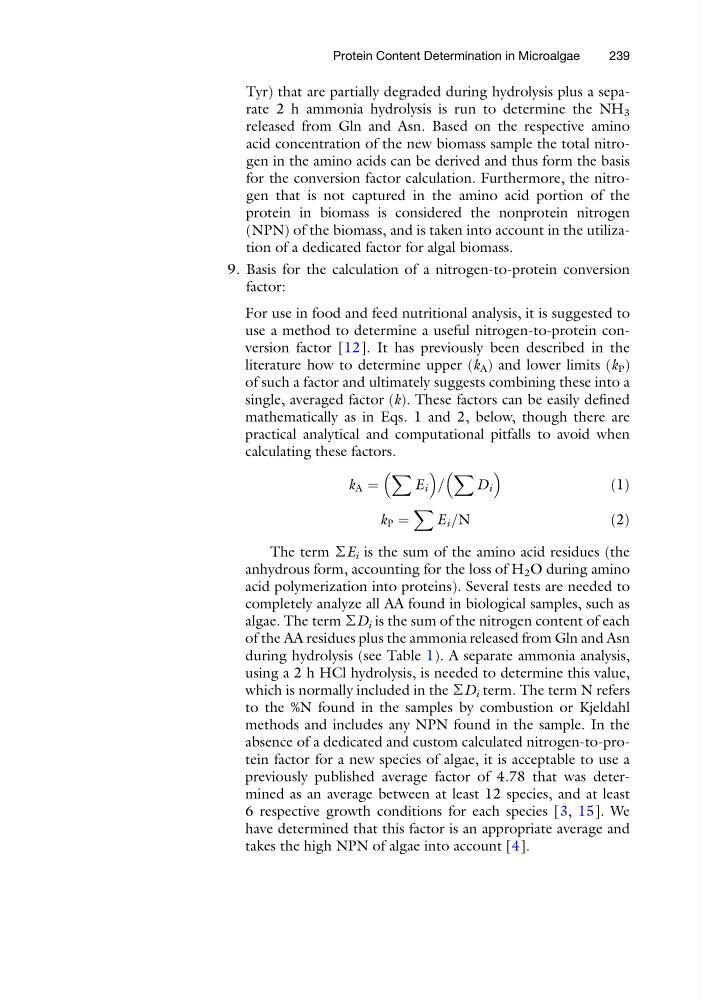
k A ¼
X E i
=
X D i
ð1Þ
k P ¼
X E i =N
ð2Þ
The term ∑E i is the sum of the amino acid residues (the
anhydrous form, accounting for the loss of H 2 O during amino
acid polymerization into proteins). Several tests are needed to
completely analyze all AA found in biological samples, such as
algae. The term ∑D i is the sum of the nitrogen content of each
of the AA residues plus the ammonia released from Gln and Asn
during hydrolysis (see Table 1). A separate ammonia analysis,
using a 2 h HCl hydrolysis, is needed to determine this value,
which is normally included in the ∑D i term. The term N refers
to the %N found in the samples by combustion or Kjeldahl
methods and includes any NPN found in the sample. In the
absence of a dedicated and custom calculated nitrogen-to-protein factor for a new species of algae, it is acceptable to use a
previously published average factor of 4.78 that was determined as an average between at least 12 species, and at least
6 respective growth conditions for each species [3, 15]. We
have determined that this factor is an appropriate average and
takes the high NPN of algae into account [4].
Protein Content Determination in Microalgae
239
released from Gln and Asn. Based on the respective amino
acid concentration of the new biomass sample the total nitrogen in the amino acids can be derived and thus form the basis
for the conversion factor calculation. Furthermore, the nitrogen that is not captured in the amino acid portion of the
protein in biomass is considered the nonprotein nitrogen
(NPN) of the biomass, and is taken into account in the utilization of a dedicated factor for algal biomass.
9. Basis for the calculation of a nitrogen-to-protein conversion
factor:
For use in food and feed nutritional analysis, it is suggested to
use a method to determine a useful nitrogen-to-protein conversion factor [12]. It has previously been described in the
literature how to determine upper (k A ) and lower limits (k P )
of such a factor and ultimately suggests combining these into a
single, averaged factor (k). These factors can be easily defined
mathematically as in Eqs. 1 and 2, below, though there are
practical analytical and computational pitfalls to avoid when
calculating these factors.
k A ¼
X E i
=
X D i
ð1Þ
k P ¼
X E i =N
ð2Þ
The term ∑E i is the sum of the amino acid residues (the
anhydrous form, accounting for the loss of H 2 O during amino
acid polymerization into proteins). Several tests are needed to
completely analyze all AA found in biological samples, such as
algae. The term ∑D i is the sum of the nitrogen content of each
of the AA residues plus the ammonia released from Gln and Asn
during hydrolysis (see Table 1). A separate ammonia analysis,
using a 2 h HCl hydrolysis, is needed to determine this value,
which is normally included in the ∑D i term. The term N refers
to the %N found in the samples by combustion or Kjeldahl
methods and includes any NPN found in the sample. In the
absence of a dedicated and custom calculated nitrogen-to-protein factor for a new species of algae, it is acceptable to use a
previously published average factor of 4.78 that was determined as an average between at least 12 species, and at least
6 respective growth conditions for each species [3, 15]. We
have determined that this factor is an appropriate average and
takes the high NPN of algae into account [4].
Protein Content Determination in Microalgae
239