

3. Microalgal biomass: weigh between 5 and 10 mg of sample into
the labeled and pre-weighed GC vials. Record the weight to the
nearest 0.1 mg (see Note 2).
4. Dry samples in vials overnight to obtain an ovendry weight
before proceeding with the transesterification (see Note 3).
3.2 Transesterification Reaction
1. Preheat a digital dry block, or equivalent, to 85 Æ 3
C
(see Note 4).
2. While the block is preheating, add the following to each of the
sample vials in this order: 25 μL of the prepared ~10 mg/mL
C13:0ME internal standard using a gas-tight syringe (see
Notes 5 and 6), 200 μL of 2:1 chloroform/methanol using a
gas-tight syringe, and 300 μL of 0.6 M HCl/methanol using a
pipet with a plastic or glass-pipet tip. Do not use metal syringes
for the HCl/methanol mixture.
3. Seal all vials with PTFE/silicone/PTFE crimp caps, and vortex
well to mix the contents (see Note 7).
4. Place the sealed sample vials into the preheated block at 85
C
for 1 h (see Note 8).
5. After 1 h on the digital dry block, remove the vials, and cool for
at least 15 min, but no longer than an hour, at room temperature (see Note 9).
3.3 Isolation and
Preparation of Sample
FAME for GC Analysis
1. After samples have reached room temperature, add 1 mL of
HPLC grade n-hexane to each of the vials using a gas-tight
syringe (see Note 10).
2. Vortex well to mix the vial contents, and let vials stand undisturbed at room temperature for at least 1 h, but no more than
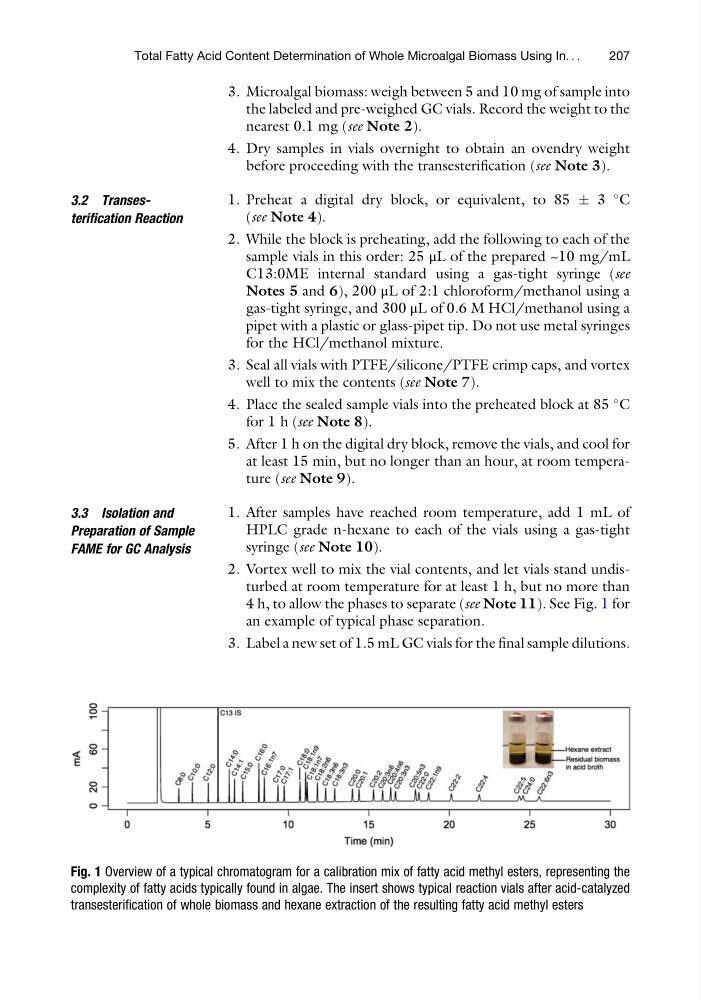
4 h, to allow the phases to separate (see Note 11). See Fig. 1 for
an example of typical phase separation.
3. Label a new set of 1.5 mL GC vials for the final sample dilutions.
Fig. 1 Overview of a typical chromatogram for a calibration mix of fatty acid methyl esters, representing the
complexity of fatty acids typically found in algae. The insert shows typical reaction vials after acid-catalyzed
transesterification of whole biomass and hexane extraction of the resulting fatty acid methyl esters
Total Fatty Acid Content Determination of Whole Microalgal Biomass Using In. . .
207
the labeled and pre-weighed GC vials. Record the weight to the
nearest 0.1 mg (see Note 2).
4. Dry samples in vials overnight to obtain an ovendry weight
before proceeding with the transesterification (see Note 3).
3.2 Transesterification Reaction
1. Preheat a digital dry block, or equivalent, to 85 Æ 3
C
(see Note 4).
2. While the block is preheating, add the following to each of the
sample vials in this order: 25 μL of the prepared ~10 mg/mL
C13:0ME internal standard using a gas-tight syringe (see
Notes 5 and 6), 200 μL of 2:1 chloroform/methanol using a
gas-tight syringe, and 300 μL of 0.6 M HCl/methanol using a
pipet with a plastic or glass-pipet tip. Do not use metal syringes
for the HCl/methanol mixture.
3. Seal all vials with PTFE/silicone/PTFE crimp caps, and vortex
well to mix the contents (see Note 7).
4. Place the sealed sample vials into the preheated block at 85
C
for 1 h (see Note 8).
5. After 1 h on the digital dry block, remove the vials, and cool for
at least 15 min, but no longer than an hour, at room temperature (see Note 9).
3.3 Isolation and
Preparation of Sample
FAME for GC Analysis
1. After samples have reached room temperature, add 1 mL of
HPLC grade n-hexane to each of the vials using a gas-tight
syringe (see Note 10).
2. Vortex well to mix the vial contents, and let vials stand undisturbed at room temperature for at least 1 h, but no more than
4 h, to allow the phases to separate (see Note 11). See Fig. 1 for
an example of typical phase separation.
3. Label a new set of 1.5 mL GC vials for the final sample dilutions.
Fig. 1 Overview of a typical chromatogram for a calibration mix of fatty acid methyl esters, representing the
complexity of fatty acids typically found in algae. The insert shows typical reaction vials after acid-catalyzed
transesterification of whole biomass and hexane extraction of the resulting fatty acid methyl esters
Total Fatty Acid Content Determination of Whole Microalgal Biomass Using In. . .
207