

manipulating this pathway [1, 17]. Therefore, accurate identification of specific pathways in a given phylogenetic group of algae is
strictly required to improve its lipid production yield through
metabolic and genetic engineering [22, 23].
The main steps of lipid biogenesis in microalgae are
(a) carboxylation of acetyl CoA to malonyl-CoA by acetyl CoA
carboxylase (ACCase) that is regarded as the first committed step
in fatty acid biosynthesis, (b) fatty acid production through series of
reactions catalyzed by type-II fatty acid synthase (FAS), and finally
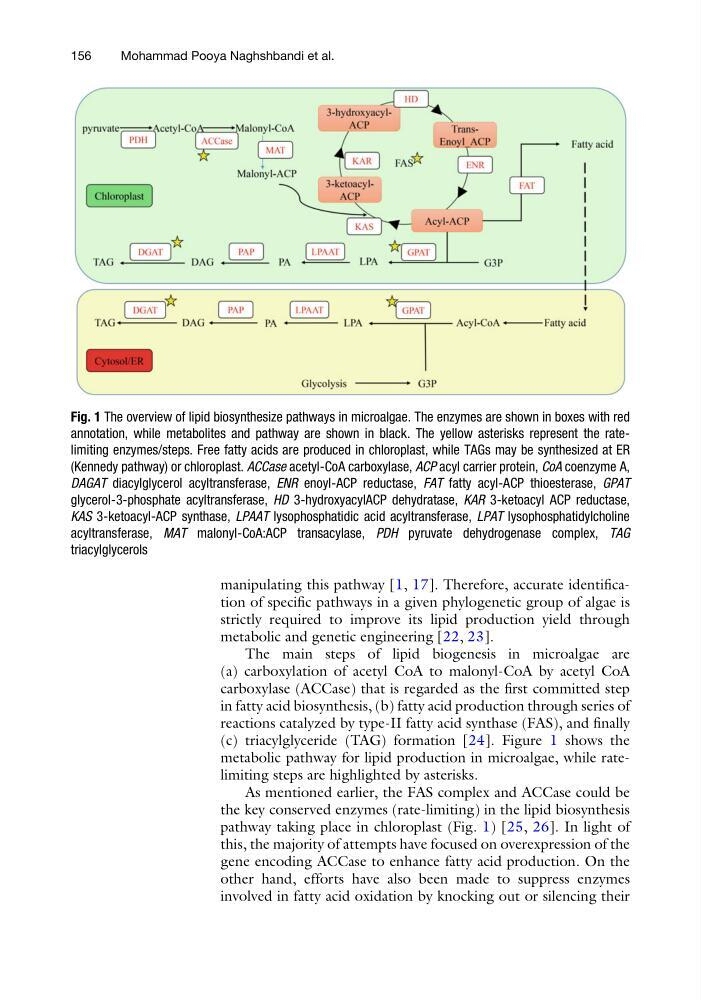
(c) triacylglyceride (TAG) formation [24]. Figure 1 shows the
metabolic pathway for lipid production in microalgae, while ratelimiting steps are highlighted by asterisks.
As mentioned earlier, the FAS complex and ACCase could be
the key conserved enzymes (rate-limiting) in the lipid biosynthesis
pathway taking place in chloroplast (Fig. 1) [25, 26]. In light of
this, the majority of attempts have focused on overexpression of the
gene encoding ACCase to enhance fatty acid production. On the
other hand, efforts have also been made to suppress enzymes
involved in fatty acid oxidation by knocking out or silencing their
Fig. 1 The overview of lipid biosynthesize pathways in microalgae. The enzymes are shown in boxes with red
annotation, while metabolites and pathway are shown in black. The yellow asterisks represent the ratelimiting enzymes/steps. Free fatty acids are produced in chloroplast, while TAGs may be synthesized at ER
(Kennedy pathway) or chloroplast. ACCase acetyl-CoA carboxylase, ACP acyl carrier protein, CoA coenzyme A,
DAGAT diacylglycerol acyltransferase, ENR enoyl-ACP reductase, FAT fatty acyl-ACP thioesterase, GPAT
glycerol-3-phosphate acyltransferase, HD 3-hydroxyacylACP dehydratase, KAR 3-ketoacyl ACP reductase,
KAS 3-ketoacyl-ACP synthase, LPAAT lysophosphatidic acid acyltransferase, LPAT lysophosphatidylcholine
acyltransferase, MAT malonyl-CoA:ACP transacylase, PDH pyruvate dehydrogenase complex, TAG
triacylglycerols
156
Mohammad Pooya Naghshbandi et al.
strictly required to improve its lipid production yield through
metabolic and genetic engineering [22, 23].
The main steps of lipid biogenesis in microalgae are
(a) carboxylation of acetyl CoA to malonyl-CoA by acetyl CoA
carboxylase (ACCase) that is regarded as the first committed step
in fatty acid biosynthesis, (b) fatty acid production through series of
reactions catalyzed by type-II fatty acid synthase (FAS), and finally
(c) triacylglyceride (TAG) formation [24]. Figure 1 shows the
metabolic pathway for lipid production in microalgae, while ratelimiting steps are highlighted by asterisks.
As mentioned earlier, the FAS complex and ACCase could be
the key conserved enzymes (rate-limiting) in the lipid biosynthesis
pathway taking place in chloroplast (Fig. 1) [25, 26]. In light of
this, the majority of attempts have focused on overexpression of the
gene encoding ACCase to enhance fatty acid production. On the
other hand, efforts have also been made to suppress enzymes
involved in fatty acid oxidation by knocking out or silencing their
Fig. 1 The overview of lipid biosynthesize pathways in microalgae. The enzymes are shown in boxes with red
annotation, while metabolites and pathway are shown in black. The yellow asterisks represent the ratelimiting enzymes/steps. Free fatty acids are produced in chloroplast, while TAGs may be synthesized at ER
(Kennedy pathway) or chloroplast. ACCase acetyl-CoA carboxylase, ACP acyl carrier protein, CoA coenzyme A,
DAGAT diacylglycerol acyltransferase, ENR enoyl-ACP reductase, FAT fatty acyl-ACP thioesterase, GPAT
glycerol-3-phosphate acyltransferase, HD 3-hydroxyacylACP dehydratase, KAR 3-ketoacyl ACP reductase,
KAS 3-ketoacyl-ACP synthase, LPAAT lysophosphatidic acid acyltransferase, LPAT lysophosphatidylcholine
acyltransferase, MAT malonyl-CoA:ACP transacylase, PDH pyruvate dehydrogenase complex, TAG
triacylglycerols
156
Mohammad Pooya Naghshbandi et al.