

lines from the water and manually collecting either part or the
whole plant [33].
The system boundaries define which processes are necessary to
deliver the product or service and set the limits of the analysis.
There are two main types of system boundaries named after the
limits of the analysis: cradle-to-gate and cradle-to-grave [34]. In a
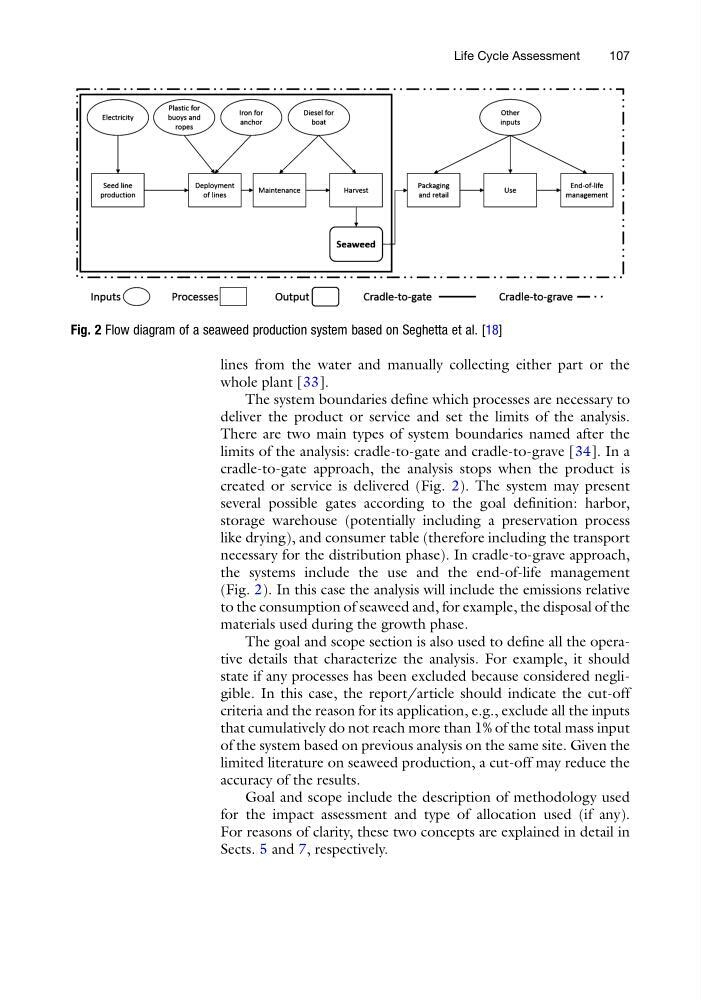
cradle-to-gate approach, the analysis stops when the product is
created or service is delivered (Fig. 2). The system may present
several possible gates according to the goal definition: harbor,
storage warehouse (potentially including a preservation process
like drying), and consumer table (therefore including the transport
necessary for the distribution phase). In cradle-to-grave approach,
the systems include the use and the end-of-life management
(Fig. 2). In this case the analysis will include the emissions relative
to the consumption of seaweed and, for example, the disposal of the
materials used during the growth phase.
The goal and scope section is also used to define all the operative details that characterize the analysis. For example, it should
state if any processes has been excluded because considered negligible. In this case, the report/article should indicate the cut-off
criteria and the reason for its application, e.g., exclude all the inputs
that cumulatively do not reach more than 1% of the total mass input
of the system based on previous analysis on the same site. Given the
limited literature on seaweed production, a cut-off may reduce the
accuracy of the results.
Goal and scope include the description of methodology used
for the impact assessment and type of allocation used (if any).
For reasons of clarity, these two concepts are explained in detail in
Sects. 5 and 7, respectively.
Fig. 2 Flow diagram of a seaweed production system based on Seghetta et al. [18]
Life Cycle Assessment
107
whole plant [33].
The system boundaries define which processes are necessary to
deliver the product or service and set the limits of the analysis.
There are two main types of system boundaries named after the
limits of the analysis: cradle-to-gate and cradle-to-grave [34]. In a
cradle-to-gate approach, the analysis stops when the product is
created or service is delivered (Fig. 2). The system may present
several possible gates according to the goal definition: harbor,
storage warehouse (potentially including a preservation process
like drying), and consumer table (therefore including the transport
necessary for the distribution phase). In cradle-to-grave approach,
the systems include the use and the end-of-life management
(Fig. 2). In this case the analysis will include the emissions relative
to the consumption of seaweed and, for example, the disposal of the
materials used during the growth phase.
The goal and scope section is also used to define all the operative details that characterize the analysis. For example, it should
state if any processes has been excluded because considered negligible. In this case, the report/article should indicate the cut-off
criteria and the reason for its application, e.g., exclude all the inputs
that cumulatively do not reach more than 1% of the total mass input
of the system based on previous analysis on the same site. Given the
limited literature on seaweed production, a cut-off may reduce the
accuracy of the results.
Goal and scope include the description of methodology used
for the impact assessment and type of allocation used (if any).
For reasons of clarity, these two concepts are explained in detail in
Sects. 5 and 7, respectively.
Fig. 2 Flow diagram of a seaweed production system based on Seghetta et al. [18]
Life Cycle Assessment
107