

common ground for the development of LCA studies and reports and
is used to develop specific certifications like environmental product
declaration [27] or product carbon footprint [28]. In this chapter we
follow the protocol described in the ISO standards 14040:2006 and
14044:2006 [8, 26].
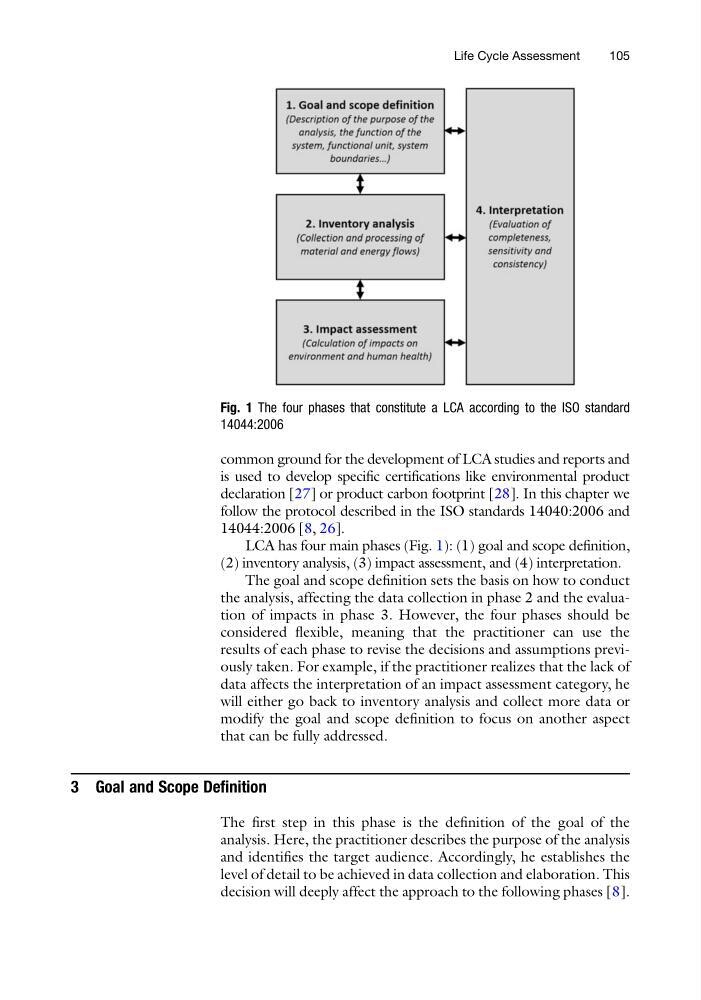
LCA has four main phases (Fig. 1): (1) goal and scope definition,
(2) inventory analysis, (3) impact assessment, and (4) interpretation.
The goal and scope definition sets the basis on how to conduct
the analysis, affecting the data collection in phase 2 and the evaluation of impacts in phase 3. However, the four phases should be
considered flexible, meaning that the practitioner can use the
results of each phase to revise the decisions and assumptions previously taken. For example, if the practitioner realizes that the lack of
data affects the interpretation of an impact assessment category, he
will either go back to inventory analysis and collect more data or
modify the goal and scope definition to focus on another aspect
that can be fully addressed.
3 Goal and Scope Definition
The first step in this phase is the definition of the goal of the
analysis. Here, the practitioner describes the purpose of the analysis
and identifies the target audience. Accordingly, he establishes the
level of detail to be achieved in data collection and elaboration. This
decision will deeply affect the approach to the following phases [8].
Fig. 1 The four phases that constitute a LCA according to the ISO standard
14044:2006
Life Cycle Assessment
105
is used to develop specific certifications like environmental product
declaration [27] or product carbon footprint [28]. In this chapter we
follow the protocol described in the ISO standards 14040:2006 and
14044:2006 [8, 26].
LCA has four main phases (Fig. 1): (1) goal and scope definition,
(2) inventory analysis, (3) impact assessment, and (4) interpretation.
The goal and scope definition sets the basis on how to conduct
the analysis, affecting the data collection in phase 2 and the evaluation of impacts in phase 3. However, the four phases should be
considered flexible, meaning that the practitioner can use the
results of each phase to revise the decisions and assumptions previously taken. For example, if the practitioner realizes that the lack of
data affects the interpretation of an impact assessment category, he
will either go back to inventory analysis and collect more data or
modify the goal and scope definition to focus on another aspect
that can be fully addressed.
3 Goal and Scope Definition
The first step in this phase is the definition of the goal of the
analysis. Here, the practitioner describes the purpose of the analysis
and identifies the target audience. Accordingly, he establishes the
level of detail to be achieved in data collection and elaboration. This
decision will deeply affect the approach to the following phases [8].
Fig. 1 The four phases that constitute a LCA according to the ISO standard
14044:2006
Life Cycle Assessment
105