

50
3 An ERA Acute Model Overview
The average number of first year spawners is: E(R) × [(1–m)
tm−tr ]
Average, natural mortality of adults is: X × m.
In a sustainable population, the gain (new recruits) and loss of individuals (natural
mortality of adults) must balance each other, and we have that E(R) × [(1–m)
tm−tr ]
= E(X) × m.
The average abundance of adults (E(X)) corresponding to an average number of
E(R) recruits is therefore: E(X) = E(R) × [(1–m)
tm−tr /m].
Because of the stochastic nature of recruitment, the abundance of the spawning
stock at time t + 1 will fluctuate around this expected number of spawners according
to the iteration equation:
X t+1 = [X t × (1 − m)] +
R t+1−(tm−tr)] × [(1 − m)
tm−tr
]
For the interested reader, the full algorithm programming guide containing 333
functions and interdependencies in given in Appendix C of Brönner et al. (2015).
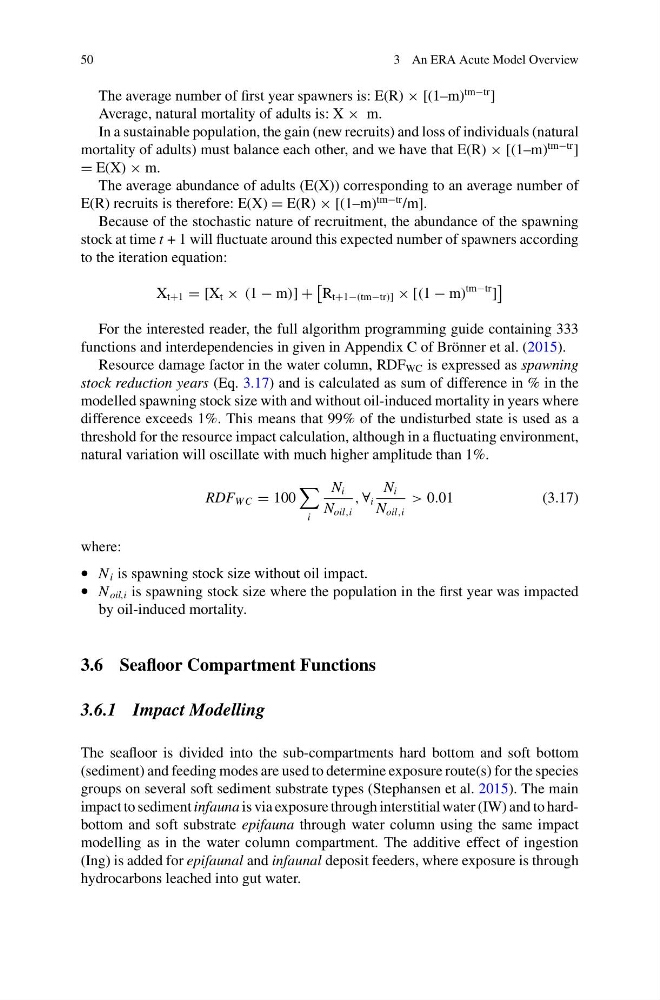
Resource damage factor in the water column, RDF WC is expressed as spawning
stock reduction years (Eq. 3.17) and is calculated as sum of difference in % in the
modelled spawning stock size with and without oil-induced mortality in years where
difference exceeds 1%. This means that 99% of the undisturbed state is used as a
threshold for the resource impact calculation, although in a fluctuating environment,
natural variation will oscillate with much higher amplitude than 1%.
RDF W C = 100
i
N i
N oil,i
, ∀ i
N i
N oil,i
> 0.01
(3.17)
where:
• N i is spawning stock size without oil impact.
• N oil,i is spawning stock size where the population in the first year was impacted
by oil-induced mortality.
3.6 Seafloor Compartment Functions
3.6.1 Impact Modelling
The seafloor is divided into the sub-compartments hard bottom and soft bottom
(sediment) and feeding modes are used to determine exposure route(s) for the species
groups on several soft sediment substrate types (Stephansen et al. 2015). The main
impact to sediment infauna is via exposure through interstitial water (IW) and to hardbottom and soft substrate epifauna through water column using the same impact
modelling as in the water column compartment. The additive effect of ingestion
(Ing) is added for epifaunal and infaunal deposit feeders, where exposure is through
hydrocarbons leached into gut water.
3 An ERA Acute Model Overview
The average number of first year spawners is: E(R) × [(1–m)
tm−tr ]
Average, natural mortality of adults is: X × m.
In a sustainable population, the gain (new recruits) and loss of individuals (natural
mortality of adults) must balance each other, and we have that E(R) × [(1–m)
tm−tr ]
= E(X) × m.
The average abundance of adults (E(X)) corresponding to an average number of
E(R) recruits is therefore: E(X) = E(R) × [(1–m)
tm−tr /m].
Because of the stochastic nature of recruitment, the abundance of the spawning
stock at time t + 1 will fluctuate around this expected number of spawners according
to the iteration equation:
X t+1 = [X t × (1 − m)] +
R t+1−(tm−tr)] × [(1 − m)
tm−tr
]
For the interested reader, the full algorithm programming guide containing 333
functions and interdependencies in given in Appendix C of Brönner et al. (2015).
Resource damage factor in the water column, RDF WC is expressed as spawning
stock reduction years (Eq. 3.17) and is calculated as sum of difference in % in the
modelled spawning stock size with and without oil-induced mortality in years where
difference exceeds 1%. This means that 99% of the undisturbed state is used as a
threshold for the resource impact calculation, although in a fluctuating environment,
natural variation will oscillate with much higher amplitude than 1%.
RDF W C = 100
i
N i
N oil,i
, ∀ i
N i
N oil,i
> 0.01
(3.17)
where:
• N i is spawning stock size without oil impact.
• N oil,i is spawning stock size where the population in the first year was impacted
by oil-induced mortality.
3.6 Seafloor Compartment Functions
3.6.1 Impact Modelling
The seafloor is divided into the sub-compartments hard bottom and soft bottom
(sediment) and feeding modes are used to determine exposure route(s) for the species
groups on several soft sediment substrate types (Stephansen et al. 2015). The main
impact to sediment infauna is via exposure through interstitial water (IW) and to hardbottom and soft substrate epifauna through water column using the same impact
modelling as in the water column compartment. The additive effect of ingestion
(Ing) is added for epifaunal and infaunal deposit feeders, where exposure is through
hydrocarbons leached into gut water.