

1.3 Basic Concepts of ERA Acute
7
based on the population loss using a discrete logistic growth model. For the water
column, a global fish-population model has been built that translates the egg or
larvae loss to a restoration time for the adult spawning stock biomass. The shoreline restoration calculations use a simpler look-up table to estimate the restoration
time for a specific ESI shoreline type. Restoration time in soft seafloor substrates is
calculated by a linear relationship between the amount of oil in the sediment above
a threshold value and the expected maximum concentration of Total Hydrocarbon
(THC) resulting from sedimentation of oil.
1.3.4 Introducing the Resource Damage Factor
ERA Acute introduces the Resource Damage Factor (RDF) as an index that combines
the extent of impact and duration of impact described by the recovery time. RDF
was previously denoted Resource Impact Factor (RIF) (Stephansen et al. 2017a,
b; Spikkerud et al. 2006) but this was updated to better clarify that the concept
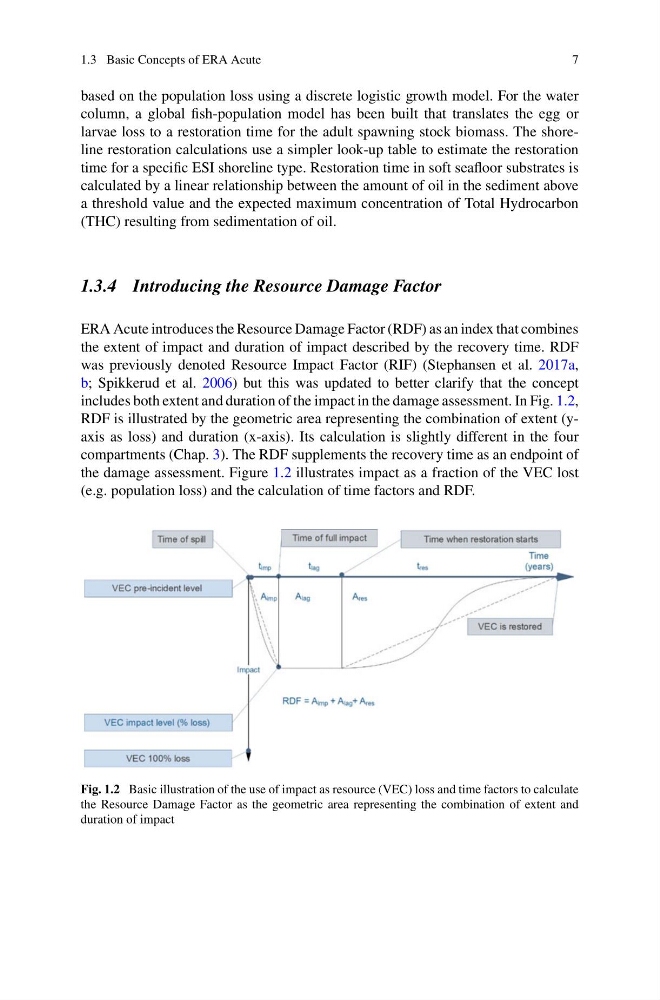
includes both extent and duration of the impact in the damage assessment. In Fig. 1.2,
RDF is illustrated by the geometric area representing the combination of extent (yaxis as loss) and duration (x-axis). Its calculation is slightly different in the four
compartments (Chap. 3). The RDF supplements the recovery time as an endpoint of
the damage assessment. Figure 1.2 illustrates impact as a fraction of the VEC lost
(e.g. population loss) and the calculation of time factors and RDF.
Fig. 1.2 Basic illustration of the use of impact as resource (VEC) loss and time factors to calculate
the Resource Damage Factor as the geometric area representing the combination of extent and
duration of impact
7
based on the population loss using a discrete logistic growth model. For the water
column, a global fish-population model has been built that translates the egg or
larvae loss to a restoration time for the adult spawning stock biomass. The shoreline restoration calculations use a simpler look-up table to estimate the restoration
time for a specific ESI shoreline type. Restoration time in soft seafloor substrates is
calculated by a linear relationship between the amount of oil in the sediment above
a threshold value and the expected maximum concentration of Total Hydrocarbon
(THC) resulting from sedimentation of oil.
1.3.4 Introducing the Resource Damage Factor
ERA Acute introduces the Resource Damage Factor (RDF) as an index that combines
the extent of impact and duration of impact described by the recovery time. RDF
was previously denoted Resource Impact Factor (RIF) (Stephansen et al. 2017a,
b; Spikkerud et al. 2006) but this was updated to better clarify that the concept
includes both extent and duration of the impact in the damage assessment. In Fig. 1.2,
RDF is illustrated by the geometric area representing the combination of extent (yaxis as loss) and duration (x-axis). Its calculation is slightly different in the four
compartments (Chap. 3). The RDF supplements the recovery time as an endpoint of
the damage assessment. Figure 1.2 illustrates impact as a fraction of the VEC lost
(e.g. population loss) and the calculation of time factors and RDF.
Fig. 1.2 Basic illustration of the use of impact as resource (VEC) loss and time factors to calculate
the Resource Damage Factor as the geometric area representing the combination of extent and
duration of impact