

5.4 Recommended Uncertainty Handling at This Point in Model Development
101
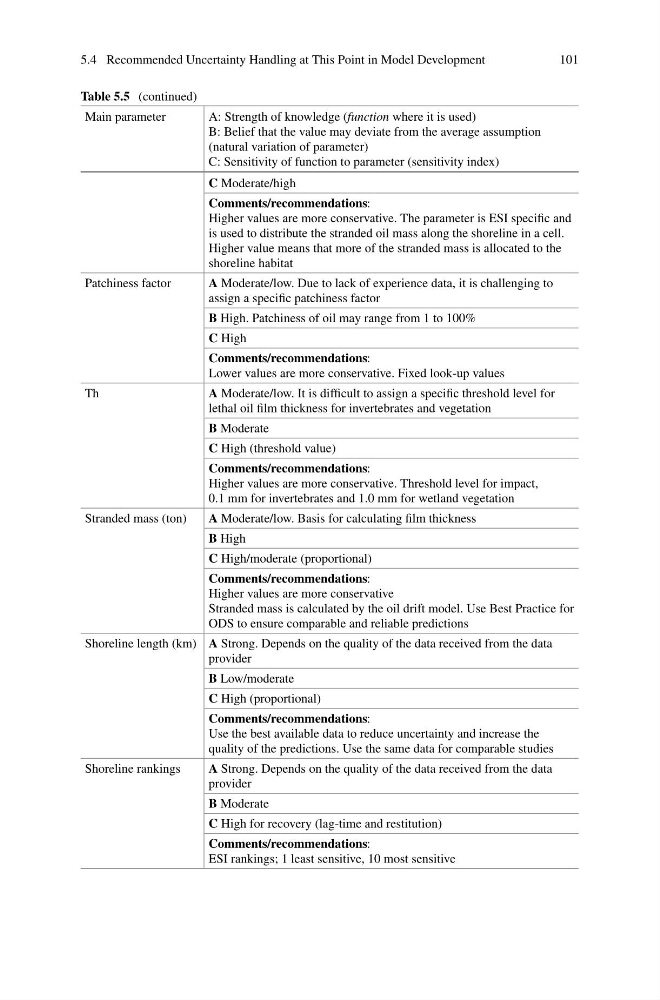
Table 5.5 (continued)
Main parameter
A: Strength of knowledge (function where it is used)
B: Belief that the value may deviate from the average assumption
(natural variation of parameter)
C: Sensitivity of function to parameter (sensitivity index)
C Moderate/high
Comments/recommendations:
Higher values are more conservative. The parameter is ESI specific and
is used to distribute the stranded oil mass along the shoreline in a cell.
Higher value means that more of the stranded mass is allocated to the
shoreline habitat
Patchiness factor
A Moderate/low. Due to lack of experience data, it is challenging to
assign a specific patchiness factor
B High. Patchiness of oil may range from 1 to 100%
C High
Comments/recommendations:
Lower values are more conservative. Fixed look-up values
Th
A Moderate/low. It is difficult to assign a specific threshold level for
lethal oil film thickness for invertebrates and vegetation
B Moderate
C High (threshold value)
Comments/recommendations:
Higher values are more conservative. Threshold level for impact,
0.1 mm for invertebrates and 1.0 mm for wetland vegetation
Stranded mass (ton)
A Moderate/low. Basis for calculating film thickness
B High
C High/moderate (proportional)
Comments/recommendations:
Higher values are more conservative
Stranded mass is calculated by the oil drift model. Use Best Practice for
ODS to ensure comparable and reliable predictions
Shoreline length (km) A Strong. Depends on the quality of the data received from the data
provider
B Low/moderate
C High (proportional)
Comments/recommendations:
Use the best available data to reduce uncertainty and increase the
quality of the predictions. Use the same data for comparable studies
Shoreline rankings
A Strong. Depends on the quality of the data received from the data
provider
B Moderate
C High for recovery (lag-time and restitution)
Comments/recommendations:
ESI rankings; 1 least sensitive, 10 most sensitive
101
Table 5.5 (continued)
Main parameter
A: Strength of knowledge (function where it is used)
B: Belief that the value may deviate from the average assumption
(natural variation of parameter)
C: Sensitivity of function to parameter (sensitivity index)
C Moderate/high
Comments/recommendations:
Higher values are more conservative. The parameter is ESI specific and
is used to distribute the stranded oil mass along the shoreline in a cell.
Higher value means that more of the stranded mass is allocated to the
shoreline habitat
Patchiness factor
A Moderate/low. Due to lack of experience data, it is challenging to
assign a specific patchiness factor
B High. Patchiness of oil may range from 1 to 100%
C High
Comments/recommendations:
Lower values are more conservative. Fixed look-up values
Th
A Moderate/low. It is difficult to assign a specific threshold level for
lethal oil film thickness for invertebrates and vegetation
B Moderate
C High (threshold value)
Comments/recommendations:
Higher values are more conservative. Threshold level for impact,
0.1 mm for invertebrates and 1.0 mm for wetland vegetation
Stranded mass (ton)
A Moderate/low. Basis for calculating film thickness
B High
C High/moderate (proportional)
Comments/recommendations:
Higher values are more conservative
Stranded mass is calculated by the oil drift model. Use Best Practice for
ODS to ensure comparable and reliable predictions
Shoreline length (km) A Strong. Depends on the quality of the data received from the data
provider
B Low/moderate
C High (proportional)
Comments/recommendations:
Use the best available data to reduce uncertainty and increase the
quality of the predictions. Use the same data for comparable studies
Shoreline rankings
A Strong. Depends on the quality of the data received from the data
provider
B Moderate
C High for recovery (lag-time and restitution)
Comments/recommendations:
ESI rankings; 1 least sensitive, 10 most sensitive