

60
2 Actual Potentials of Theoretical Chemistry: What Can Be Obtained
O
Me
Me
H
H
ΔE/eV
R
calc. /10 -40
cgs
Δε /l mol -1
cm -1
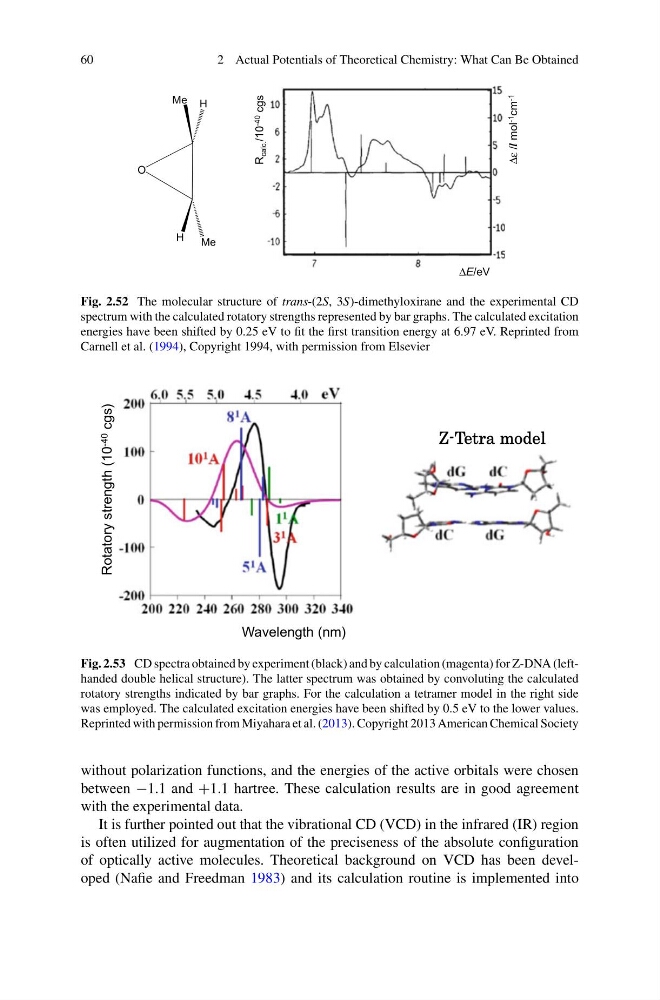
Fig. 2.52 The molecular structure of trans-(2S, 3S)-dimethyloxirane and the experimental CD
spectrum with the calculated rotatory strengths represented by bar graphs. The calculated excitation
energies have been shifted by 0.25 eV to fit the first transition energy at 6.97 eV. Reprinted from
Carnell et al. (1994), Copyright 1994, with permission from Elsevier
Z Z-Tetra model
Rotatory strength (10 -40
cgs)
Wavelength (nm)
Fig. 2.53 CD spectra obtained by experiment (black) and by calculation (magenta) for Z-DNA (lefthanded double helical structure). The latter spectrum was obtained by convoluting the calculated
rotatory strengths indicated by bar graphs. For the calculation a tetramer model in the right side
was employed. The calculated excitation energies have been shifted by 0.5 eV to the lower values.
Reprinted with permission from Miyahara et al. (2013). Copyright 2013 American Chemical Society
without polarization functions, and the energies of the active orbitals were chosen
between −1.1 and +1.1 hartree. These calculation results are in good agreement
with the experimental data.
It is further pointed out that the vibrational CD (VCD) in the infrared (IR) region
is often utilized for augmentation of the preciseness of the absolute configuration
of optically active molecules. Theoretical background on VCD has been developed (Nafie and Freedman 1983) and its calculation routine is implemented into
2 Actual Potentials of Theoretical Chemistry: What Can Be Obtained
O
Me
Me
H
H
ΔE/eV
R
calc. /10 -40
cgs
Δε /l mol -1
cm -1
Fig. 2.52 The molecular structure of trans-(2S, 3S)-dimethyloxirane and the experimental CD
spectrum with the calculated rotatory strengths represented by bar graphs. The calculated excitation
energies have been shifted by 0.25 eV to fit the first transition energy at 6.97 eV. Reprinted from
Carnell et al. (1994), Copyright 1994, with permission from Elsevier
Z Z-Tetra model
Rotatory strength (10 -40
cgs)
Wavelength (nm)
Fig. 2.53 CD spectra obtained by experiment (black) and by calculation (magenta) for Z-DNA (lefthanded double helical structure). The latter spectrum was obtained by convoluting the calculated
rotatory strengths indicated by bar graphs. For the calculation a tetramer model in the right side
was employed. The calculated excitation energies have been shifted by 0.5 eV to the lower values.
Reprinted with permission from Miyahara et al. (2013). Copyright 2013 American Chemical Society
without polarization functions, and the energies of the active orbitals were chosen
between −1.1 and +1.1 hartree. These calculation results are in good agreement
with the experimental data.
It is further pointed out that the vibrational CD (VCD) in the infrared (IR) region
is often utilized for augmentation of the preciseness of the absolute configuration
of optically active molecules. Theoretical background on VCD has been developed (Nafie and Freedman 1983) and its calculation routine is implemented into