

2.5 Optical Properties
57
R(S 0 )
R(T 1 ) R
S 0
S 1
T 1
E
Absorption
Vibrational relaxation
Intersystem crossing
Phosphorescence
R(S 0 )
R(T 1 ) R
S 0
S 1
T 1
E
Absorption
Vibrational relaxation
Intersystem crossing
Radiationless transition
(a)
(b)
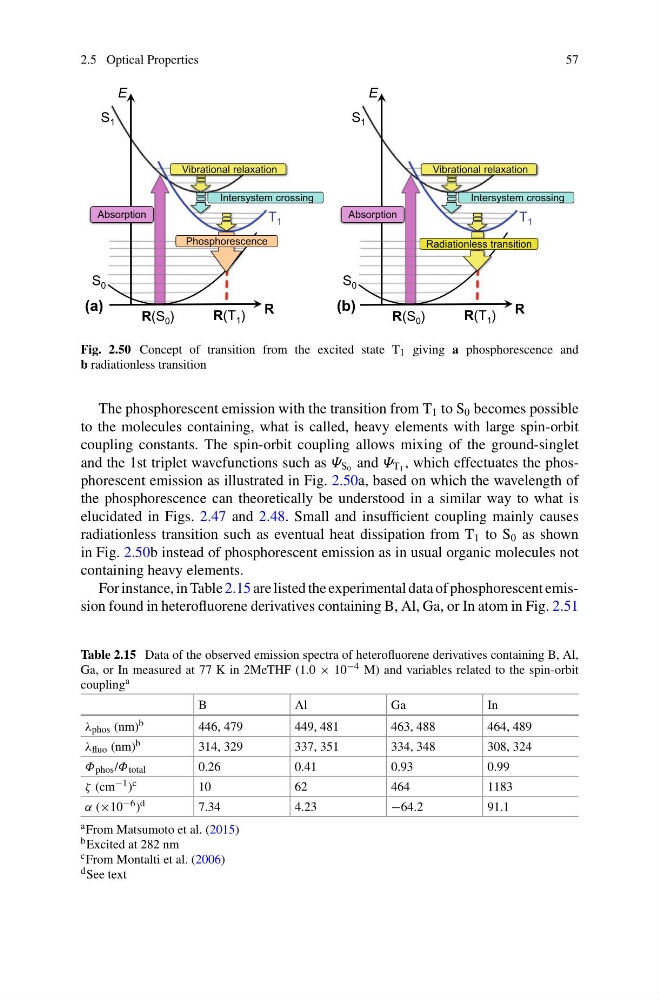
Fig. 2.50 Concept of transition from the excited state T 1 giving a phosphorescence and
b radiationless transition
The phosphorescent emission with the transition from T 1 to S 0 becomes possible
to the molecules containing, what is called, heavy elements with large spin-orbit
coupling constants. The spin-orbit coupling allows mixing of the ground-singlet
and the 1st triplet wavefunctions such as Ψ S 0 and Ψ T 1 , which effectuates the phosphorescent emission as illustrated in Fig. 2.50a, based on which the wavelength of
the phosphorescence can theoretically be understood in a similar way to what is
elucidated in Figs. 2.47 and 2.48. Small and insufficient coupling mainly causes
radiationless transition such as eventual heat dissipation from T 1 to S 0 as shown
in Fig. 2.50b instead of phosphorescent emission as in usual organic molecules not
containing heavy elements.
For instance, in Table 2.15 are listed the experimental data of phosphorescent emission found in heterofluorene derivatives containing B, Al, Ga, or In atom in Fig. 2.51
Table 2.15 Data of the observed emission spectra of heterofluorene derivatives containing B, Al,
Ga, or In measured at 77 K in 2MeTHF (1.0 × 10 −4 M) and variables related to the spin-orbit
coupling a
B
Al
Ga
In
λ phos (nm) b
446, 479
449, 481
463, 488
464, 489
λ fluo (nm) b
314, 329
337, 351
334, 348
308, 324
Φ phos /Φ total
0.26
0.41
0.93
0.99
ζ (cm −1 ) c
10
62
464
1183
α (×10 −6 ) d
7.34
4.23
−64.2
91.1
a From Matsumoto et al. (2015)
b Excited at 282 nm
c From Montalti et al. (2006)
d See text
57
R(S 0 )
R(T 1 ) R
S 0
S 1
T 1
E
Absorption
Vibrational relaxation
Intersystem crossing
Phosphorescence
R(S 0 )
R(T 1 ) R
S 0
S 1
T 1
E
Absorption
Vibrational relaxation
Intersystem crossing
Radiationless transition
(a)
(b)
Fig. 2.50 Concept of transition from the excited state T 1 giving a phosphorescence and
b radiationless transition
The phosphorescent emission with the transition from T 1 to S 0 becomes possible
to the molecules containing, what is called, heavy elements with large spin-orbit
coupling constants. The spin-orbit coupling allows mixing of the ground-singlet
and the 1st triplet wavefunctions such as Ψ S 0 and Ψ T 1 , which effectuates the phosphorescent emission as illustrated in Fig. 2.50a, based on which the wavelength of
the phosphorescence can theoretically be understood in a similar way to what is
elucidated in Figs. 2.47 and 2.48. Small and insufficient coupling mainly causes
radiationless transition such as eventual heat dissipation from T 1 to S 0 as shown
in Fig. 2.50b instead of phosphorescent emission as in usual organic molecules not
containing heavy elements.
For instance, in Table 2.15 are listed the experimental data of phosphorescent emission found in heterofluorene derivatives containing B, Al, Ga, or In atom in Fig. 2.51
Table 2.15 Data of the observed emission spectra of heterofluorene derivatives containing B, Al,
Ga, or In measured at 77 K in 2MeTHF (1.0 × 10 −4 M) and variables related to the spin-orbit
coupling a
B
Al
Ga
In
λ phos (nm) b
446, 479
449, 481
463, 488
464, 489
λ fluo (nm) b
314, 329
337, 351
334, 348
308, 324
Φ phos /Φ total
0.26
0.41
0.93
0.99
ζ (cm −1 ) c
10
62
464
1183
α (×10 −6 ) d
7.34
4.23
−64.2
91.1
a From Matsumoto et al. (2015)
b Excited at 282 nm
c From Montalti et al. (2006)
d See text