

14
2 Actual Potentials of Theoretical Chemistry: What Can Be Obtained
(a)
(b)
E
R
2
2
0
E
R
0
E
R
2
2
0
E
R
(c)
0
E
R
2
2
0
E
R
0
E
R
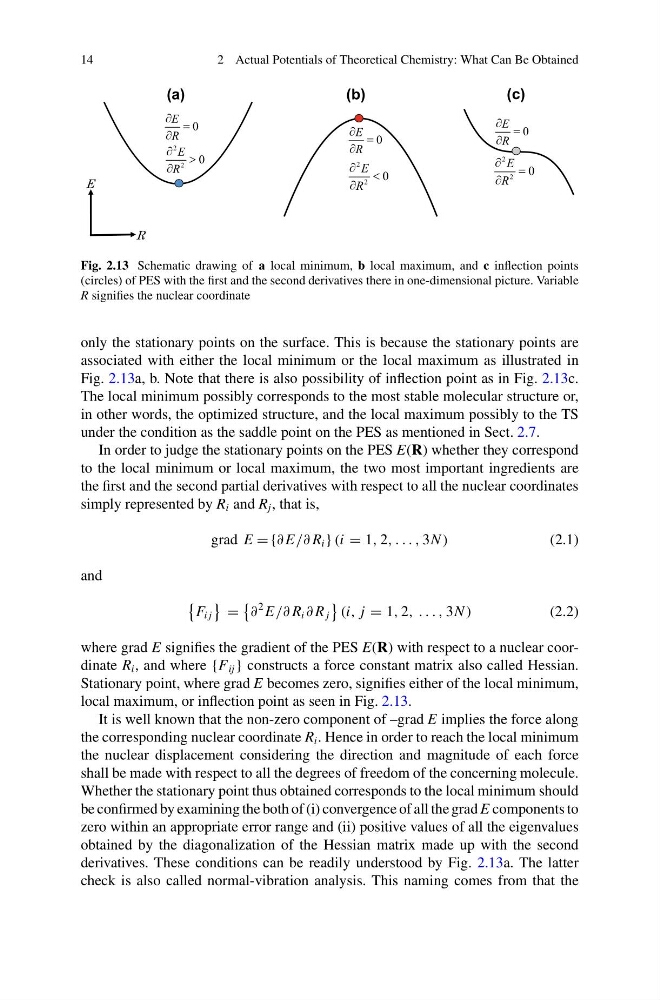
Fig. 2.13 Schematic drawing of a local minimum, b local maximum, and c inflection points
(circles) of PES with the first and the second derivatives there in one-dimensional picture. Variable
R signifies the nuclear coordinate
only the stationary points on the surface. This is because the stationary points are
associated with either the local minimum or the local maximum as illustrated in
Fig. 2.13a, b. Note that there is also possibility of inflection point as in Fig. 2.13c.
The local minimum possibly corresponds to the most stable molecular structure or,
in other words, the optimized structure, and the local maximum possibly to the TS
under the condition as the saddle point on the PES as mentioned in Sect. 2.7.
In order to judge the stationary points on the PES E(R) whether they correspond
to the local minimum or local maximum, the two most important ingredients are
the first and the second partial derivatives with respect to all the nuclear coordinates
simply represented by R i and R j , that is,
grad E = {∂ E/∂ R i } (i = 1, 2, . . . , 3N )
(2.1)
and
F i j
=
∂
2 E/∂ R i ∂ R j
(i, j = 1, 2, . . . , 3N )
(2.2)
where grad E signifies the gradient of the PES E(R) with respect to a nuclear coordinate R i , and where {F ij } constructs a force constant matrix also called Hessian.
Stationary point, where grad E becomes zero, signifies either of the local minimum,
local maximum, or inflection point as seen in Fig. 2.13.
It is well known that the non-zero component of –grad E implies the force along
the corresponding nuclear coordinate R i . Hence in order to reach the local minimum
the nuclear displacement considering the direction and magnitude of each force
shall be made with respect to all the degrees of freedom of the concerning molecule.
Whether the stationary point thus obtained corresponds to the local minimum should
be confirmed by examining the both of (i) convergence of all the grad E components to
zero within an appropriate error range and (ii) positive values of all the eigenvalues
obtained by the diagonalization of the Hessian matrix made up with the second
derivatives. These conditions can be readily understood by Fig. 2.13a. The latter
check is also called normal-vibration analysis. This naming comes from that the
2 Actual Potentials of Theoretical Chemistry: What Can Be Obtained
(a)
(b)
E
R
2
2
0
E
R
0
E
R
2
2
0
E
R
(c)
0
E
R
2
2
0
E
R
0
E
R
Fig. 2.13 Schematic drawing of a local minimum, b local maximum, and c inflection points
(circles) of PES with the first and the second derivatives there in one-dimensional picture. Variable
R signifies the nuclear coordinate
only the stationary points on the surface. This is because the stationary points are
associated with either the local minimum or the local maximum as illustrated in
Fig. 2.13a, b. Note that there is also possibility of inflection point as in Fig. 2.13c.
The local minimum possibly corresponds to the most stable molecular structure or,
in other words, the optimized structure, and the local maximum possibly to the TS
under the condition as the saddle point on the PES as mentioned in Sect. 2.7.
In order to judge the stationary points on the PES E(R) whether they correspond
to the local minimum or local maximum, the two most important ingredients are
the first and the second partial derivatives with respect to all the nuclear coordinates
simply represented by R i and R j , that is,
grad E = {∂ E/∂ R i } (i = 1, 2, . . . , 3N )
(2.1)
and
F i j
=
∂
2 E/∂ R i ∂ R j
(i, j = 1, 2, . . . , 3N )
(2.2)
where grad E signifies the gradient of the PES E(R) with respect to a nuclear coordinate R i , and where {F ij } constructs a force constant matrix also called Hessian.
Stationary point, where grad E becomes zero, signifies either of the local minimum,
local maximum, or inflection point as seen in Fig. 2.13.
It is well known that the non-zero component of –grad E implies the force along
the corresponding nuclear coordinate R i . Hence in order to reach the local minimum
the nuclear displacement considering the direction and magnitude of each force
shall be made with respect to all the degrees of freedom of the concerning molecule.
Whether the stationary point thus obtained corresponds to the local minimum should
be confirmed by examining the both of (i) convergence of all the grad E components to
zero within an appropriate error range and (ii) positive values of all the eigenvalues
obtained by the diagonalization of the Hessian matrix made up with the second
derivatives. These conditions can be readily understood by Fig. 2.13a. The latter
check is also called normal-vibration analysis. This naming comes from that the