

4.4 Theoretical Biology
189
is obviously related to lack in computation-machine resource at present. Hence,
analyses of biological systems by combination of quantum mechanics (QM) and
molecular mechanics (MM) or by molecular dynamics (MD) ought to be employed,
which is still one of the most challenging themes in the current theoretical chemistry.
In this section, some recent challenges to these themes from the theoretical side are
to be introduced.
4.4.1 QM/MM Study of Catalytic Action of Cytochrome
P450cam
Cytochrome P450 (also called CYP) is one of the hemoproteins and belongs to
monooxygenase family working as a redox enzyme. P450 widely distributes among
biological kingdom including microbials, plants, and animals. Especially P450cam
is one of P450 families and makes hydroxylation at 5 exo position of camphor. In
the catalytic cycle of P450cam the active site is the heme iron in a protoporphyrin
IX complex with a cysteine (Cys) residue as the axial ligand and a molecular oxygen
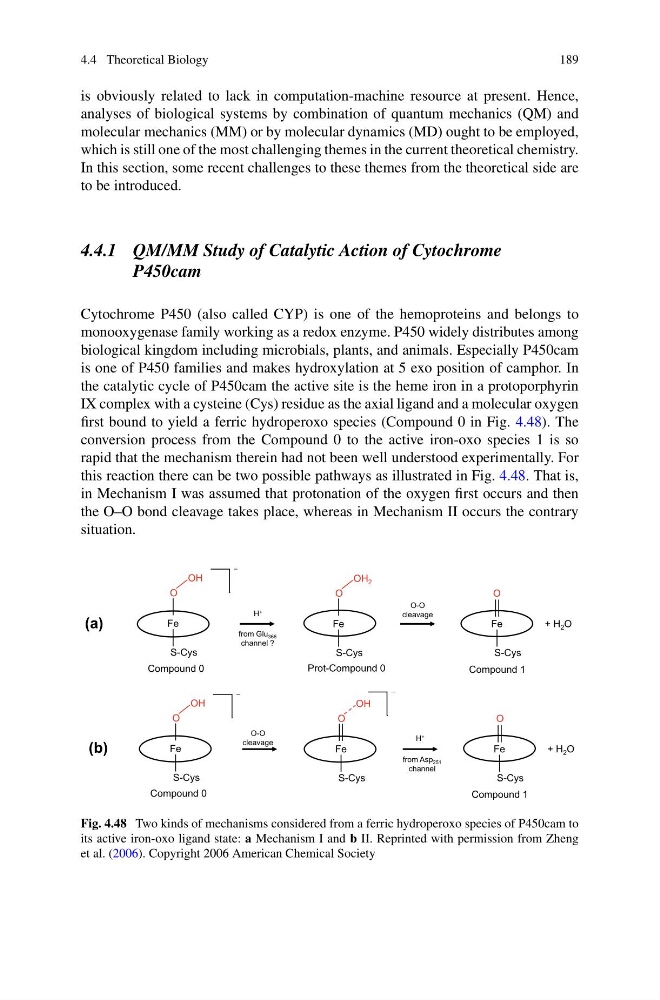
first bound to yield a ferric hydroperoxo species (Compound 0 in Fig. 4.48). The
conversion process from the Compound 0 to the active iron-oxo species 1 is so
rapid that the mechanism therein had not been well understood experimentally. For
this reaction there can be two possible pathways as illustrated in Fig. 4.48. That is,
in Mechanism I was assumed that protonation of the oxygen first occurs and then
the O–O bond cleavage takes place, whereas in Mechanism II occurs the contrary
situation.
Fe
S-Cys
O
OH
Fe
S-Cys
O
OH 2
Fe
S-Cys
O
H +
O-O
cleavage
Compound 0
Prot-Compound 0
Compound 1
+ H 2 O
−
Fe
S-Cys
O
OH
Fe
S-Cys
O
OH
Fe
S-Cys
O
Compound 0
Compound 1
+ H 2 O
−
O-O
cleavage
H +
−
(a)
(b)
from Asp 251
channel
from Glu 366
channel ?
Fig. 4.48 Two kinds of mechanisms considered from a ferric hydroperoxo species of P450cam to
its active iron-oxo ligand state: a Mechanism I and b II. Reprinted with permission from Zheng
et al. (2006). Copyright 2006 American Chemical Society
189
is obviously related to lack in computation-machine resource at present. Hence,
analyses of biological systems by combination of quantum mechanics (QM) and
molecular mechanics (MM) or by molecular dynamics (MD) ought to be employed,
which is still one of the most challenging themes in the current theoretical chemistry.
In this section, some recent challenges to these themes from the theoretical side are
to be introduced.
4.4.1 QM/MM Study of Catalytic Action of Cytochrome
P450cam
Cytochrome P450 (also called CYP) is one of the hemoproteins and belongs to
monooxygenase family working as a redox enzyme. P450 widely distributes among
biological kingdom including microbials, plants, and animals. Especially P450cam
is one of P450 families and makes hydroxylation at 5 exo position of camphor. In
the catalytic cycle of P450cam the active site is the heme iron in a protoporphyrin
IX complex with a cysteine (Cys) residue as the axial ligand and a molecular oxygen
first bound to yield a ferric hydroperoxo species (Compound 0 in Fig. 4.48). The
conversion process from the Compound 0 to the active iron-oxo species 1 is so
rapid that the mechanism therein had not been well understood experimentally. For
this reaction there can be two possible pathways as illustrated in Fig. 4.48. That is,
in Mechanism I was assumed that protonation of the oxygen first occurs and then
the O–O bond cleavage takes place, whereas in Mechanism II occurs the contrary
situation.
Fe
S-Cys
O
OH
Fe
S-Cys
O
OH 2
Fe
S-Cys
O
H +
O-O
cleavage
Compound 0
Prot-Compound 0
Compound 1
+ H 2 O
−
Fe
S-Cys
O
OH
Fe
S-Cys
O
OH
Fe
S-Cys
O
Compound 0
Compound 1
+ H 2 O
−
O-O
cleavage
H +
−
(a)
(b)
from Asp 251
channel
from Glu 366
channel ?
Fig. 4.48 Two kinds of mechanisms considered from a ferric hydroperoxo species of P450cam to
its active iron-oxo ligand state: a Mechanism I and b II. Reprinted with permission from Zheng
et al. (2006). Copyright 2006 American Chemical Society