

4.1 Nanoscience
163
0
0.5
1
1.5
2
0
0.5
1
1.5
2
0
50
100
150
200
250
300
V sd (V )
V g
(V )
I sd
(μA
)
0
0.5
1
1.5
2
0
0.5
1
1.5
2
0
0.5
1
1.5
V sd (V )
V g
(V )
I sd
(μA
)
(a)
(b)
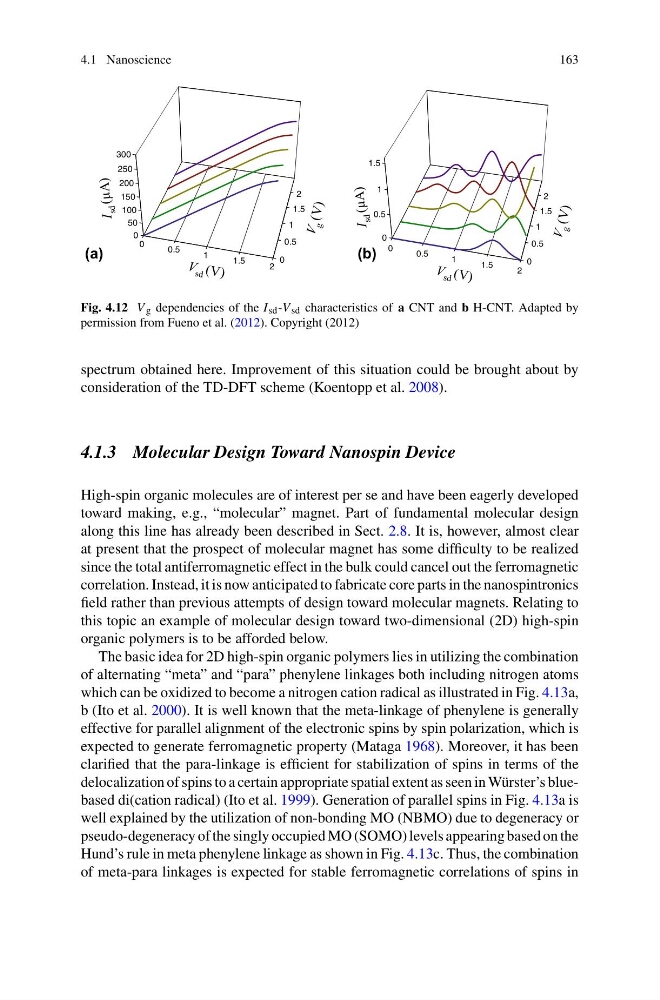
Fig. 4.12 V g dependencies of the I sd -V sd characteristics of a CNT and b H-CNT. Adapted by
permission from Fueno et al. (2012). Copyright (2012)
spectrum obtained here. Improvement of this situation could be brought about by
consideration of the TD-DFT scheme (Koentopp et al. 2008).
4.1.3 Molecular Design Toward Nanospin Device
High-spin organic molecules are of interest per se and have been eagerly developed
toward making, e.g., “molecular” magnet. Part of fundamental molecular design
along this line has already been described in Sect. 2.8. It is, however, almost clear
at present that the prospect of molecular magnet has some difficulty to be realized
since the total antiferromagnetic effect in the bulk could cancel out the ferromagnetic
correlation. Instead, it is now anticipated to fabricate core parts in the nanospintronics
field rather than previous attempts of design toward molecular magnets. Relating to
this topic an example of molecular design toward two-dimensional (2D) high-spin
organic polymers is to be afforded below.
The basic idea for 2D high-spin organic polymers lies in utilizing the combination
of alternating “meta” and “para” phenylene linkages both including nitrogen atoms
which can be oxidized to become a nitrogen cation radical as illustrated in Fig. 4.13a,
b (Ito et al. 2000). It is well known that the meta-linkage of phenylene is generally
effective for parallel alignment of the electronic spins by spin polarization, which is
expected to generate ferromagnetic property (Mataga 1968). Moreover, it has been
clarified that the para-linkage is efficient for stabilization of spins in terms of the
delocalization of spins to a certain appropriate spatial extent as seen in Würster’s bluebased di(cation radical) (Ito et al. 1999). Generation of parallel spins in Fig. 4.13a is
well explained by the utilization of non-bonding MO (NBMO) due to degeneracy or
pseudo-degeneracy of the singly occupied MO (SOMO) levels appearing based on the
Hund’s rule in meta phenylene linkage as shown in Fig. 4.13c. Thus, the combination
of meta-para linkages is expected for stable ferromagnetic correlations of spins in
163
0
0.5
1
1.5
2
0
0.5
1
1.5
2
0
50
100
150
200
250
300
V sd (V )
V g
(V )
I sd
(μA
)
0
0.5
1
1.5
2
0
0.5
1
1.5
2
0
0.5
1
1.5
V sd (V )
V g
(V )
I sd
(μA
)
(a)
(b)
Fig. 4.12 V g dependencies of the I sd -V sd characteristics of a CNT and b H-CNT. Adapted by
permission from Fueno et al. (2012). Copyright (2012)
spectrum obtained here. Improvement of this situation could be brought about by
consideration of the TD-DFT scheme (Koentopp et al. 2008).
4.1.3 Molecular Design Toward Nanospin Device
High-spin organic molecules are of interest per se and have been eagerly developed
toward making, e.g., “molecular” magnet. Part of fundamental molecular design
along this line has already been described in Sect. 2.8. It is, however, almost clear
at present that the prospect of molecular magnet has some difficulty to be realized
since the total antiferromagnetic effect in the bulk could cancel out the ferromagnetic
correlation. Instead, it is now anticipated to fabricate core parts in the nanospintronics
field rather than previous attempts of design toward molecular magnets. Relating to
this topic an example of molecular design toward two-dimensional (2D) high-spin
organic polymers is to be afforded below.
The basic idea for 2D high-spin organic polymers lies in utilizing the combination
of alternating “meta” and “para” phenylene linkages both including nitrogen atoms
which can be oxidized to become a nitrogen cation radical as illustrated in Fig. 4.13a,
b (Ito et al. 2000). It is well known that the meta-linkage of phenylene is generally
effective for parallel alignment of the electronic spins by spin polarization, which is
expected to generate ferromagnetic property (Mataga 1968). Moreover, it has been
clarified that the para-linkage is efficient for stabilization of spins in terms of the
delocalization of spins to a certain appropriate spatial extent as seen in Würster’s bluebased di(cation radical) (Ito et al. 1999). Generation of parallel spins in Fig. 4.13a is
well explained by the utilization of non-bonding MO (NBMO) due to degeneracy or
pseudo-degeneracy of the singly occupied MO (SOMO) levels appearing based on the
Hund’s rule in meta phenylene linkage as shown in Fig. 4.13c. Thus, the combination
of meta-para linkages is expected for stable ferromagnetic correlations of spins in