

144
3 Fundamentals of the Analysis Tools
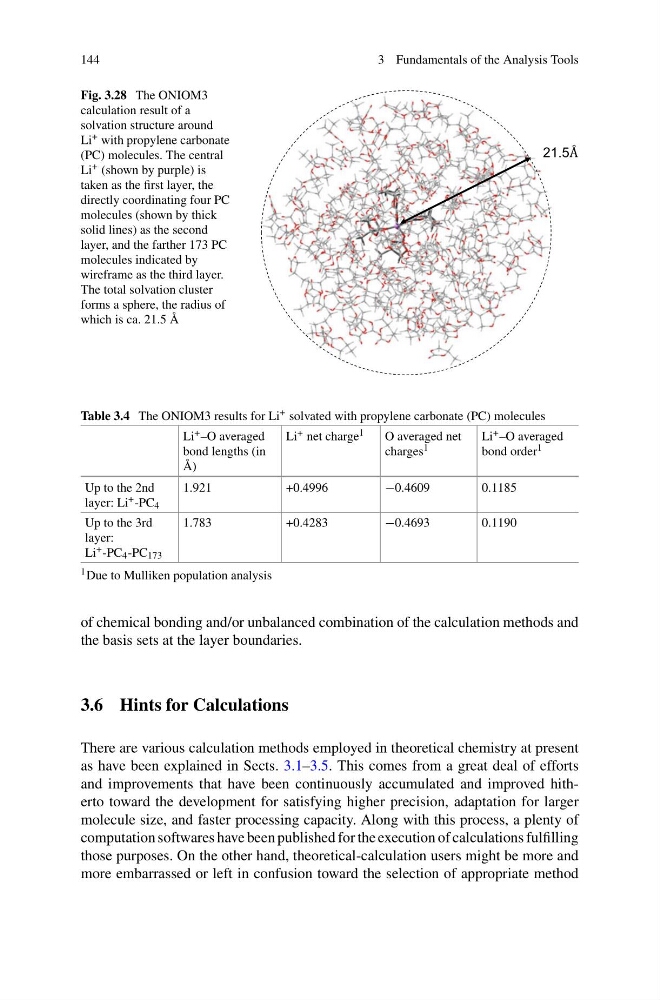
Fig. 3.28 The ONIOM3
calculation result of a
solvation structure around
Li + with propylene carbonate
(PC) molecules. The central
Li + (shown by purple) is
taken as the first layer, the
directly coordinating four PC
molecules (shown by thick
solid lines) as the second
layer, and the farther 173 PC
molecules indicated by
wireframe as the third layer.
The total solvation cluster
forms a sphere, the radius of
which is ca. 21.5 Å
21.5
Table 3.4 The ONIOM3 results for Li + solvated with propylene carbonate (PC) molecules
Li + –O averaged
bond lengths (in
Å)
Li + net charge 1
O averaged net
charges 1
Li + –O averaged
bond order 1
Up to the 2nd
layer: Li + -PC 4
1.921
+0.4996
−0.4609
0.1185
Up to the 3rd
layer:
Li + -PC 4 -PC 173
1.783
+0.4283
−0.4693
0.1190
1 Due to Mulliken population analysis
of chemical bonding and/or unbalanced combination of the calculation methods and
the basis sets at the layer boundaries.
3.6 Hints for Calculations
There are various calculation methods employed in theoretical chemistry at present
as have been explained in Sects. 3.1–3.5. This comes from a great deal of efforts
and improvements that have been continuously accumulated and improved hitherto toward the development for satisfying higher precision, adaptation for larger
molecule size, and faster processing capacity. Along with this process, a plenty of
computation softwares have been published for the execution of calculations fulfilling
those purposes. On the other hand, theoretical-calculation users might be more and
more embarrassed or left in confusion toward the selection of appropriate method
3 Fundamentals of the Analysis Tools
Fig. 3.28 The ONIOM3
calculation result of a
solvation structure around
Li + with propylene carbonate
(PC) molecules. The central
Li + (shown by purple) is
taken as the first layer, the
directly coordinating four PC
molecules (shown by thick
solid lines) as the second
layer, and the farther 173 PC
molecules indicated by
wireframe as the third layer.
The total solvation cluster
forms a sphere, the radius of
which is ca. 21.5 Å
21.5
Table 3.4 The ONIOM3 results for Li + solvated with propylene carbonate (PC) molecules
Li + –O averaged
bond lengths (in
Å)
Li + net charge 1
O averaged net
charges 1
Li + –O averaged
bond order 1
Up to the 2nd
layer: Li + -PC 4
1.921
+0.4996
−0.4609
0.1185
Up to the 3rd
layer:
Li + -PC 4 -PC 173
1.783
+0.4283
−0.4693
0.1190
1 Due to Mulliken population analysis
of chemical bonding and/or unbalanced combination of the calculation methods and
the basis sets at the layer boundaries.
3.6 Hints for Calculations
There are various calculation methods employed in theoretical chemistry at present
as have been explained in Sects. 3.1–3.5. This comes from a great deal of efforts
and improvements that have been continuously accumulated and improved hitherto toward the development for satisfying higher precision, adaptation for larger
molecule size, and faster processing capacity. Along with this process, a plenty of
computation softwares have been published for the execution of calculations fulfilling
those purposes. On the other hand, theoretical-calculation users might be more and
more embarrassed or left in confusion toward the selection of appropriate method