

4
2 Actual Potentials of Theoretical Chemistry: What Can Be Obtained
S 0
T 1
S 1
E
R (Nuclear Coordinates)
R(S 0 ) opt
R(T 1 ) opt R(S 1 ) opt
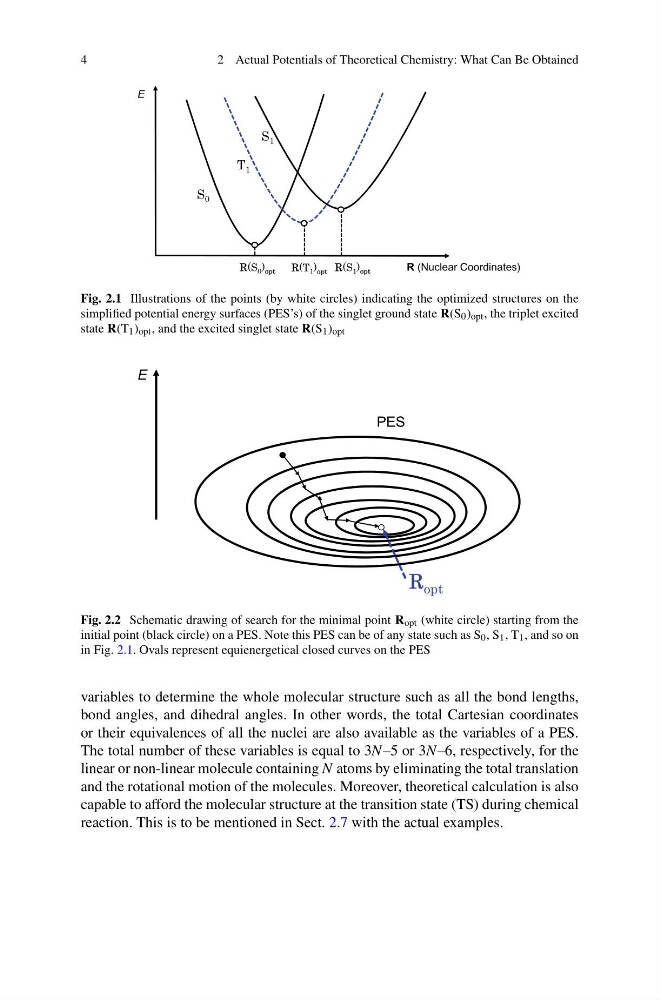
Fig. 2.1 Illustrations of the points (by white circles) indicating the optimized structures on the
simplified potential energy surfaces (PES’s) of the singlet ground state R(S 0 ) opt , the triplet excited
state R(T 1 ) opt , and the excited singlet state R(S 1 ) opt
E
R opt
PES
Fig. 2.2 Schematic drawing of search for the minimal point R opt (white circle) starting from the
initial point (black circle) on a PES. Note this PES can be of any state such as S 0 , S 1 , T 1 , and so on
in Fig. 2.1. Ovals represent equienergetical closed curves on the PES
variables to determine the whole molecular structure such as all the bond lengths,
bond angles, and dihedral angles. In other words, the total Cartesian coordinates
or their equivalences of all the nuclei are also available as the variables of a PES.
The total number of these variables is equal to 3N–5 or 3N–6, respectively, for the
linear or non-linear molecule containing N atoms by eliminating the total translation
and the rotational motion of the molecules. Moreover, theoretical calculation is also
capable to afford the molecular structure at the transition state (TS) during chemical
reaction. This is to be mentioned in Sect. 2.7 with the actual examples.
2 Actual Potentials of Theoretical Chemistry: What Can Be Obtained
S 0
T 1
S 1
E
R (Nuclear Coordinates)
R(S 0 ) opt
R(T 1 ) opt R(S 1 ) opt
Fig. 2.1 Illustrations of the points (by white circles) indicating the optimized structures on the
simplified potential energy surfaces (PES’s) of the singlet ground state R(S 0 ) opt , the triplet excited
state R(T 1 ) opt , and the excited singlet state R(S 1 ) opt
E
R opt
PES
Fig. 2.2 Schematic drawing of search for the minimal point R opt (white circle) starting from the
initial point (black circle) on a PES. Note this PES can be of any state such as S 0 , S 1 , T 1 , and so on
in Fig. 2.1. Ovals represent equienergetical closed curves on the PES
variables to determine the whole molecular structure such as all the bond lengths,
bond angles, and dihedral angles. In other words, the total Cartesian coordinates
or their equivalences of all the nuclei are also available as the variables of a PES.
The total number of these variables is equal to 3N–5 or 3N–6, respectively, for the
linear or non-linear molecule containing N atoms by eliminating the total translation
and the rotational motion of the molecules. Moreover, theoretical calculation is also
capable to afford the molecular structure at the transition state (TS) during chemical
reaction. This is to be mentioned in Sect. 2.7 with the actual examples.