

3.1 Molecular Orbital Calculations
105
where MO ψ i of the ith level is set to also include the spin information of the electron
accommodated therein, i.e., ψ i is a spin-orbital (or spin MO). The right-hand side
in Eq. (3.4) signifies the combination of MO’s which satisfies the Pauli exclusion
principle and is called Slater determinant. The total energy of a molecule is given by
the sum of E HF and the internuclear repulsion potential, i.e.,
E tot = E HF +
A>B
Z A Z B
R AB
(3.7)
Notations used are described in Glossaries 3.
Glossaries 3: Molecular integrals
H i core integral
H i =
ψ
∗
i (r)
−
1
2
∇
2
−
A
Z A
r A
ψ i (r) dr
(3.8)
where all the variables are defined in Glossaries 1. Note again that only one electron
is dealt with in the HF method.
J ij Coulomb integral
J ij =
|ψ i (r)|
2
ψ j (r
)
2
|r − r |
drdr
(3.9)
K ij exchange integral
K ij =
ψ
∗
i (r)ψ
∗
j
r
ψ i
r
ψ j (r)
|r − r |
drdr
(3.10)
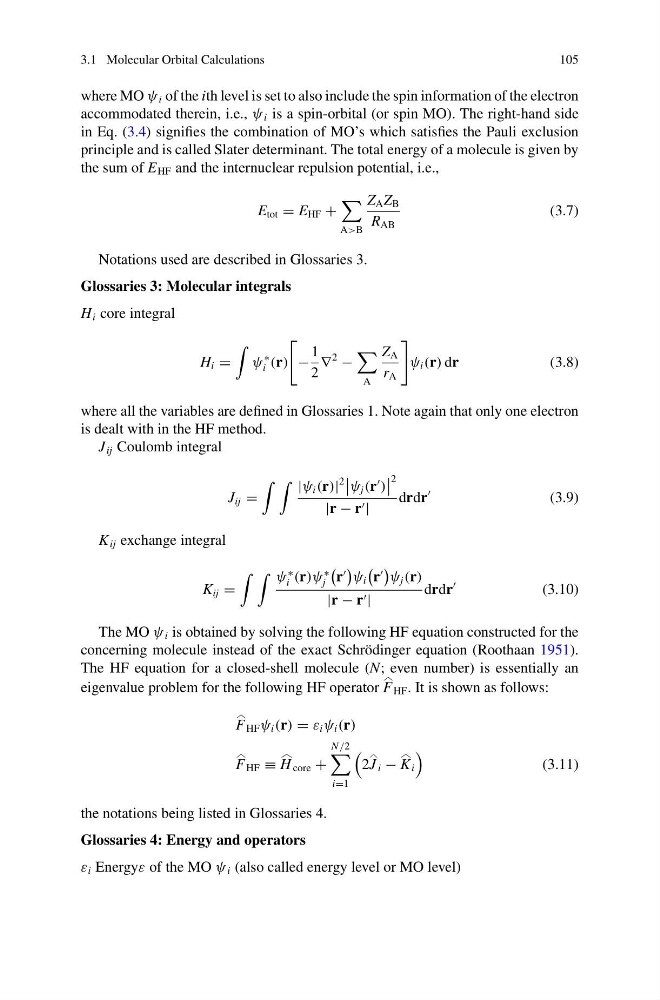
The MO ψ i is obtained by solving the following HF equation constructed for the
concerning molecule instead of the exact Schrödinger equation (Roothaan 1951).
The HF equation for a closed-shell molecule (N; even number) is essentially an
eigenvalue problem for the following HF operator F
HF . It is shown as follows:
F
HF ψ i (r) = ε i ψ i (r)
F
HF ≡ H
core +
N /2
i=1
2J
i − K
i
(3.11)
the notations being listed in Glossaries 4.
Glossaries 4: Energy and operators
ε i Energyε of the MO ψ i (also called energy level or MO level)
105
where MO ψ i of the ith level is set to also include the spin information of the electron
accommodated therein, i.e., ψ i is a spin-orbital (or spin MO). The right-hand side
in Eq. (3.4) signifies the combination of MO’s which satisfies the Pauli exclusion
principle and is called Slater determinant. The total energy of a molecule is given by
the sum of E HF and the internuclear repulsion potential, i.e.,
E tot = E HF +
A>B
Z A Z B
R AB
(3.7)
Notations used are described in Glossaries 3.
Glossaries 3: Molecular integrals
H i core integral
H i =
ψ
∗
i (r)
−
1
2
∇
2
−
A
Z A
r A
ψ i (r) dr
(3.8)
where all the variables are defined in Glossaries 1. Note again that only one electron
is dealt with in the HF method.
J ij Coulomb integral
J ij =
|ψ i (r)|
2
ψ j (r
)
2
|r − r |
drdr
(3.9)
K ij exchange integral
K ij =
ψ
∗
i (r)ψ
∗
j
r
ψ i
r
ψ j (r)
|r − r |
drdr
(3.10)
The MO ψ i is obtained by solving the following HF equation constructed for the
concerning molecule instead of the exact Schrödinger equation (Roothaan 1951).
The HF equation for a closed-shell molecule (N; even number) is essentially an
eigenvalue problem for the following HF operator F
HF . It is shown as follows:
F
HF ψ i (r) = ε i ψ i (r)
F
HF ≡ H
core +
N /2
i=1
2J
i − K
i
(3.11)
the notations being listed in Glossaries 4.
Glossaries 4: Energy and operators
ε i Energyε of the MO ψ i (also called energy level or MO level)